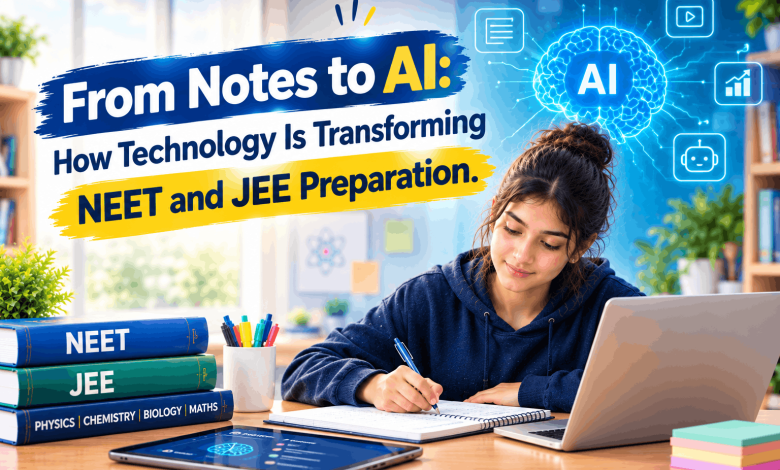
The landscape of NEET and JEE preparation has undergone a significant transformation with the advent of technology. With the traditional method of competitive examination preparation using textbooks and classroom teaching, handwritten notes and repeated practice are the only methods used. These are still core principles, but as educational technology evolves, preparing for challenging exams like NEET and JEE is undergoing significant transformation.
Personalized learning with artificial intelligence, adaptive learning platforms, digital testing and performance analytics are opening new avenues for personalized learning. Rather than studying in a similar pattern, students are allowed to increasingly learn about learning gaps and learn how to modify study and to utilize the available time effectively.
This is not a shift in the traditional teaching methods and replacing them with technology. It’s a matter of blending traditional education with smart digital solutions.
The emergence of AI-driven personalised learning is undeniable.
A drawback to traditional test preparation is that students who have varying strengths and weaknesses are given the same type of instruction and work plan.
AI-powered educational platforms can analyze a student’s performance and identify patterns in their learning. The chance to make repeated errors, score low chapters, and time and accuracy on questions can be good indicators of those needing more focus.
For instance, a NEET seeking student could have a good performance in Biology and poor performance in numerical questions in Physics. A technology empowered learning system can detect this difference and suggest more practice in the weaker area.
This is a more individualized way of preparing for exams rather than being all on the same study model.
Efficient practice through intelligent technology.More efficient practice using intelligent technology.
While problem-solving is still a key component of competition exam preparation, students will not always be at their best when they solve a ton of questions.
Digital learning platforms can identify learning performance over time from multiple sessions.
They can identify:
* Frequently repeated mistakes
* Difficult question types
The time taken on each question
* Accuracy by chapter
Progress of the performance over time.Changes in performance over time.
This information will enable students to concentrate their effort where it will have maximum benefit.
Question banks may also be adaptive, which means that depending on how the problem is solved, the level of difficulty of the items can change, so that students can go from simple to more complex problems.
The Evolution of Digital Mock Testing
The traditional mock tests are mainly used for giving a score. Today’s digital testing platforms can give a far wider view of performance.
Once a test is complete, students can view their accuracy, time utilised, incorrect answers and skipped questions or performance by chapter.
The role of mock examinations is changing. They are not just score producing activities, but diagnostic activities.
For example, the student might realize that he is not doing well on one part of the material because of taking too long on difficult items and not conceptualizing the material. Other students may recognize that there are repeating mistakes within certain chapters without knowing the concepts.
This kind of information helps us to make more evidence-based preparation strategies.
Data Analytics and the Modern Learning Process
Data is playing an increasingly significant role in the field of digital education.
Information about student performance can be captured from every online quiz, practice session and mock test. If used responsibly, this data can show trends that may not otherwise be seen in periodic evaluations.
Performance data can be used to determine if accuracy is improving, if there are any aspects that need further work and if areas where accuracy is low are becoming high.
It is also helpful for teachers to look at the aggregated performance to see what are common problems that all students encounter and modify their instruction-based on that.
This is why the field of educational technology is shifting from mere content delivery to ongoing monitoring and analysis of learning.
AI-Assisted Revision and Knowledge Retention
Technology can also be helpful in revision.
It takes a lot of time for students to determine the topics that need to be given priority. AI systems can also review past results and guide revision by structuring it around topics where students have shown a lower grasp.
All the digital flashcards, quizzes, systems for spaced repetition and the individual practice suggestions can help with repeated exposure to key concepts.
But these tools should be used in conjunction, rather than in lieu of, good textbooks and trustworthy syllabi and educational materials. It is important for students to check information before taking AI-written explanations for granted.
The Importance of Responsible AI Use
AI’s increasing presence in the field of education introduces fresh duties.
AI systems sometimes give incorrect explanations, misunderstand questions or give unreliable info. Relying too much on automated responses can also demoralize students from being able to problem-solve independently.
Responsible use involves using AI as a learning aide, not a de facto expert.
Students can use AI to:
* Explain difficult concepts
* Solve the questions and check the answers.
* Organize revision schedules
* Analyze learning patterns
* Give alternative definitions for familiar terms
Students should verify important academic information using trusted sources to validate AI-generated information.
The role of the teacher is changing with the advent of technology.Teachers’ role is changing with the help of technology.
Teachers are not dispensable in the development of AI. On the other hand, it can alter the way teachers allocate their time.
Technology can help with repetitive tasks like basic performance analysis, question suggestions, progress monitoring, etc. This enables teachers to concentrate more on conceptual explanations, mentoring, feedback and solving individual problems.
Such a blend of people and technology could be a crucial component of exam practice for the future.
The Future of Technology-Driven Exam Preparation by Math Talent Leaps.The Future of Technology-Driven Exam Preparation by Math Talent Leaps.
The use of education technology in the preparation for competitive examinations is likely to be growing.
Other possible futures include:
* AI-powered tutoring
* Adaptive question banks
* Automated performance analysis
* Personalized revision systems
* Digital simulations
* Voice-based learning assistants
* Real-time progress tracking
The benefits of these technologies will, of course, hinge on their ability to meet real learning needs.
Don’t use technology because it is new. It is supposed to enhance the learning experience, making it more focused, measurable and accessible, while retaining the value of conceptual understanding and independent thought.
Conclusion
This transition from traditional notes to learning with the support of AI is a larger trend in education. The approach to preparation for NEET and JEE is becoming more and more personalized, data-driven and technology-assisted.
AI can assist students in detecting what they’re weak at, practicing effectively, reviewing and revising performance with mock-tests, and organizing revision. Concurrently, students’ traditional study materials, self-discipline training, and supervision by teachers are indispensable.
The future of competitive-exam preparation is unlikely to be between traditional education and artificial intelligence. Instead, it’s more about blending human teaching and technology to create the most personalized, informed, and effective learning.