AI assistants are becoming a new way for people to find coaches, consultants and advisors. But the step after discovery, when a prospect tries to understand, trust and start working with an expert, is still split across disconnected pages and tools. As AI changes how clients arrive, that handoff deserves far more attention than it gets.
The new front door, and the old hallway behind it
Picture a small-business owner who wants help with pricing. She opens an AI assistant late at night and asks who could help a service business like hers. A few names come back. She clicks one.
What happens next has nothing to do with AI. She lands on a page, then a calendar link, then a separate form. Somewhere there is a payment page and, eventually, an agreement to sign. Each step lives in a different place, and none of them explains how they fit together.
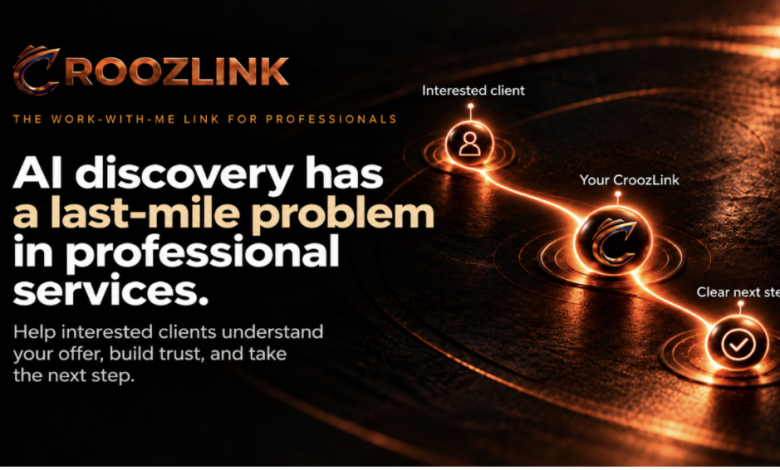
Logistics has a name for this kind of gap. The “last mile” is the final stretch of a delivery, from the local hub to the customer’s door. It is usually the slowest, most expensive and most fragile part of the journey. Professional services now have their own version. AI is getting better at bringing a prospect close to an expert. The last stretch, from interest to an actual working relationship, is still where people get lost.
AI is becoming a discovery channel, and a qualified one
The volume is still small, and it is worth saying so plainly. An SE Ranking study of 101,574 websites found that AI platforms sent 0.32% of all website traffic in early 2026. Organic search still sent about 134 times more.
The direction matters more than the size. The same study put AI’s share at 0.02% in 2024, a sixteenfold rise in under two years. It also found that visitors arriving from AI platforms spent about 68% more time on sites than visitors from organic search.
The researchers’ explanation is the important part. A person who clicks through from an AI conversation has often already described their situation, refined the question and narrowed the options. They arrive further along in their decision. For a coach or consultant, that is close to the ideal prospect: someone who already has a problem, a context and a reason to listen.
What the prospect finds after the click
That well-prepared visitor then meets a setup that was never designed as one journey. Without one connected path, a typical independent professional runs their client intake across several tools, each chosen at a different time for a different reason:
- a website or profile page that describes their services
- a scheduling link for discovery calls
- a form for intake questions
- a payment link, often from a separate provider
- an agreement sent later by email for signature
- a shared folder or email thread for documents
Each tool works. The problem is the spaces between them. The prospect has to work out which link comes first, what each step is for and what happens after they pay. The professional, meanwhile, ends up explaining the same process by email to every new client.
An interior designer put it well in a recent online discussion about client tools. She wrote that half of her job now seemed to be telling clients where things were. She did not describe a lack of software. She described a lack of order.
Why the gap costs more in professional services
In many markets a confusing checkout is an annoyance. In professional services it is a warning sign.
Economists have a name for services whose quality a buyer cannot easily judge, sometimes not even after buying them. Since Darby and Karni’s 1973 paper, these have been called credence goods, and expert services are the classic example. A review of that literature uses the two terms almost interchangeably. When you hire a coach, a consultant or an advisor, you are mostly buying trust before you can verify anything.
That changes how the first interaction is read. A prospect cannot test a coaching programme before paying for it. So they judge what they can see: how clearly the process is explained, whether the next step is obvious, and whether money and agreements are handled with care. A scattered intake does not just add friction. It quietly tells the prospect that the engagement itself may be just as disorganised.
AI discovery sharpens this. The visitor who arrives from an AI conversation is more prepared and more intentional. They are also comparing. If the first experience feels unclear, the next recommendation is one click away.
Designing the work-with-me moment
The last mile in professional services is not one page or one tool. It is a moment: the few minutes in which a stranger decides whether to start working with someone. That moment can be designed, and the questions it has to answer are fairly consistent.
- Who is this person, really? Not a list of services, but the path that made them good at what they do: the turning points, the clients they understand, the problems they have lived through.
- Is this for someone like me? A prospect should be able to see which situation they are in and which offer fits it, without booking a call to find out.
- What do I do next? One clear next step, placed where trust has just been earned, not shouted from the top of the page.
- What happens after that? Booking, agreement, payment and onboarding should feel like one sequence in a known order, not six separate errands. Starting should not require yet another portal, account or password either; a verified email address is enough to begin. Once it starts, client and professional should see the same status as each step changes, instead of chasing each other by email to ask what is done.
- Are my money and my details safe? Payments confirmed properly, agreements recorded clearly, and nothing marked as done until it actually is.
The question of what to do next deserves attention. Most professional pages put the call to action first and the story second, if at all. Yet a person rarely decides to hire an expert at the top of a page. They decide in the middle of a story, at the line where they recognise their own problem. A next step placed at that moment reads as an invitation rather than a sales pitch.
None of this requires a large team. It requires treating the path from interest to engagement as a product in its own right, rather than as the leftover space between tools.
Where AI helps, and where it should stop
AI can help on both ends of this problem. It is already bringing prospects to professionals. It can also help professionals tell their own story, which many of them find surprisingly hard to do. Most experts are good at their work and uncomfortable describing it. A model can turn scattered notes about a career, a method and the people they serve into a clear narrative, with the next step placed where it belongs.
That is also where the risk sits. A model asked to make someone sound impressive will happily invent a result, a testimonial or a credential. In a credence market, that is the worst possible failure, because the prospect cannot check the claim until it is too late.
When I designed the story-writing feature in CroozLink, I started from one rule: the model works only with what the professional supplies. It can structure, shorten and sharpen. It does not add achievements, client outcomes or qualifications that were not given to it. Every story stays a draft until the professional reviews it and chooses to publish it.
The same line applies further down the journey. AI is useful for drafting, summarising and suggesting. It should not be the thing that decides whether a payment has cleared or a booking is confirmed. Those moments need verified facts, not plausible language. A prospect forgives an imperfect sentence. They do not forgive a booking that was never real.
Being found is only half the job
Most of the conversation about AI and visibility is about being found: which experts get recommended, which pages get cited, how to appear in the answer. That conversation matters. But for independent professionals, it covers only half the journey.
More than five startups I built before this one failed, and the hardest lesson across all of them was the same. Attention is rarely the final obstacle. The final obstacle is the moment someone is interested and has to decide, quickly and on limited information, whether to trust you with their time and money.
AI is changing the first half of that journey quickly. The professionals who benefit most will be the ones who also design the second half: a clear, honest and well-ordered path from “this person might help me” to “we have started working together.” That is the last mile. For now, it is still mostly unbuilt.