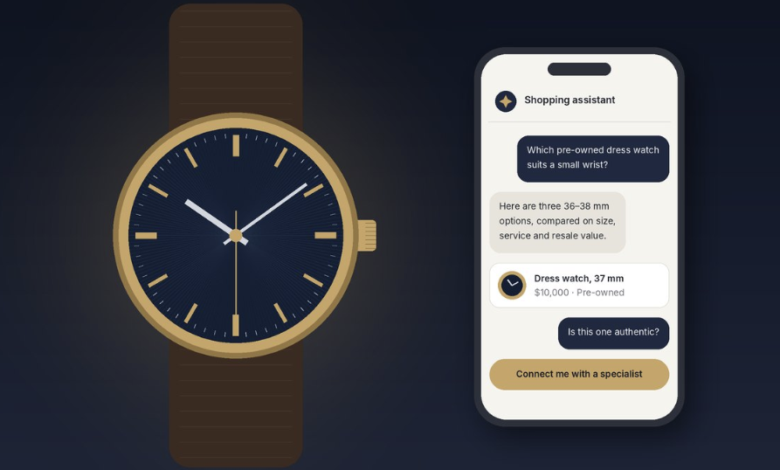
When the Shopping Assistant Meets a Five-Figure Purchase
Generative AI has become a real shopping channel, not an experiment. During the 2025 holiday season, traffic to US retail sites from generative AI tools rose 693.4% year over year, according to Adobe Analytics. Shoppers arriving from those tools also stayed longer and were less likely to leave immediately than other visitors.
Luxury buyers are part of this shift. In a May 2026 McKinsey survey, 85% of luxury consumers said they use a multipurpose AI assistant to support shopping decisions, and 83% reported high or very high satisfaction with AI shopping tools.
So an AI assistant can now find, explain, and compare a $10,000 watch in seconds. The harder question is whether it can earn enough trust to carry a buyer all the way to checkout. Just as important is what should happen when it can’t.
Where AI Genuinely Improves Luxury Discovery
Luxury watches are hard to research. Reference numbers, movement calibers, case sizes, production years, and dial variations can confuse even experienced buyers. A good AI assistant turns that complexity into plain language.
AI is well suited to the early questions. What separates two similar references? Which models suit a smaller wrist? How has a model’s price moved on the secondary market?
Answering these instantly lowers the barrier for first-time buyers who might otherwise feel intimidated walking into a boutique or messaging a dealer. Comparison is another strength. An assistant can line up specifications, service intervals, and typical resale values across a shortlist without fatigue or sales pressure.
For the buyer, that means arriving at a human conversation better informed and with sharper questions. That alone is a meaningful improvement to the luxury shopping experience.
A Recommendation Is Not a Decision
Discovery answers the question, “What should I consider?” A five-figure purchase also has to answer, “Can I trust this specific watch, from this specific seller, at this price?” Those are different questions, and the second one carries the risk.
McKinsey’s research calls this a delegation boundary. Luxury shoppers in its survey were comfortable with AI involvement in discovery and selection (50%) and in transaction execution (58%), but comfort fell to 39% for post-purchase care. Only 9% wanted a fully autonomous AI shopping experience.
The pattern makes sense. When a purchase is expensive, personal, and hard to undo, buyers want help, but they also want to keep their hands on the decision.
Authenticity and Provenance Are Not Just Data Points
Counterfeiting has shaped the watch market for decades. The Federation of the Swiss Watch Industry has estimated that around 40 million fake watches are produced each year, more than the number of genuine Swiss watches exported, as Worldtempus reported. The best fakes can be difficult to spot without opening the case.
An AI model can describe what an authentic movement should look like. It cannot hold the watch, open the caseback, or confirm that the serial number matches the papers. Nor can it verify a seller’s track record or whether the listing photos show the exact item being sold.
Provenance adds another layer. Original box and papers, service records, and ownership history can materially change both a watch’s value and a buyer’s confidence. Assessing those documents, and explaining what missing ones mean, still depends on people who handle watches every day.
The Purchase Doesn’t End at Checkout
For a mechanical watch, the purchase is the start of a long relationship. Movements need periodic servicing, seals need replacing to maintain water resistance, and parts availability varies by brand and era. A buyer needs to know who stands behind the watch after it arrives.
Warranty terms differ widely between authorized dealers, independent retailers, and private sellers. An AI assistant can summarize a policy. But buyers often want someone accountable to explain what is covered, what voids coverage, and what happens if something goes wrong three months in.
Trade-ins raise the stakes further. Valuing a buyer’s current watch depends on condition, completeness, market timing, and demand for that reference. Market data can inform the number, but a fair offer usually follows an expert inspection, and buyers want to talk it through with a person.
New or Pre-Owned Is a Judgment Call
The choice between new and pre-owned has become more nuanced. Morgan Stanley analysts expected rising US retail prices from leading Swiss brands to push more buyers toward the secondary market, as Business Insider reported. At the same time, secondary demand has concentrated in a few blue-chip brands, while many others have seen steeper price declines.
An AI assistant can lay out those numbers. What it can’t easily weigh is what matters to a particular buyer. That might be a full manufacturer warranty, the condition of a vintage dial, the experience of buying from a boutique, or the chance to own a discontinued reference.
These trade-offs are personal. Good advice here sounds less like a ranking and more like a conversation about how the buyer plans to wear, keep, or eventually sell the watch.
Designing the Handoff Between AI and Human Expertise
Retailers shouldn’t frame this as AI versus people. The better question is when technology should step back and an expert should step in. Customers have been clear that being trapped with automation is the real problem: a Gartner survey found 64% of customers would prefer companies didn’t use AI for customer service, with difficulty reaching a person as their top concern.
A good handoff has four traits:
- Clear triggers. Price thresholds, authenticity questions, condition concerns, trade-in valuations, and signs of buyer hesitation should route to a person.
- Context that carries over. The specialist should see what the customer already asked, so the buyer never starts from scratch.
- Transparency. Customers should always know whether they are talking to AI or a person, and how to reach a human.
- Accountability. A named expert should own the outcome once the conversation moves beyond general guidance.
Done well, AI handles the groundwork and the specialist spends their time on judgment and reassurance. McKinsey’s survey points the same way: transparency about the agent’s role (54%) and proven reliability (52%) topped what luxury shoppers said they need before trusting AI agents.
What Luxury Retailers Should Ask Before AI Becomes the Front Door
Before making AI the primary customer interface, luxury retailers should be able to answer a few questions honestly:
- Is our product data accurate enough to automate? Reference numbers, condition grades, and service histories must be correct, because an AI will repeat errors with confidence.
- Where are the escalation points? Define which questions and price bands always go to a person.
- How will mistakes be caught? Someone should regularly review AI answers on authenticity, warranty, and pricing.
- What does the customer see? Clear disclosure that they are using AI, and an always-visible path to a human.
- Who owns after-sales? Servicing, returns, and warranty claims need a human owner, whichever channel the sale came through.
Retailers that skip these questions risk saving money on the conversation and losing it on the transaction.
Trust Is Still the Deciding Factor
AI is making luxury watches easier to find, understand, and compare, and that is good for buyers and the industry. More people can now approach a five-figure purchase with context they didn’t have before.
But when someone is spending thousands of dollars on an object they may wear for decades, information alone rarely closes the gap. Buyers still need to believe in the specific watch, the seller, and the support behind it. The retailers that earn that belief will be the ones that know exactly when technology should hand the conversation to a person.
References
- Adobe, “AI-driven traffic surges across industries”
- McKinsey & Company, “When AI meets desire: Innovating human-centered luxury experiences in the agentic age” (May 2026)
- Worldtempus, “The counterfeit chessboard”
- Business Insider, “Swiss watch brands are raising prices and it’s driving buyers to the resale market”
- Gartner, “Gartner Survey Finds 64% of Customers Would Prefer That Companies Didn’t Use AI for Customer Service” (July 2024)