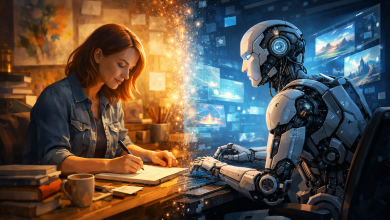
When it comes to creative industries, and music in particular, the use of AI is one of the most controversial topics. Should we allow AI to integrate into the creative sphere, or should we try to prevent it? Can AI really replace humans when it comes to creativity? You hear these questions everywhere, especially now, as AI-generated music is on the rise.
It sometimes happens that people who actually make music are not often heard in this conversation. That’s why we at Muse Group ran a comprehensive survey of 1,200 practicing musicians to understand what AI means to them. As it turns out, musicians, just like all of us, are open to AI tools when it comes to delegating routine tasks. However, they draw a clear line around how it should be used.
The Hierarchy of Tools
A vast majority, 78% of survey participants, say they’re open to AI tools, while only 12% oppose it. Nearly 70% of music creators have used AI features in their workflows within the last three months. The most common applications include removing noise and cleaning audio (54%), generating ideas (46%), and stem separation (38%). Musicians are increasingly viewing AI as a practical assistant that can handle the “heavy lifting” of production. This allows them to focus more on the core act of artistic expression.
When describing the outcomes, musicians most often say these tools save time on repetitive or technical work. 55% describe their experience as very positive, and another 36% as somewhat positive. Still, the experience is not flawless. Among negative sides, participants of the survey name accuracy issues, uneven quality that requires manual correction, concerns about authenticity, and frustration when results feel generic or lacking a human element.
As the technology moves away from routine tasks, acceptance drops and opposition rises. Generative AI tools that create new melodies, lyrics, or sounds from scratch face significantly more tension. Only 18% are open to AI helping with generation and even then, only with guidance and full editability, meaning 82% of respondents are against music generation.
Ethical Dealbreakers for Creators
Musicians are not rejecting AI outright, but they resist the idea of losing control over their work. 34% of survey participants are questioning what counts as “their work” when AI is involved. People are comfortable as long as they stay in control and remain the author.
The main dealbreakers for musicians involve the use of other creators’ work without permission (41%) and the copying of recognizable artist styles without consent (40%). Unclear copyright is a dealbreaker for 34%.
Another significant concern is the displacement of musicians in specific roles. About 68% of creators expect some types of musicians to be replaced by AI. Approximately 64% of musicians believe AI will make it harder to earn money in the industry. This fear persists even among those who personally benefit from the tools.
The solution lies in control and transparency. An overwhelming 93% of creators prefer having more control over the process, even if it takes longer to complete a task. They reject the idea of “black box” automation in favor of fine-grained controls. Trust builders include clear labeling of AI-modified content (43%) and the ability to easily undo or compare changes (39%).
81% agree that companies building AI in music need stronger rules and transparency. Most users also want AI features to be off by default or to ask for permission before taking any action. This highlights a “creator-first” philosophy where the human remains the ultimate author and decision-maker.
The Future of AI in Music: High-Quality Assistance
Despite all the concerns, AI tools are already part of musicians’ day-to-day activities – only 7% say AI has no place in their workflow. When asked what AI should “feel” like, musicians prioritize traits such as “high quality,” “helpful,” and “controllable”. They are looking for tools that respect their rights as creators and provide a clear path to human authorship.
The demand map for future features reflects this practical mindset. Noise removal, mistake detection, and practice feedback remain the most requested AI features. As the technology continues to evolve, the industry must ensure that AI supports the creative process rather than seeking to replace the creator. Some creators even worry about losing their skills or becoming overly dependent on these tools, which they fear could lead to a long-term decline in musical craft.
Speaking of the future, one of the most surprising findings is the sentiment of the youngest generation of creators. While often assumed to be early adopters of new tech, musicians aged 18–24 are the most skeptical and polarized group. They report the highest levels of concern (26%) and frustration (21%) regarding AI in music tools. It suggests that acceptance of AI tools in music will probably be defined by whether they can earn trust on creative, ethical, and practical terms.
Methodology
The survey was conducted among 1,200 US-based musicians (users of MuseScore, Ultimate Guitar, Audacity, and MuseHub). Results were analyzed across products, age groups, and skill levels.
Full report is available here