Over the past two years, the conversation surrounding AI and human creativity has evolved at remarkable speed. What once felt like a speculative debate about AI’s potential impact on creative industries has quickly become an immediate cultural reality. The emotional shift has been equally dramatic: from early anxiety and resistance, to widespread experimentation and enthusiasm, and now, increasingly, to a mixture of dependence, skepticism, and fatigue. Terms like “AI-powered creativity” have become so pervasive across media, technology, and design culture that many creators now respond with equal parts fascination and exhaustion. Yet beneath the noise, a more nuanced question has quietly emerged—less about whether AI will replace creativity altogether, and more about which parts of creativity remain fundamentally human.
Among the designers navigating this rapidly shifting landscape is Chen Huang, a multidisciplinary designer and illustrator whose work spans visual design, UI/UX design, product design for enterprise products, with his latest commitments to AI-powered solutions for design-to-code efficiency. Having worked across both artistic and systems-oriented design environments, Huang has spent years observing how differently various creative industries respond to AI. His experiences working at the intersection of illustration, product design, human-centered design, and emerging AI workflows gradually led him toward a particular question: why does human tolerance toward AI seem to fluctuate so dramatically depending on the type of creativity involved?
The Rise of “AI Purism”
Recently, Huang observed an interesting phenomenon within the community – an increasing number of illustrators updated their self-promotion pages with statements that felt almost puritanical in tone—openly declaring that their work contained “not a trace of AI.” Some framed their rejection of AI not merely as a workflow preference, but as a creative stance, almost a moral position.
At times, the rhetoric resembled a modern form of cultural isolationism: an attempt to preserve artistic purity by drawing a hard boundary against technological change itself.
As someone working within the same AI wave—as both an illustrator and a designer—Huang understood the anxiety behind those reactions.
For creators whose work depends heavily on visual language, personal style, and authorship, this is the first time they have genuinely questioned whether abilities once considered highly individual and irreplaceable might someday become infinitely reproducible and scalable.
At the same time, Huang also wondered whether complete rejection risked becoming overly rigid in its own way. For creators navigating long-term careers, is total resistance truly protection? Or can it quietly become another form of self-imposed isolation?
Why Human Authorship Still Matters
Huang remains deeply convinced of the importance of human authorship.
He is firmly against AI directly replacing the core expressive processes belonging to human creativity—especially in fields such as commercial art, illustration, IP development, and editorial art, etc., where emotional experience and personal perspective remain central to the work itself.
But the question Huang keeps returning to is this:
While preserving authorship, is it possible to approach AI with something other than complete rejection? Can creators resist allowing AI to replace creation itself while still allowing it to function as assistance, cognitive extension, or a tool that helps push beyond existing creative limitations?
Creativity Exists on a Spectrum
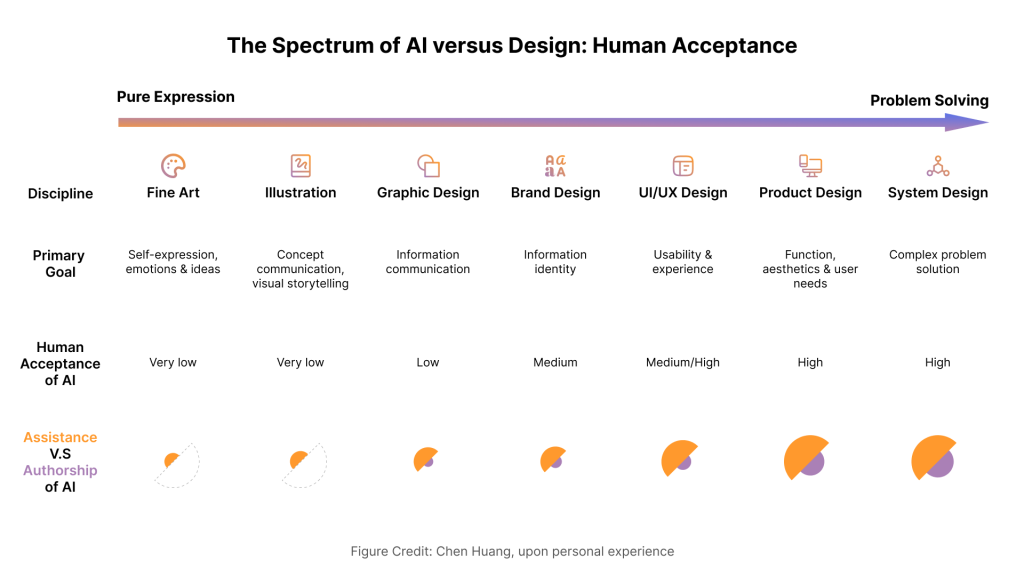
The more Huang placed different creative disciplines along the same spectrum, the more a pattern emerged.
^ Figure – A chart summarizing the relationship between AI and various creation genres, created by Chen Huang based on his observations and professional experience
On one end are fields deeply tied to emotion, aesthetics, self-expression, and authorship itself: illustration, fine art, editorial art, and character design. The closer a field moves toward this side of the spectrum, the more sensitive people become to AI involvement—and the stronger the resistance tends to be. Many international illustration competitions still explicitly prohibit AI-generated content. Character design work tied closely to IP development often assumes AI should not participate in the core creative process at all. Even when AI is permitted, its role is usually limited to background or prop design, ideation support, or early-stage exploration.
To Huang, this reveals something important.
What people care about in these fields is not simply whether the final work “looks good.” What matters is whether a real human being exists behind the work itself – the creator’s emotions, their lived experience, imperfections, contradictions, etc. People are responding not only to the work itself, but to the fact that another human being created it.
But as the spectrum shifts toward systems, workflows, engineering, logic, and problem-solving, the conversation changes. The closer design moves toward systems thinking, the more comfortable people become with AI participation. Especially in fields like UI/UX, Product Design, and Service Design—where systems thinking and technology are already deeply intertwined—AI has increasingly become part of the workflow itself. It participates in ideation, research, prototyping, production pipelines, and coding, etc. On this side of the spectrum, originality alone is rarely the primary concern. Whether a button has never existed before or whether a layout feels radically experimental often matters far less than usability, clarity, consistency, efficiency, and whether the product genuinely solves a problem. Most mature design systems already rely on conventions refined through years of collective industry learning. In many cases, the designer’s role is not to reinvent everything from scratch, but to understand existing paradigms deeply enough to innovate with precision and restraint.
Given the chart, Huang claims that the question “Will AI destroy creativity?” has always been too broad.
Human tolerance for AI changes dramatically depending on where a field sits between assistance and authorship. The closer a discipline moves toward authorship, the more fiercely people defend human originality. The closer it moves toward systems, workflows, and optimization, the more naturally people embrace AI assistance.
And perhaps that raises a deeper question:
What should AI’s role in creativity actually be?
AI as A Cognitive Research Tool
From his current experience, Huang still strongly believes that true authorship should remain human. The things that genuinely move people—emotional memory, contradiction, vulnerability, aesthetic obsession, personal expression—still belong profoundly to human experience. Prompt engineering alone cannot truly replicate them.
At the same time, Huang has become increasingly comfortable inviting AI into his creative PROCESS—not to replace creation, but to expand COGNITION.
In illustration, visual design, and concept development, for example, Huang rarely asks AI to generate a final “answer” , since the results often become generalized, and strangely hollow. They can appear aesthetically correct, but lack authorship.
Instead, Huang increasingly uses AI as a Cognitive Research Tool. During visual research phases, he often relies on prompts grounded in the 80/20 principle—not to generate imagery directly, but to uncover the underlying structure of a visual field.
Prompts such as:
- “Enumerate the 20 keywords that represent 80% of the visual language of this field.”
- “Find the smallest number of references that reveal the deepest structure of this aesthetic.”
This approach has proven highly valuable, because many creative limitations do not come from technical skill. They come from cognitive boundaries.
Huang shares that traditional visual reference gathering can easily become fragmented, repetitive, or opinionated inside existing aesthetic habits. AI, in contrast, helps him enter unfamiliar creative territories faster, uncover relationships between visual languages, and discover perspectives he might never have actively searched for himself.
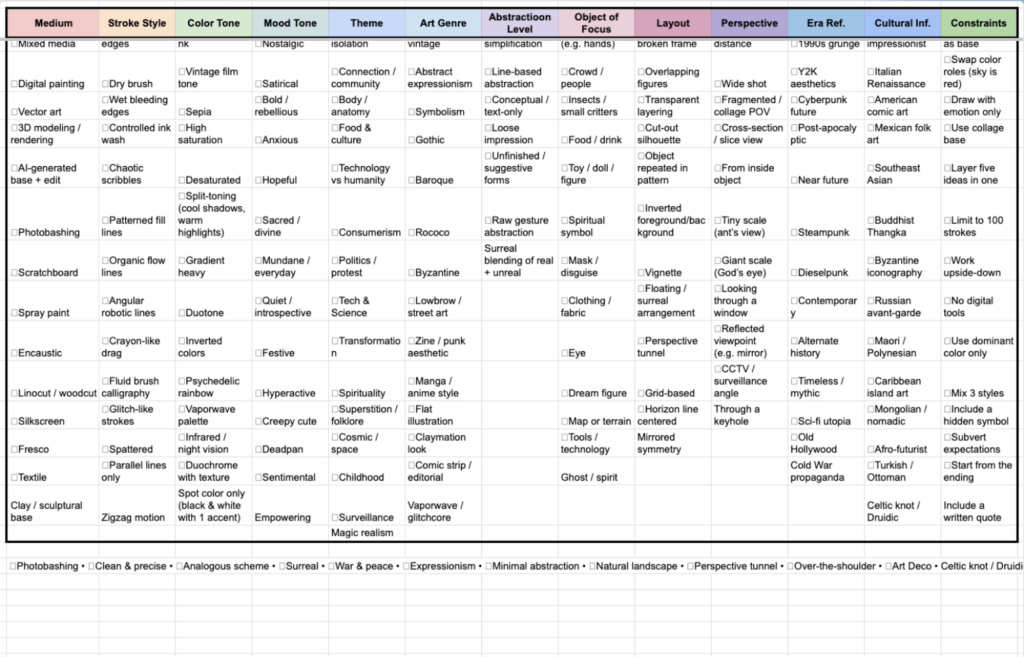
^ Figure – A creativity tool created by Chen Huang for daily sketch inspiration, empowered by AI-assisted categorization systems
Using AI to Boost Unconventional Inspirations
Another way Huang frequently uses AI is to break existing patterns of thought.
He rarely asks AI: “How would you design this?” Instead, he prefers placing it inside more abstract conceptual situations:
“If you were a curator, how would you prevent this idea from becoming cliché?”
“How would you stop this from turning into something so obvious that a ten-year-old could immediately predict?”
The value of these prompts is not necessarily the answers themselves. The value lies in how they force creators to confront their own blind spots. Especially when creators become trapped inside long-term aesthetic obsessions, that kind of divergence can become extremely important.
Building a “Second Brain”
In product design and UX research—fields shaped more heavily by systems thinking—AI takes on another role entirely. Traditional UX methodologies have long emphasized interviews, observation, behavioral mapping, personas, and frameworks like the Double Diamond process.
Today, AI increasingly functions as a tool for rapidly constructing knowledge frameworks. Huang does not ask AI to generate user research conclusions directly for him. Those outputs claimed to be shallow, flattened, and lacking contextual understanding.
But he does use AI to help surface existing methodologies, historical frameworks, and industry case studies more systematically, such as Kano Analysis, Sacrificial Concepts, Behavior Mapping—methods that remain foundational, yet are not always discussed frequently in day-to-day workflows.
From there, Huang often moves those materials into tools like NotebookLM for deeper synthesis, organization, and long-term knowledge accumulation.
In some ways, it feels less like outsourcing thinking and more like building an evolving second brain.It does not think for creators. But it can extend the boundaries of how far their thinking reaches.
May The Future Belong to Neither Extreme?
Compared to a few years ago, Huang no longer believes the central question is whether creators should use AI at all. The more meaningful question now may be:
How can human authorship be preserved without romanticizing the rejection of tools themselves?
As someone living through the same instability affecting the creative industry, Huang completely understands the anxiety, anger, resistance, and unease many creators feel toward AI today. He said, “The old structures are loosening, while the new ones have not fully formed. However, history suggests this uncertainty is not unique to AI- previously, the Internet triggered it, Photography triggered it and so did Industrialization.”
Human progress has always involved periods of confusion, negotiation, experimentation, and the rebuilding of boundaries.Perhaps society is simply living through one of those transitional moments now—messy, ambiguous, and deeply disorienting while it unfolds.
Still, Huang remains cautiously optimistic.
He doubts that the most important creators of the future will be those who completely reject AI. Nor does he believe they will be the ones who surrender entirely to it. According to Huang, the creators who endure may instead be those who preserve distinctly human qualities—emotion, taste, imperfection, contradiction, vulnerability—while also learning how to navigate new tools without losing themselves in the process. Because in the end, people may gradually become accustomed to AI, while they will still continue searching for something else:
Another real human soul.