The phrase “human-in-the-loop” has become shorthand for responsible AI as agents begin to take on more of the workflow. It sounds reassuring because it suggests somebody is still watching, still deciding and still accountable when something goes wrong. The trouble is that the phrase tells us almost nothing about the job that person is actually being asked to do.
Glean’s Work AI Institute found that AI is saving digital workers around 11 hours a week, while those same workers spend 6.4 hours managing the technology, including checking outputs, debugging errors and cleaning up AI-generated work. If automating routine execution means employees spend much of the recovered time supervising a machine, dealing with exceptions and carrying responsibility for failures they did not create, the burden has simply moved. Avoiding that outcome means being much more deliberate about where human attention is actually needed.
Decide what deserves human attention
Human judgement becomes most valuable at the points where context, uncertainty or consequence make automated decisions harder to trust. Putting a person into every stage of an automated process may feel safer, but it can create review fatigue, slower decisions and people approving work they no longer have the time or context to interrogate properly.
A better approach begins with the process itself. Workflows usually contain routine cases, known exceptions and a smaller number of situations that need closer scrutiny.
Over time, teams develop workarounds, shortcuts and informal checks that rarely make it into the official process map. Those details often determine how the work functions in practice, so automating only the documented version can leave an agent well equipped for straightforward cases while struggling with the exceptions people have quietly learned to manage around it.
Human attention should be concentrated where the machine is least reliable or where the cost of being wrong is highest, rather than spread evenly across every transaction.
Give people enough authority to intervene
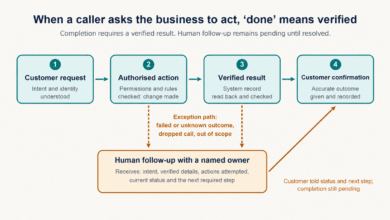
Once leaders have decided when a person should step in, they need to be clear about what that intervention should achieve. A member of the finance team reviewing an unusual reconciliation needs to understand what the agent has done, why the case was escalated and what evidence sits behind the recommendation. They also need the authority to stop the process, change the outcome or send it back for further investigation. Without that, oversight quickly becomes approval theatre: someone is formally responsible for a decision they have little practical ability to challenge. I have come to call this accountability without authority, and it is the failure I see most often when an organisation tells me it has a human in the loop.
Recent research involving 1,261 managers illustrates the wider accountability risk. When AI was framed as an “AI employee” rather than an “AI tool”, managers identified fewer errors, felt less personally accountable and were more likely to defer personal responsibility to the AI system. The finding matters because responsibility can become blurred once a system starts to feel like an actor in its own right.
Clear decision rights become even more important in this context. People need to understand what an agent can do independently, which actions require approval, who owns the final outcome and what happens when a decision goes wrong.
Governance has to survive production
One technical requirement that rarely gets enough attention in these discussions is visibility, because meaningful oversight depends on being able to see how the system is operating.
An agent may interact with several systems, make a sequence of decisions and trigger actions before a person becomes involved. If the reviewer cannot see what happened, what data was used or which permissions were exercised, they are left reconstructing the decision after the event. There is now hard evidence that this is the normal case rather than the exception: in a 2026 study by Microsoft and Hugging Face running agents across hundreds of business workflows, around two thirds of the runs that failed still finished cleanly and reported no error at all. If a system cannot be relied on to say when it has gone wrong, the visibility has to be built into the engineering around it.
Governance becomes much harder to defend if those controls exist only in a policy document. Organisations need traceability, clear permissions, testing, monitoring and escalation routes that work once the system is live. They also need to recognise that production behaviour is not fixed. Models change, integrations change, and the data flowing through a process changes with them.
A workflow that behaved sensibly during a pilot can produce different results months later without anything obviously breaking. Human oversight therefore depends on the engineering around the agent as much as on the person beside it.
Redesign the role, not just the workflow
As more execution moves to agents, the human role changes. People will spend less time carrying out routine steps and more time investigating unusual cases, improving processes and deciding when the system has moved beyond the conditions it was designed for.
This shift requires different skills and different incentives. When employees are judged only on speed and volume, careful review can start to feel like friction. Expecting them to challenge automated decisions also means recognising good escalation, thoughtful intervention, and improvements to the system as productive work.
Human oversight becomes useful when the person involved has a reason to be there and the means to influence what happens next. Meaningful intervention depends on judgement and authority on the human side, alongside enough visibility and control in the technology.
With agents capable of carrying more of a process themselves, organisations will have to be much more deliberate about the work they leave to people. Otherwise, there is a real risk of automating the execution while leaving employees with the exceptions, the uncertainty and accountability when the system gets something wrong.