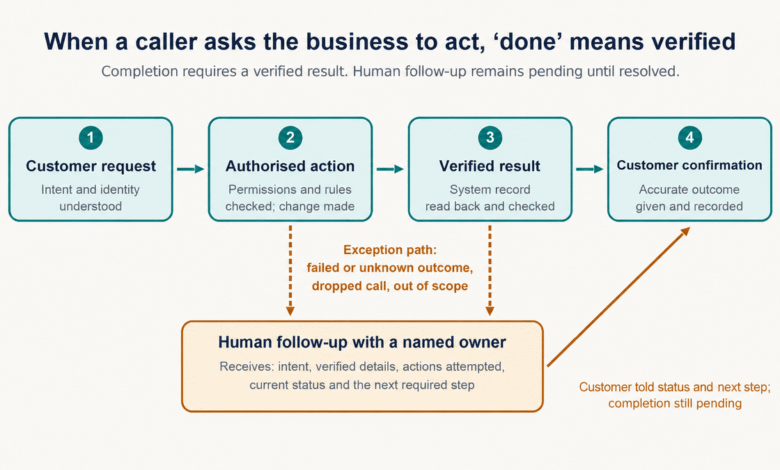
Why businesses should verify bookings, CRM updates and human handoffs – not just the quality of the conversation.
Disclosure: The author is the founder and CEO of NextLevel.AI, which sells voice AI agents. This is a paid placement, not an independent product review.
The booking that only existed in the conversation
Here is a hypothetical example, not a real case. A customer phones a car-servicing garage to move Thursday’s service to the following Tuesday. The voice agent is polite and quick. It repeats the new date, apologises for the inconvenience and says the change is done. The customer rings off satisfied.
The workshop calendar still shows Thursday. On Thursday, a technician holds a bay for a car that does not arrive. On Tuesday, the customer turns up to find no slot booked. Someone at the front desk now has to work out what happened, rearrange the day and apologise for a promise the business never kept.
Listening to the recording alone could suggest good service. The agent understood the request and gave a clear confirmation, but the business never made the change.
A successful conversation and a completed task are different things
When people evaluate voice AI, they tend to judge what they can hear: how natural it sounds, how quickly it replies, whether it copes with accents and interruptions. Those things matter. None of them is evidence that a customer’s request was completed.
When a caller asks the business to do something, five separate things have to go right:
- Understanding. Working out what the caller wants and which record it concerns.
- Permission. Checking that this caller may make this change, and that the business’s rules allow it.
- Action. Making the change in the system that actually runs the business: the calendar, the booking tool, the CRM.
- Verification. Checking the resulting state of that system, rather than assuming the change worked.
- Confirmation. Telling the customer what really happened, and recording it.
A fluent conversation can deliver the first and last of these while the middle three quietly fail. If the agent confirms before it verifies, the customer receives a confident statement about something nobody has checked.
Not every call is a transaction. Many callers want opening hours, a price range or an update on an order. Those calls need their own definition of success: typically, a correct answer drawn from an approved source, with no repeat contact needed on the same question. The argument here is narrower. When a caller asks the business to act, success means the action happened and was checked.
Following one request from beginning to end
Take the rescheduling request again and walk through it properly.
- Identify the correct appointment. Match the caller to the booking using the business’s approved identity-verification process. The checks should establish that the caller is authorised to make the change and match the risk involved.
- Clarify the date, time and time zone. “Next Tuesday afternoon” is not a slot. Confirm the exact date and time, and the time zone wherever the business and the customer might differ.
- Check availability and booking rules. Is the slot free? Does the job need a particular technician, duration or notice period? Is there a charge for late changes?
- Make the authorised change. Move the existing booking. Do not create a new one and leave the old one in place.
- Verify that the correct appointment was updated. Read the record back from the calendar: the original slot is released, and the new one shows the right customer and service.
- Confirm and record the outcome. Tell the customer the verified date and time, send written confirmation if that is the business’s practice, and log what was done.
Then come the failure branches, where most of the design work sits.
- The slot is unavailable. Offer real alternatives from the calendar, not times the agent assumes are free.
- The booking system times out. The agent must not say the change is done. It should explain that the request is being checked, and pass it to someone who will confirm.
- The result of the change is uncertain. The change was sent, but no clear answer came back.
- The caller changes their mind. Anything already changed must be reversed or explicitly confirmed, not left half-done.
- The call drops. The request does not disappear with the connection. It needs a status and an owner.
The most important distinction is between “failed” and “unknown outcome”. A confirmed failure means the intended change did not happen. Whether it can be retried depends on the failure and the system’s rules. An unknown outcome means the change may or may not have happened. Repeating it blindly can turn one rescheduling request into two bookings.
The safer pattern is to check the record first, then decide. Stripe, for example, designs its API around exactly this problem: its API documentation describes idempotency keys, which let the same request be retried after a connection error “without accidentally performing the same operation twice”. The retry must reuse the same key and parameters within the API’s rules. Ask whether the systems your voice agent writes to offer an equivalent safeguard, and whether the agent uses it.
Measure outcomes without hiding failures
If the dashboard reports only call volumes, containment or sentiment, a voice agent can look excellent while leaving a trail of broken bookings. A small scorecard built around outcomes is more honest. Each measure needs a stated denominator and a fixed reporting window, such as weekly and calendar-monthly, so that figures can be compared over time.
- Verified completion rate for eligible requests. Of the requests the agent is permitted to handle, the share where the action was completed and verified in the business system. Report out-of-scope requests separately, and report autonomous and human-assisted completions separately.
- Failed or uncertain system actions. Of all attempted actions, the share that failed and, separately, the share that ended with an unknown outcome.
- Duplicate or incorrect bookings. Found by reconciling the calendar or CRM against call records, expressed per 100 completed actions.
- Successful human handoffs with useful context. Of requests passed to people, the share accepted by the receiving person without needing to call the customer back to collect basic details again.
- Repeat contacts about the same unresolved request. The share of handled requests that trigger at least one repeat contact about the same unresolved issue within a fixed follow-up period, such as seven days. Include only requests with a complete follow-up window.
- Cost per verified completed request. Total cost of the service, including AI usage, platform fees and staff time spent on follow-ups and corrections, divided by verified completions in the same window.
Keep autonomous completion separate from human-assisted resolution. Both can be good outcomes for the customer, but they cost different amounts and say different things about the system. Blending them flatters the automation.
There are no universal targets here. Sensible figures depend on the business, its rules and its systems. Agree a baseline before launch and judge the trend against it.
Make human follow-up an owned process
Every voice deployment will pass some requests to people. The question is whether that handoff is a process or a hope.
The person receiving the request needs five things: the customer’s intent in a sentence; the details that were verified, and how; the actions already attempted and their results; the current status, whether completed, failed or unknown; and the next step required. Without the attempted actions and their status, a colleague may repeat a change that has already gone through.
At least one platform vendor documents this pattern in detail. Twilio’s solution blueprint for AI-to-human handoff describes transferring a customer from a virtual agent to a live agent without ending the active call or chat, with the live agent receiving the conversation context and an AI-generated summary. Whatever platform you use, check what the receiving person actually sees.
Then plan for the moment when nobody is available: after hours, at lunch, during a spike. The agent should tell the customer honestly what will happen next and by when, create a task in a queue that someone monitors, and give that task an owner and a deadline. “We’ll call you back” is only a commitment if it exists somewhere other than the call.
Finally, “transferred” does not mean “received and resolved”. A transfer can ring out, land in the wrong queue, or be accepted and then forgotten. Track handoffs through to resolution, and count the unresolved ones in the scorecard above.
Ask to see the completed workflow
I work at NextLevel.AI, which builds voice AI agents for sales, support and booking, so I have a commercial interest in this market. The test I am proposing applies to any vendor, including us.
Before accepting a deployment, ask to see a completed request rather than a recorded conversation. Choose a real workflow, run it end to end against a test system, and inspect the records afterwards. Then ask three questions.
- Where is the evidence that the action succeeded? Look for a read-back of the system record, not the agent’s own statement.
- What happens when the result is uncertain? Ask to see a timeout or a dropped call handled in a live test, not on a slide.
- Who owns the unresolved request? Expect a named queue, a responsible role and a deadline.
A voice agent that sounds good is easy to demonstrate. One that gets the work done can show you the evidence.
Sources
- Twilio, “AI to human handoff” (solution blueprint), Twilio Docs, last modified 4 November 2026. Accessed 18 November 2026. https://www.twilio.com/docs/conversations/solution-blueprints/ai-to-human-handoff
- Stripe, “Idempotent requests”, Stripe API reference. Accessed 18 November 2026. https://docs.stripe.com/api/idempotent_requests
About the author
Michael Lazor is the founder and CEO of NextLevel.AI, which develops voice AI agents for business sales, support and appointment booking. His work focuses on the economics and engineering of voice AI, including how it connects to telephony and business systems. He writes about practical deployment, workflow reliability and the trade-offs businesses should examine before adopting conversational automation.
Disclosures
AI disclosure: An AI writing assistant helped draft and edit this article. The original diagram was created programmatically and its wording was subsequently corrected using an AI image-editing tool. It contains no photographs, people or customer data.