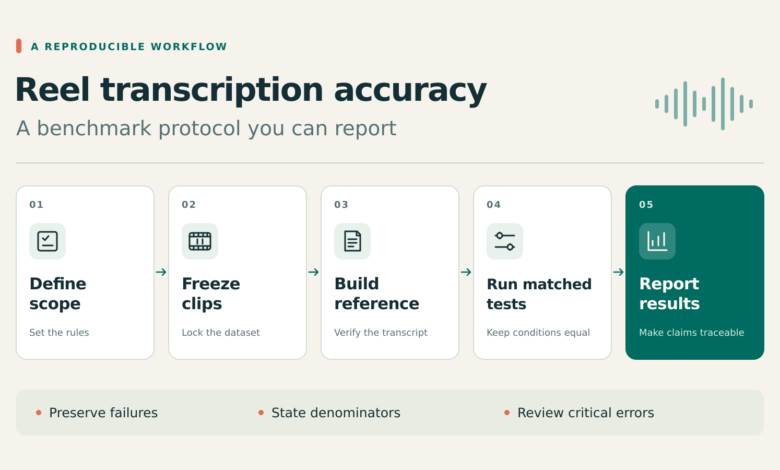
A useful Reel transcription accuracy report lets another evaluator trace the headline back to the clips, reference text, and scoring rules. “Accurate enough for publishing” needs more evidence than a low average word error rate. A single wrong price or missing negative may change the meaning of an otherwise readable transcript.
The protocol below is for teams planning a benchmark. Define the intended decision first, preserve failures, and produce a report whose denominators remain visible. No product result is implied by the method.
Write the acceptance policy before choosing settings
Specify the work the system must support. Searchable research notes and publishable quotations have different review requirements. State which errors block release, what correction process is allowed, and what workload the evaluation represents.
Keep input access and recognition quality separate. An eligible source that a service cannot retrieve is an end-to-end failure, but there is no recognizer output to score. Report completion across submitted inputs and recognition scores across completed inputs. A reader should not have to discover in a footnote that failed jobs disappeared from the comparison.
Freeze a representative set and a challenge set
Sample authorized clips from the intended workload. Record source identifiers, language, duration, speakers, audio conditions, and collection date. State how clips were selected and what the collection leaves out.
Create a separate challenge set for loud music, fast or reduced speech, overlaps, uncommon names, and mixed languages. Those cases expose failure modes. Keep their scores separate from the ordinary workload so readers know which population each result describes.
Use development material to choose settings and resolve scoring conventions. Freeze those choices before examining holdout outputs. Keep closely related material, such as excerpts from the same recording, in the same partition. Report clips, speakers, minutes, and reference words; a large word count from one speaker does not establish broad coverage.
Build an independent reference and preserve disagreements
Have qualified reviewers prepare reference text without seeing evaluated outputs, then reconcile disagreements against the recording. Write rules for fillers, contractions, false starts, number spelling, and unintelligible regions. Retain a verbatim reference even if the operational deliverable will be edited prose.
Verify proper-name spellings from reliable context, while checking that the audio actually contains that name. For quantities, check the number, unit, and qualifier together. Keep uncertain regions marked until adjudication; fluent guesses make poor reference text.
Record exclusions with their duration and reason. If reviewers cannot establish a reference for an obscured passage, say so. Removing every difficult region without reporting it would change what the benchmark measures.
Give Reel transcription accuracy metrics explicit denominators
Word error rate (WER) adds substitutions, deletions, and insertions, then divides by the number of reference words. The NIST OpenSAT20 evaluation plan documents this approach and scoring conventions.
For arithmetic illustration only, four substitutions, three deletions, and two insertions against a 100-word reference produce 9% WER. Calling that “91% accurate” obscures what was counted. WER does not measure publication readiness, and enough insertions can make it exceed 100%.
Save raw text and the scorer’s version and configuration. Declare normalization rules for case, punctuation, contractions, and equivalent number spellings before comparison. For languages requiring different segmentation, document that choice; do not merge incompatible token definitions into a single language ranking.
Report pooled WER as total errors divided by total reference words. An unweighted average of clip-level WER gives each clip equal influence and answers a different question. Label it separately if useful. For a clip with no reference words, per-clip WER is undefined; report any unsupported inserted words separately rather than assigning a convenient zero.
Count consequential errors on their own terms
Add a source-linked error record containing clip, time region, reference, output, category, and adjudication. Useful categories include altered numbers, meaning reversals, proper-name errors, missing speech, invented speech, and incorrect speaker attribution.
Define the counting unit for every rate. A source price-mention error rate could count mentions containing a wrong or omitted value, currency, or qualifier, divided by all source price mentions checked. Count each mention once even if it has several defects. Report invented prices separately because they have no corresponding source mention in that denominator.
Categories may overlap, so explain overlap before anyone sums them. If you publish a weighted score, disclose the weights and unweighted counts. A composite should not hide the errors that would block the intended use.
For verbatim quotations, compare the whole selected passage with the recording. A fluent paraphrase fails that check. Test an authorized speech-only original or processed audio as a separate input condition; any improvement belongs to that condition, not automatically to the recognizer alone.
Run matched comparisons and keep failed attempts
Use the same eligible clips, declared settings, and retry rules across systems. Save first-attempt outcomes, eventual outcomes, and raw outputs before correction. Record service versions when available and dates when a hosted version is not exposed.
Compare systems on matched clips and show subgroup sample sizes. If reporting uncertainty intervals, specify the method and sampling unit, including how related clips from a speaker or source are handled. Leave underrepresented subgroups inconclusive.
Measure editing effort separately with a fixed brief and consistent timing rules. Where practical, hide system identity from reviewers. Report reviewer differences rather than presenting one person’s correction time as a universal productivity result.
Reuse this report structure
A benchmark handover can use these seven sections:
- Decision and scope: intended workload, acceptance policy, evaluated systems, dates, and commercial interests.
- Dataset: selection process, permissions, partitions, subgroup counts, and known coverage gaps.
- Reference and scorer: transcription conventions, adjudication, exclusions, normalization, and scorer configuration.
- Execution: settings, input conditions, attempts, acquisition failures, processing failures, and completion denominators.
- Recognition results: pooled errors and reference words, labeled clip summaries, subgroup scores, and any uncertainty method.
- Consequences and effort: critical-error definitions, counts and denominators, quotation checks, and editing-time method.
- Decision and reproducibility: supported conclusion, remaining human checks, unresolved cases, and accessible supporting artifacts.
Share media and outputs only where permitted; identify what cannot be released. A reader should still be able to understand how each reported quantity was produced.
Make the result inspectable
Reel transcription accuracy is useful evidence when the report shows what entered the test, what failed, and what every rate counts. Preserve those details and the conclusion can remain appropriately narrow without becoming vague.
Author disclosure
The author builds Video Script Extractor, a video transcription tool. This article presents a vendor-neutral evaluation protocol and reports no product test results. AI tools assisted with drafting and editing.