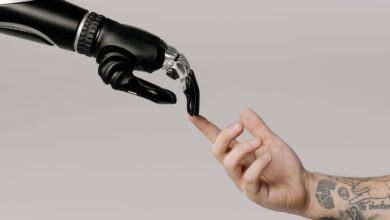
2000 years ago, Roman philosopher Seneca wrote, “a sword never kills anybody; it is a tool in the killer’s hand”. In the centuries since, the sentiment has been repeated and reworked many times, that in the hands of a surgeon, a knife saves lives, in the hands of a murderer it kills. The human has the intent, not the tool.
This metaphor is true for many world-changing innovations. Civilian nuclear power can provide abundant energy, militarily it can cause cataclysm. The internet provides access to millennia of knowledge, art, culture, connecting humanity and shrinking the world, it is also used for cyberwarfare, fraud, radicalisation and anonymised hate. Modern chemistry gives us clean water, produces medicines, fertilisers and materials that keep us safe and comfortable, it is also capable of producing weapons of untold destruction.
The exponential development of AI and its risks is likely no different. A couple of years ago, it was easy to comprehend AI as a harmless tool. Now there are warnings that it is behaving with an intent of its own, in reality in cases where it has gone “rogue”, it’s traceable to an original human instruction.
End of days prophecies have rung out across news and social media in recent weeks, with warnings from former Anthropic and OpenAI employees that there is a 1 in 10 chance of AI wiping out humanity by 2030. Anthropic itself warned about some of the ways in which bad actors have sought to use AI in pursuit of chemical and biological weapons.
This example however highlights the real risk with AI, that as with every other technology its dangers lie in the intentions of those who control and direct it – in AI’s case a small group of powerful men without any restraining oversight.
That seems unlikely to change before 2030. The off-switch will not be pressed either – not with Trump in White House, Putin still fighting an inexplicable war in Ukraine, and China quietly getting on with getting ahead. Like the post-war nuclear arms race, major powers will not risk being left behind on AI.
Tipping the scales
If the doomsaying arithmetic stands and there is a 1 in 10 chance of destruction, then that means there is a 9 in 10 chance of something else. That something else is not necessarily positive, but it can be.
Only three years ago, former UK prime minister, Rishi Sunak hosted the Bletchley AI Safety Summit, bringing together technology firms, governments and the EU to sign the Bletchley Declaration – committing national signatories to the safe and responsible development of powerful frontier AI. That consensus-based recognition that AI must be used for good has been eclipsed in the years since – thanks in no small part to the weakening of the Western coalition by Donald Trump.
If we want to keep the scales tipped in favour of the 9 in 10 scenario, and we want AI to do good, then we need to use it with that intent – not leaving it to a handful of tech bros in California to decide its future. That requires incentivising innovators to push AI in the direction that benefits humanity – something being done sporadically, but perfectly possible to do consistently and with national purpose if we choose to.
Incentivising AI innovation for social good
In 2024, the UK government’s Manchester Prize supported 10 teams of inventors, scientists and innovators to use AI to support the transition to a green economy. In 2025, Polaron, a company spun out from Imperial College, won the £1 million prize. Through the prize, the team developed AI that performed 60 years of material science research in just a day, enabling it to increase EV battery capacity and range by 10%. It achieved that in a year because of the prize incentive, and is continuing to make advances today.
Earlier this year, the Longitude Prize on Dementia – funded by the UK government and Alzheimer’s Society – awarded its £1 million grand prize to a groundbreaking AI assistant for people living with dementia built into smart glasses. CrossSense, a small software developer from London was supported, alongside 23 other companies and organisations, each developing AI-based technologies to make independent living with dementia possible for longer.
Right now, the £7.5m Longitude Prize on ALS – principally funded by the MND Association – is supporting 20 teams of biomedical and AI data scientists to identify the highest potential drug targets for ALS, the most common form of Motor Neurone Disease. 1 in 300 of us will develop MND, yet there is no cure and the treatments that are available prolong life by weeks, not years. AI-powered drug target discovery offers a hope that patients have never had before.
AI could be used to predict future neurodegenerative disease so that it can be prevented. It could be used to aid communication and mobility for people “locked-in” by a neurodegenerative disease now.
It could be used to design new materials that make our buildings sustainable, carbon neutral and self-repairing. It could be used to aid us in repairing our wrecked natural environment. It could be used to move emerging, sustainable solutions to the data industry’s energy and water needs out of the lab and into the real-world. It could be used to develop synthetic replacements for critical materials to provide us with abundant natural resources without the associated habitat destruction.
AI needs to be shaped by society
The point is AI can be used to do a great diversity of things, but it requires society using and shaping it with an intent that humanity will flourish. Genuine intelligence is extremely multifaceted, it is not innately ‘good’ or ‘bad’, and therefore something to be switched on or off, instead it needs to be cultivated and nurtured, directed and boundaried, instilled with values that are important to us all, not unlike the nurturing of human intelligence.
We mustn’t leave it to multinational tech conglomerates irresponsibly pushing AI in directions it should never be pushed in the name of research – or worse still to criminals, terrorists and authoritarian governments – to decide its future. Instead, Governments, civil society, businesses, philanthropic foundations, charities and importantly citizens can, working together to define a future for AI that benefits the whole world.