Every productivity gain from artificial intelligence eventually shows up as hours. Consider a claims team that needed 1,000 hours a week to clear its queue and now clears it in 700. The software performed as promised. The 300 hours left over are the part of the deployment almost nobody planned for.
Most AI business cases answer one question: whether the technology works. Far fewer answer the second: what the organization will do with the capacity once it does. That second decision carries most of the strategic weight. In most enterprises, it is being made by default.
AI Produces Capacity, and Capacity Always Gets Allocated
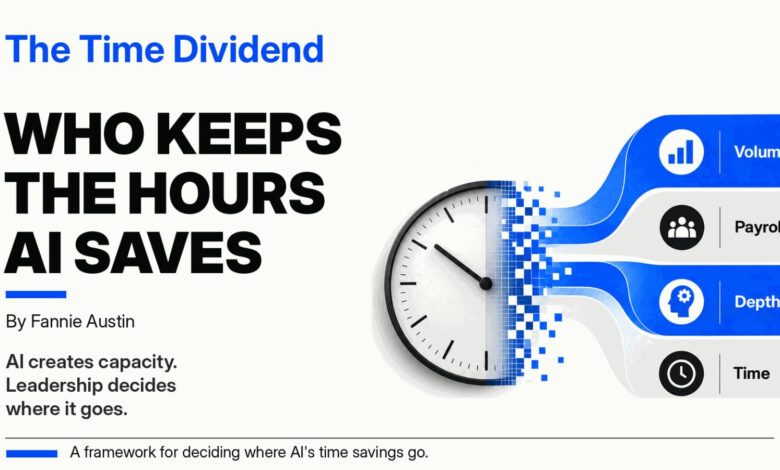
When a task gets cheaper to perform, the savings land somewhere. Across deployments moving from pilot to production, released hours flow into four channels. Together they make up what this article calls the time dividend.
1. Volume. The team stays the same size and takes on more work.
2. Payroll. The organization reduces staffing or leaves vacancies unfilled, converting released capacity into labor-cost savings.
3. Depth. Hours move into work that was chronically underfunded: quality review, exception handling, training, compliance, and customer escalations.
4. Time. Some hours return to employees as shorter weeks, protected leave, or recovery capacity.
Each channel is a defensible business choice. Most organizations will use more than one. The failure is allocating the dividend without deciding to.
The Default Setting Is Volume
When no one assigns the hours, they drift toward volume. Performance systems count output. Budgets count heads. Almost no dashboard counts hours returned to the people doing the work.
So expectations rise to meet the new capacity. Response times shorten, queues refill, and the saved hours disappear into a faster cadence that nobody chose and everybody now has to sustain. The organization records a productivity gain. Its employees record a heavier week.
The drift is about to accelerate. AI is moving from tools employees consult to agents organizations assign work to. This fall, one major developer began rolling out always-on agents that connect across business applications and keep working between conversations. Each agent like it is a new source of released hours, and each will be allocated by policy or by drift.
Capability and Viability Move at Different Speeds
In physical work, the gap is wide. A company-produced study from Anthropic estimates that robots can already perform about three-quarters of physical job tasks in the United States, covering roughly 34 percent of working hours, though often only in constrained settings. The same study found robots cost-competitive with human workers on just 0.3 percent of tasks.
Technical capability is not the same as economically viable deployment. The timing will differ across industries and technologies. That makes the case for governing capacity as it is released, rather than waiting for automation to reach some imagined tipping point.
The Time Channel Has Evidence Behind It
Returning hours to workers is often dismissed as generosity a business cannot afford. The best-known test suggests otherwise. In a six-month UK pilot, 61 companies and roughly 2,900 workers moved to a four-day week. At the end, 56 companies kept the shorter week, 18 planned to make it permanent, and revenue rose an average of 1.4 percent among the 23 organizations that reported it.
The caveats matter. The companies chose to participate, and the trial was organized by groups that advocate for shorter workweeks. Still, the result undercuts the assumption that time returned is output lost.
Slack Is a Risk Control
Anyone who has run operations knows that a process with no slack fails the first time a person does. People get sick, parents decline, and children arrive. When a death in the family takes the person who handles escalations offline for two weeks, a team with no spare capacity has nowhere to put the work.
Most American workers absorb those disruptions with little structural cushion. Employment-based insurance covered 53.5 percent of Americans for some or all of 2025, the most common form of coverage. The Family and Medical Leave Act creates no general right to bereavement leave. When security runs that tightly through the job, every absence becomes an emergency for the employee and a coverage gap for the employer.
The time channel turns part of the AI dividend into resilience. Hours held in reserve absorb illness, caregiving, and grief without breaking service levels or burning out the colleagues who cover. That capacity has a cost. So does the turnover that follows when it is missing.
Decide the Dividend Before the Deployment
The fix is procedural, and it fits inside any existing AI governance process. For every deployment, the business case needs three additions.
1. Estimate the hours released. Use the same baseline that justified the investment.
2. Assign them across the four channels. Put the percentages in writing, and name who approved the split.
3. Audit at 90 days. Start by separating realized hours from projected savings, since a dividend that exists only in the financial model was never there to allocate. Then compare headcount, output per worker, average hours worked, absence, and attrition against the plan.
Then tell employees what was decided. People who can see where the last dividend went are far more willing to help find the next one. Those who watch saved hours vanish into rising quotas learn to hide efficiency instead of reporting it.
The hours are coming either way. The only open variable is whether leadership names where they go or lets the default name it for them.