Why the orchestration layer is where embodied AI actually scales
Every robotics headline is a demo: a humanoid folds a shirt, a robot dog climbs a staircase, or a machine on a trade-show floor does a trick for a crowd holding up phones. Those demonstrations are important, but they reveal very little about what happens when robots have to operate continuously in real commercial environments.
The harder problem begins after the demo. A robot that works perfectly for 10 minutes is not necessarily a robot that can be relied upon for months across multiple sites, shifts and changing operating conditions.
As autonomous machines move from controlled demonstrations into hospitality, logistics, healthcare and other physical environments, the industry is confronting a different challenge: orchestration. Hardware remains important, but deploying a fleet reliably requires software and operating systems that can coordinate machines, manage exceptions, measure performance and adapt as the underlying hardware changes.
That distinction could determine where much of the value in embodied AI ultimately resides. As robotics hardware becomes more capable and more standardized, the ability to operate many different machines as a reliable workforce may matter more than any individual robot.
The Machine is Becoming a Line Item
Here’s what’s happened to the hardware in the last few years. Riding a wave of investment and technological advancement, robots have gotten good at what they do. For the most part, they’re very good. The capabilities available across robotic platforms are expanding, from perception and navigation systems to increasingly capable batteries and onboard computing.
The scale of deployment is growing, too. The International Federation of Robotics reported 542,000 industrial robots installed globally in 2024, with more than 4.6 million industrial robots in operation worldwide.
Professional service robotics is expanding alongside industrial automation. The IFR reported almost 200,000 professional service robots sold in 2024, up 9% from the prior year, while robot-as-a-service fleets grew 31%.
As organizations have more options for deploying autonomous machines, the question executives have to ask changes. Instead of asking only which robot can perform a particular task, buyers increasingly must consider how those machines will be deployed, monitored, maintained and measured over time.
We’ve seen this movie before. Computers, servers, phones, drones, you name it. As capabilities become more standardized, buyers gain more options and may place greater emphasis on interoperability, reliability and the software that connects different systems. The machine becomes one component of a larger technology stack.
That creates a different competitive environment for robotics companies. As hardware capabilities converge, buyers may place increasing importance on reliability, integration, service and measurable outcomes rather than specifications or the ability to do a specific task alone.
A Robot is a Virtual Machine with Wheels
The closest analogy I know is cloud computing. In 2008, a virtual machine was a small miracle. By 2014, it was a commodity you rented by the hour. The value didn’t disappear, but it moved up a layer, to the software that scheduled thousands of those machines, watched their health, restarted the ones that failed, scaled the fleet up and down, and told you what was happening so you could adjust.
That evolution offers a useful parallel for robotics. The Cloud Native Computing Foundation’s 2025 Annual Cloud Native Survey found that 82% of container users were running Kubernetes in production, reflecting how orchestration infrastructure has become a foundational part of modern computing.
The lesson is not that robotics will simply recreate cloud computing. The physical world is considerably harder to manage than a server environment. But the cloud demonstrates how value can move from underlying infrastructure toward the systems that coordinate and manage it at scale.
Embodied AI is approaching a similar inflection point. A robot is a compute node that happens to move. Once you have more than a handful of them across more than one site, the questions become fleet questions. Which unit goes where and when? Which one is degrading? What happens when one stops? Can they operate in lockstep together?
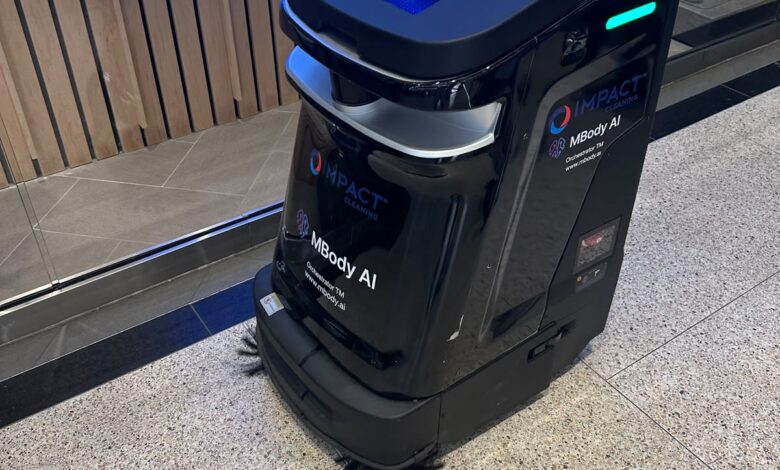
The differences from the cloud make the problem harder, not easier. A server that fails is a ticket, while a robot that fails is a 200-kilogram object sitting in a hotel lobby at 3 in the morning. It runs in a public space and it consumes water, pads and power. Its “reset” might need a person on site with a key.
Physical exceptions are the problem, and no amount of better hardware makes them disappear.
What the Orchestration Layer Actually Does
When I say orchestration, I’m referring to the software and operating discipline that turns a pile of individual machines into one coordinated workforce. I don’t just mean a dashboard with a map on it. In my experience, this type of fleet orchestration has six jobs:
- Dispatch: Assigning work across sites, shifts and floor plans, and re-planning when a ballroom is booked or a corridor is blocked. A robot that finishes early and parks itself is wasted capacity.
- Health: Continuous telemetry on every unit, with the judgment to tell the difference between a sensor that needs a wipe and a drive motor that will fail next week. Maintenance you schedule costs a fraction of maintenance you discover.
- Exception handling: Defined paths for what happens when a machine gets stuck, a guest interferes, or a job fails. Who gets paged, in what order, with what information, and what the machine does while it waits is of high importance. This is where deployments live or die, and it’s rarely in the sales deck.
- Heterogeneity: Running scrubbers from one manufacturer, vacuums from another and a delivery robot from a third under one set of rules. Different tasks want different machines. The manager must speak to all of them, in a language they can understand.
- Consumables and logistics: Water, chemicals, pads, batteries, spare parts. Boring, and the source of a surprising share of downtime.
- The productivity record: Turning all of that telemetry into an account the customer trusts: what was done, where, when, and to what standard. This one matters the most, because it’s what the customer is actually paying for.
Enterprise buyers are ultimately looking for measurable outcomes, not autonomy for its own sake. An effective orchestration layer can help connect robotic activity to those outcomes and provide a record of what was accomplished.
Mixed Fleets are the Forcing Function
One open question for the industry is whether enterprises will favor vertically integrated robotics stacks or mixed fleets managed through a common software layer.
Large operators may be reluctant to standardize on a single robot manufacturer, particularly when different jobs call for different form factors and capabilities. Procurement teams may also want flexibility as hardware improves and new suppliers enter the market.
That creates a potential role for a management layer that sits above individual manufacturers. Such a layer could allow operators to coordinate different machines according to the task at hand rather than forcing every application into a single hardware ecosystem. In that environment, orchestration becomes an operational capability rather than simply another feature attached to a robot.
Measure the Fleet like a Workforce
There’s a framing shift that makes all of this concrete: executives should count productive hours instead of robots.
Most enterprises still buy robots as equipment, a capital line with a depreciation schedule. But the economics behave like labor. A fleet has shifts, it has productivity, it has absenteeism, which we call downtime, and it needs onboarding, which we call deployment. Going one step further, it needs supervision and management, which we call orchestration.
Once you see it that way, the unit count stops meaning anything. 20 robots at 40% utilization are a team of eight that you’re paying for as 20. Orchestration exists to close that gap, and to prove that it closed.
If I were a CFO looking at a fleet, I’d want four numbers every month:
- Coverage: how much of the contracted tasks actually got done
- Productive hours per unit per day
- Cost per productive hour, all-inclusive
- Exception rate and how fast exceptions were cleared.
If the vendor can’t produce those four numbers, there’s no orchestration behind the robot, leaving you with a machine and a hope.
A Buyer’s Test
Here’s my advice to anyone evaluating embodied AI for a real operation: skip the demo. You already know the robot can move. Ask 5 questions instead:
- What was your fleet-level uptime over the last 12 months, across every site, not the best one?
- How many productive hours per robot per day do you deliver, and how do you measure it?
- When a unit gets stuck at three in the morning, who finds out, how, and what happens next?
- What breaks when I add a second manufacturer’s machines to the fleet?
- What report reaches my CFO, and would your team be comfortable if we audited it?
The important distinction is whether the vendor can demonstrate how the fleet performs after the demonstration ends.
Embodied AI is moving into hospitality, gaming, logistics, healthcare and other physical environments. As autonomous machines become more capable and more widely deployed, their ability to deliver consistent outcomes at scale will become increasingly important.
The cloud offers one useful precedent: as underlying infrastructure became more standardized, value shifted toward the systems that made large-scale computing manageable. Robotics may follow a similar path, with orchestration helping turn individual machines into coordinated operational systems.
Embodied AI will ultimately be judged less by what a robot can do in a demonstration than by what an organization can reliably accomplish with a fleet. As the machines become more capable and more interchangeable, orchestration may become the layer that turns individual robots into a dependable operational system.