Nearly four years after ChatGPT introduced the public to generative AI, it still hasn’t quite gone mainstream. About half of U.S. adults have used an AI chatbot, but fewer than a quarter use one every day. And as of August, just 16% of U.S. employees were using AI daily in their jobs.
For all the attention generative AI has received, most people still aren’t regularly using it. Largely, that’s because it asks people to do the work: set up accounts, remember passwords, learn applications and figure out what to type into a prompt box.
At the same time, another vision of AI’s future is gaining traction: humanoid robots that can serve as both companions and helpers. But that future is still years away. Morgan Stanley and other analysts say we will be waiting at least a decade before robots are folding our laundry, washing our dishes and laughing at our jokes.
So will it really be another decade or longer before people can experience the benefits of AI in the physical world?
Fortunately, no. They can experience it right now. The part of physical AI that matters most to the people it serves is its ability to understand what someone needs and help them in a natural way. The software that powers that experience is already here, and it can be deployed across a wide range of existing hardware, as well as humanoid robotics hardware that is yet to be released.
AI That Adapts to People
LiveX AI hosts are human-like, conversational avatars that can create fun and engaging experiences while driving tangible business outcomes. Even though they can be deployed in digital kiosk form factors (among others), LiveX AI Hosts are in another stratosphere of capability compared to conventional kiosks.
With a traditional kiosk, you have to figure out which menu option matches what you need. With a LiveX AI Host, you walk up, say what you need in your own words, and the Host will act on it.
At an airport, you might say, “I’m on flight UA 218. How do I get to my gate?” From that one question, the Host looks up your flight, finds your gate, and shows you the route from where you’re standing on an interactive 3D map. From there, the AI Host can text you a link to the same map, this time in a first person view optimized for your mobile. Simply follow the blue guiding arrows and you’ll be at your gate in no time. Need to make a pit stop at a coffee shop? The mobile wayfinding experience on your phone comes preloaded with the same AI Host that you initially got the directions from. Simply ask the host to add a stop, and they will do it instantly.
At a hospital, visitors from another country might not speak the language and struggle to find their elderly parent’s room. They can simply walk up to one of the LiveX devices mounted across the hospital campus and ask in any of 140+ languages, “Can you please help me find the oncology unit?”
With LiveX AI hosts, the experience goes far beyond wayfinding and covers everything from retail to live sporting events.
In a store, ask to see a jacket, and the Host shows it to you in 3D. Say, “Can I see the back?” and the host turns the jacket around. Shoppers can even try it on virtually, see how it fits, and make the purchase out right there with the Host. If they are traveling and don’t want to carry the new gear, the AI Host can have it sent directly to the shopper’s home. With integrations to connect shoppers with in-store staff members, the AI Host can also check live inventory or connect you with a staff member.
The Hardware Interface: Gateway to physical AI experience
How people meet AI in a public space matters as much as what the AI can do. A small screen asks you to lean in and tap. A life-size Host stands with you at eye level, sees you, hears you and talks back, the way a person at an information desk would.
The LiveX Gateway is designed around that moment. Its 86-inch display stands roughly seven feet tall and runs nearly floor to ceiling, so the AI Host appears life-size, with the camera built into the top bar rather than bolted on. Microphones with spatial audio and noise isolation pick out the person speaking, even in a crowded concourse or arena. Powered by LiveX Interactive Intelligence and NVIDIA’s software and hardware stack, the Host understands its surroundings, follows what you mean when you change topics mid-conversation, and takes action to get you what you need, in more than 140 languages. When you’re ready to move on, a quick scan carries the conversation to your phone.
The Gateway is one of three forms. The Portal is a wall-mounted touchscreen display for hotel lobbies, hospital corridors and store aisles where floor space is tight. The Paragon brings the experience outdoors: a 65-inch holographic display with 3,200-nit brightness for direct sunlight, IP55-rated against dust, rain and heat, for plazas, stadium gates and transit stops. Each can run on cloud models or on premises on NVIDIA RTX PRO GPUs, keeping conversations fast and natural even where connectivity is limited.
Different shapes, one intelligence. The same LiveX AI Host can greet a traveler on a Gateway in the terminal, answer a guest on a Portal in the hotel lobby and guide a fan on a Paragon outside the stadium. And when humanoid robots arrive in these spaces, that same human-like interaction is what will make them useful to the people they serve.
Beyond Information: Interactive Intelligence
Many public venues already have digital information systems. Airports and hospitals have directories, displays, maps and registration kiosks. Retailers have product catalogs and digital signage.
But systems like these are designed to deliver information, not to understand what a person needs. A kiosk can’t talk through the best route to a particular destination. A store’s display doesn’t learn a shopper’s preferences and suggest the right options.
Interactive Intelligence changes that. Combined with spatial awareness, interactive 3D maps, visual understanding and multilingual capabilities, AI can offer help tailored to a person’s surroundings and circumstances. A traveler can ask follow-up questions instead of scrolling through menus. A hospital visitor can get step-by-step directions instead of interpreting a map. A shopper can explore products through conversation instead of toggling between screens.
This also helps organizations extend personalized service without asking busy employees to answer every routine question. When a request involves complex decisions, emotional sensitivity or professional judgment, a person is still very much in the loop. AI handles the repetitive requests so employees can focus on the moments where human expertise matters most.
Physical AI Is Already Here
AI operating in physical spaces is not just a promising idea. LiveX has deployed interactive AI Hosts across more than 100 customer sites, including PUMA stores, San José Mineta International Airport, SAP Center, El Camino Hospital and properties operated by Marriott and Hilton.
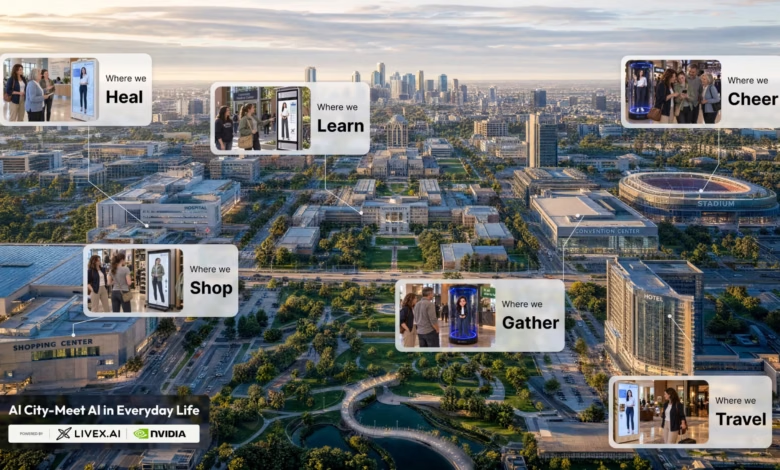
At the Smart City Expo World Congress in Barcelona, LiveX and NVIDIA unveiled AI City, with new capabilities including interactive 3D navigation, 3D product discovery, expanded real-time translation and AI Hosts powered by Lyra, our Physical AI agent.
NVIDIA Hardware and AI technologies help make this possible. NVIDIA Cosmos world models, Nemotron language models and the Metropolis Video Search and Summarization Blueprint serve as building blocks for understanding visual environments and responding to requests. NVIDIA Omniverse libraries enable digital twins tailored to each environment, which is what makes location-aware help like 3D wayfinding possible.
The result is a form of physical AI that doesn’t need arms, legs, wheels or apps to provide meaningful help in the real world.
This is the idea behind AI City: bringing human-like, context-aware AI into the places people already go, so intelligence becomes a natural part of airports, hospitals, hotels, stores, stadiums and other public venues. Instead of people navigating layers of technology to reach AI, the intelligence meets them where they are.
The Hardware Will Change. The Interaction Will Last.
AI in public spaces might be a hologram, a projection, a screen or a humanoid robot. Its form will keep evolving. What will endure is human-like interaction: getting help should feel as natural as asking a person.
Humanoid robots will undoubtedly play an important role in the future of physical AI. They will likely transform manufacturing, logistics, healthcare and other industries once they become cost-effective. But when they step into airports, hospitals and stores, they will need the same thing an AI Host needs today: the ability to understand what a person wants, in that person’s language, in a loud and crowded space, and then act on it.
That is Interactive Intelligence, and it is being refined today in live deployments, not in a lab. Humanoid robots won’t replace that layer. They will benefit from it. Our aim is for the same human-like Interactive Intelligence that powers today’s AI Hosts to carry across whatever form AI takes next.
Making AI Accessible to Everyone
Physical AI is removing the barriers that have limited generative AI adoption. Whether someone adopts a new technology can hinge on age, language, accessibility needs and digital literacy. An AI Host designed for natural, face-to-face interaction lowers many of those obstacles. A person can speak to it in their own language. Someone lost in a cavernous building can ask for directions the way they would ask another person. No one needs to know anything about the technology behind it.
We believe intelligence should be as ubiquitous and accessible as electricity, everywhere real life happens. AI should greet travelers at the airport, guide a grandmother through the hospital, help every shopper the way the best employee in the building would, and answer sixty thousand fans at once. Our goal is to make that the norm in public spaces, so every visitor gets personal help and every venue extends its team’s reach.
For millions of people, their first meaningful interaction with AI may not happen through ChatGPT or a humanoid robot. It may happen when they walk into an airport, hospital, hotel or store and come face to face with an AI Host ready to help.
That is how AI moves beyond the screen and into everyday life. And it isn’t happening years from now. It’s happening today.