A real category is forming to capture, structure, and distribute expert knowledge. It spans startups, enterprises, and institutions — and it is growing fast.
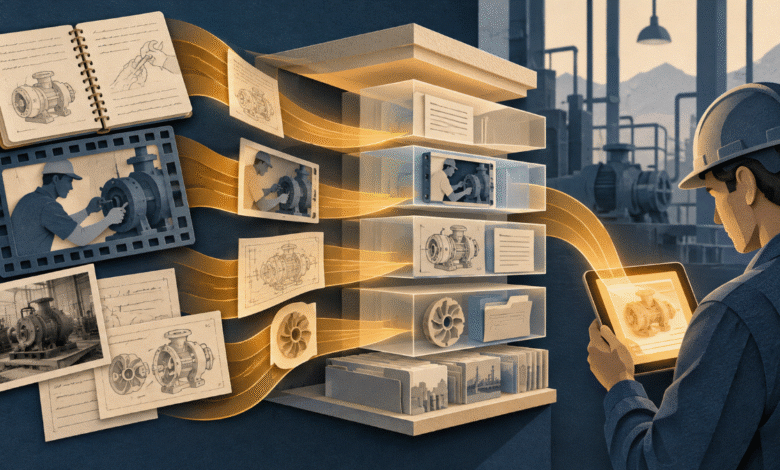
For most of industrial history, the knowledge held by expert practitioners had one home: the expert. When the expert left, the knowledge left. There was no infrastructure for capturing it, no mechanism for distributing it, no way to give a less experienced person meaningful access to a veteran’s accumulated judgment. That has begun to change. A real category is forming around knowledge preservation, and it is worth surveying what is already being built.
Field intelligence platforms
The most direct response to the problem has come from field-service technology. Companies like Aquant have built platforms that analyze service history data to identify which technicians handle which problems well, surface the most relevant prior cases when a new issue comes in, and make something like expert judgment accessible to the whole team rather than just the few people who have seen a particular failure before. Augmentir takes a connected-worker approach, embedding guided workflows and knowledge capture directly into the service job. XOi builds asset intelligence from job documentation and field video, turning completed work into a structured reference that future technicians can draw on.
The common thread across these platforms is that they treat completed service calls as knowledge assets rather than closed records. The technician who solved a hard problem is not just closing a ticket — they are adding to a body of expertise that the next person with a similar problem can reach.
Enterprise knowledge repositories
Larger organizations have been building internal versions of the same infrastructure. Atlas Copco, the Swedish industrial equipment company, has invested significantly in systems that capture institutional knowledge from service technicians and engineers and make it accessible across their global service organization. The goal is to ensure that what a senior engineer in one country knows about a specific failure mode does not stay in that engineer’s head — it becomes organizational infrastructure.
This approach is expensive and requires sustained commitment to maintain, but it addresses the scale problem that smaller point solutions cannot: when an organization has thousands of technicians across dozens of countries, knowledge preservation cannot depend on mentorship relationships alone.
Public knowledge institutions
The philosophical precedent for this kind of work comes from institutions that have been thinking about knowledge preservation much longer than the technology sector. The Internet Archive has spent decades building infrastructure to ensure that human knowledge does not disappear simply because the medium it lives on becomes obsolete. StoryCorps has recorded hundreds of thousands of personal oral histories — a different kind of knowledge, but the same underlying conviction that lived experience is worth preserving deliberately rather than leaving to chance.
The connecting thesis across all of these — field-service platforms, enterprise repositories, cultural archives — is that structured knowledge is a durable asset. It does not depreciate the way equipment does. Invested in properly, it compounds. The veteran who teaches the junior technician produces value once. The veteran whose knowledge is captured and made accessible produces value indefinitely.
What comes next in this series
Building the stack is one challenge. Getting people to trust it is another — and in some ways harder. Part 5 takes on the trust problem: verification, hallucination, and what it actually takes for a technician to stake their work on an AI-generated answer. Part 5: The Trust Problem.