An enterprise sales team can have accurate CRM records, a substantial pipeline, and experienced representatives while still struggling to move opportunities forward.
After a customer meeting, an account executive may need to send technical documentation, contact another stakeholder, update the opportunity record, and prepare for the next discussion. Multiply those responsibilities across dozens of accounts, and routine sales activities can consume a significant portion of the working week.
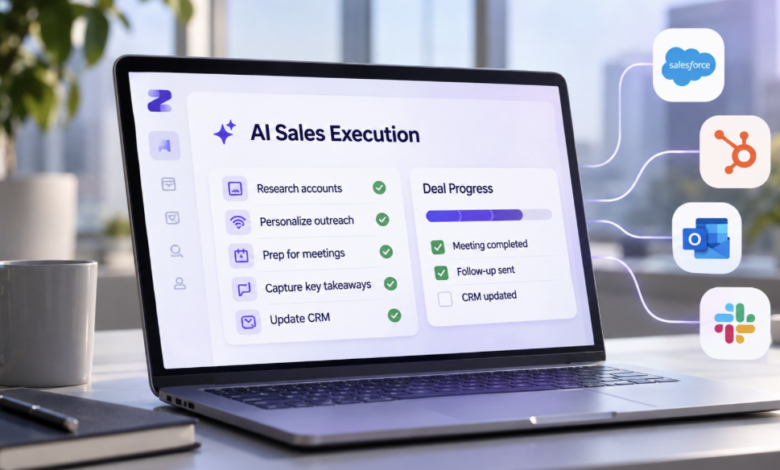
AI sales execution platforms help revenue teams manage and complete these activities. Depending on the product, they can support account research, prospect communication, meeting preparation, CRM maintenance, customer conversation analysis, and pipeline management.
The category serves several groups within enterprise sales organizations. Account executives need accurate customer information and timely follow-ups. Sales development representatives manage prospecting and outbound communication. Sales managers monitor deal progress, while revenue operations teams maintain data quality and coordinate processes across departments.
Products differ in how they address these requirements. Sales engagement platforms organize prospect communication. Conversation intelligence tools analyze customer interactions. Revenue intelligence systems help leadership understand pipeline conditions and forecast outcomes. Broader sales execution platforms support the activities representatives perform across their existing applications.
These distinctions matter when companies already use multiple sales tools. An organization with an established CRM may want AI agents and automation that work with its current systems. Another may prefer a consolidated sales workspace that replaces several applications.
This guide compares six AI sales execution platforms, their capabilities, and the operational problems enterprise buyers should consider before selecting one.
Best AI Sales Execution Platforms Compared
| Platform | Primary Strength | Best For |
| Zig | AI sales execution across existing revenue systems | Enterprise teams coordinating sales activities across tools |
| Salesloft | Revenue orchestration, engagement, and forecasting | Revenue leadership and RevOps |
| Gong | Conversation and deal intelligence | Sales managers and account executives |
| Reevo | AI-native CRM and consolidated sales workspace | Teams evaluating unified sales systems |
| Outreach | Structured sales engagement and sequencing | Enterprise SDR and outbound teams |
| People.ai | Sales activity and relationship intelligence | Enterprise RevOps and strategic account teams |
1. Zig — Best for AI Sales Execution Across Existing Revenue Systems
Enterprise sales teams often depend on several applications to manage customer relationships. CRM records, email conversations, meeting notes, and internal documents contain information representatives need before contacting customers or progressing opportunities.
Preparing for a meeting may involve reviewing previous discussions, researching stakeholders, examining account information, and identifying outstanding commitments. Afterward, representatives need to document the interaction and coordinate the next steps.
Zig provides enterprise sales automation capabilities for revenue organizations working across multiple systems and activities.
Its offering includes ZigLead enrichment, AI outbound email, ZigDialer, Zigscribe meeting preparation and transcription, and AI GTM automation.
For enterprise deployments, Zig also supports custom datasets, workflows, and AI agents configured around an organization’s business information and sales processes.
This approach is relevant to companies that want to retain their existing revenue systems while reducing the manual work required between them.
Consider an account executive managing several strategic opportunities. Before an important meeting, the representative may need to research the account, identify relevant stakeholders, and review previous interactions. Following the discussion, additional work may include preparing communications and maintaining CRM records.
Zig supports activities across this process, including research, outreach, meeting preparation, follow-up, and CRM-related workflows.
Its CRM Sync functionality also provides a review process for suggested record changes before they are applied. This allows organizations to incorporate AI-assisted CRM maintenance while keeping employees involved in approving updates.
For larger deployments, implementation involves determining which business data sources to connect, which activities should be automated, and where human approval is required.
Zig’s enterprise positioning is particularly relevant to revenue teams evaluating AI sales agents and automation without replacing their established sales infrastructure.
Key capabilities: Lead enrichment, AI outbound email, calling, meeting preparation, transcription, CRM-related workflows, custom datasets, and AI GTM automation.
Best for: Enterprise revenue organizations seeking AI-supported execution across their existing sales systems.
Consideration: Organizations should identify their highest-volume activities, required data connections, and approval processes before configuring automation.
2. Salesloft — Best for Connecting Revenue Intelligence With Sales Activity
Revenue leaders frequently have access to detailed pipeline reports. Turning that information into coordinated action across a sales organization requires additional work.
A forecast might indicate that several opportunities are unlikely to close within the expected quarter. Managers then need to examine the affected deals, understand what is delaying progress, and coordinate appropriate follow-up.
Salesloft brings together sales engagement, revenue intelligence, conversation intelligence, and forecasting.
Following its merger with Clari, the combined company operates under the Salesloft brand. Its Predictive Revenue System connects information from buyer engagement, customer conversations, pipeline activity, and forecasting.
Revenue teams can use this information to examine opportunity conditions alongside the activities being performed by representatives.
A regional sales director reviewing an underperforming territory, for instance, may need to identify which opportunities require additional attention and determine whether sales activities align with the expected pipeline outcome.
Salesloft is relevant to larger organizations where forecasting, pipeline inspection, and seller activity are closely connected.
Its broad product scope also makes configuration an important purchasing consideration. Buyers should confirm which intelligence, forecasting, and engagement capabilities are included in their proposed deployment.
Key capabilities: Sales engagement, conversation intelligence, revenue forecasting, deal inspection, and revenue orchestration.
Best for: CROs, sales directors, and RevOps teams coordinating forecasting and sales execution.
Consideration: Evaluate the specific forecasting, intelligence, and engagement capabilities included in the proposed configuration, particularly when consolidating existing tools.
3. Gong — Best for Understanding Customer Conversations and Deal Risk
CRM records do not always reflect everything discussed during customer meetings.
An opportunity may appear healthy in the pipeline even though the buyer has raised concerns about implementation costs, competing products, or internal approval requirements. These details can be difficult to evaluate when managers depend entirely on manually entered notes.
Gong provides conversation and revenue intelligence by capturing and analyzing customer interactions.
The platform helps sales teams examine discussions, identify recurring themes, and review information relevant to opportunity progress.
During pipeline reviews, managers can examine customer conversation context alongside CRM information rather than relying exclusively on representatives’ summaries.
Conversation analysis also supports coaching. Sales leaders can review how representatives handle objections, discuss pricing, or respond to customer concerns.
For enterprise organizations with lengthy buying cycles and multiple stakeholders, access to conversation context can help teams maintain a clearer understanding of opportunity conditions.
Gong differs from platforms primarily focused on outbound engagement or administrative automation. Its emphasis is on understanding customer interactions and using those insights to inform sales decisions.
Key capabilities: Conversation capture, transcription, conversation analysis, deal insights, and coaching support.
Best for: Sales managers and account executives seeking deeper visibility into customer conversations.
Consideration: Establish how conversation insights will inform coaching and opportunity reviews. Teams should also examine recording permissions and data-handling requirements.
4. Reevo — Best for Consolidating Sales Information and Execution
Sales technology stacks often expand gradually.
A company may introduce separate applications for prospecting, CRM management, sales engagement, meeting intelligence, and pipeline reporting. Each product addresses a particular requirement, but employees can eventually spend considerable time navigating between systems.
Reevo offers a consolidated approach through its AI-native sales workspace.
The platform combines CRM capabilities with prospecting, engagement, meeting intelligence, and deal management.
Its Ask Reevo functionality allows users to query customer and deal information available within the platform.
A representative preparing for a contract negotiation may need to review previous discussions, account history, and unresolved commercial questions. Accessing that information from a consolidated workspace can reduce the effort required to reconstruct the customer’s history.
Reevo is relevant to organizations considering whether a unified sales environment would improve how representatives access information and manage opportunities.
Adopting a consolidated workspace is a different project from adding AI automation to an existing CRM.
Companies with established systems need to consider migration requirements, reporting continuity, integrations, and the impact on employees who depend on current processes.
Key capabilities: AI-native CRM, prospecting, sales engagement, meeting intelligence, deal management, and AI-assisted information retrieval.
Best for: Revenue teams evaluating a consolidated CRM and sales workspace.
Consideration: Review existing CRM investments, migration requirements, and integration needs before adoption.
5. Outreach — Best for Improving Outbound Sales Execution
Large sales development organizations need consistent prospecting processes across representatives, territories, and account segments.
Without a structured approach, follow-up activity can vary considerably. Some prospects receive timely communication, while others receive no further contact after an initial interaction.
Outreach provides sales engagement and sequencing capabilities that help teams organize outbound communication.
Representatives can work through defined sequences, manage prospect activities, and track engagement within established sales processes.
For an enterprise SDR organization entering a new market, these capabilities can provide a consistent structure for prospecting across multiple territories.
Managers can also review how engagement activities are being completed and identify differences in execution between teams.
The platform is relevant to organizations that want greater consistency in outbound sales processes, particularly when many representatives work across substantial prospect portfolios.
Sequence design remains important. A structured process still requires appropriate messaging, account segmentation, and decisions about when representatives should personalize communication.
Key capabilities: Sales sequences, engagement workflows, prospect activity management, and CRM-connected sales processes.
Best for: Enterprise SDR teams and organizations managing structured outbound sales programs.
Consideration: Evaluate sequence configuration, CRM synchronization, and how representatives will personalize communication for different accounts.
6. People.ai — Best for Enterprise Account Relationship Visibility
Complex B2B purchases rarely involve a single decision-maker.
An enterprise opportunity may include procurement, finance, IT, legal, department leadership, and executive sponsors. Different sales representatives may communicate with different members of the buying group.
Maintaining a clear picture of those relationships becomes difficult when engagement information is distributed across employees and applications.
People.ai focuses on sales activity and relationship intelligence.
Its platform captures sales activity information and helps organizations understand engagement across accounts and opportunities.
An account manager may have frequent contact with a department champion but limited engagement with the executive responsible for approving the purchase.
Relationship intelligence can help identify that gap and support more informed account planning.
This is particularly relevant to enterprise RevOps teams and strategic account leaders who need visibility into customer relationships across a larger sales organization.
People.ai’s primary focus differs from outbound sequencing or general sales task automation. Its value centers on activity data, account relationships, and the visibility those records provide.
Key capabilities: Sales activity capture, relationship intelligence, account engagement visibility, and CRM-connected activity data.
Best for: Enterprise RevOps teams and strategic account managers overseeing complex customer relationships.
Consideration: Review supported activity sources, data permissions, CRM integration requirements, and how relationship information will inform account planning.
Sales Execution vs. Revenue Intelligence vs. Forecasting
Enterprise sales software categories overlap, but they address different operational questions.
| Category | Main Question | Practical Example |
| Sales execution | What work needs to be completed? | Preparing a follow-up after a customer meeting |
| Sales engagement | How should representatives communicate with prospects? | Managing an outbound sequence |
| Conversation intelligence | What did customers say during interactions? | Reviewing objections raised during discovery |
| Relationship intelligence | Which stakeholders are engaged? | Identifying limited executive involvement |
| Revenue forecasting | What revenue outcome is expected? | Reviewing quarterly pipeline projections |
These distinctions become important when an organization already uses several sales applications.
A company with reliable forecasting data may still struggle to complete follow-ups or maintain accurate CRM records. Purchasing another forecasting product would address a different operational problem.
Similarly, a team with consistent outbound activity may need better information about customer objections or stakeholder relationships.
Some vendors offer capabilities across multiple categories. Buyers should therefore examine the activities supported by the specific product configuration rather than assuming that every platform addresses the same requirements.
How to Identify Your Biggest Sales Execution Gap
Before comparing vendors, enterprise buyers should examine where sales activities are delayed, repeated, or poorly documented.
| Warning Sign | Likely Problem | Capability to Evaluate |
| Follow-ups are consistently delayed | Administrative workload | Sales execution automation |
| Managers discover objections too late | Incomplete customer context | Conversation intelligence |
| Pipeline projections change unexpectedly | Limited forecasting visibility | Revenue intelligence |
| Representatives constantly switch applications | Fragmented sales systems | Cross-system automation or consolidated workspace |
| Prospecting activity varies by representative | Inconsistent engagement processes | Sales sequencing |
| Strategic accounts depend on one contact | Limited stakeholder coverage | Relationship intelligence |
These warning signs provide a starting point for investigation rather than proof that a particular technology is required.
Delayed follow-ups, for example, may result from excessive administrative work, unclear ownership, or poorly configured CRM processes. Software can address some of these issues, while others require changes to team responsibilities.
A useful evaluation begins with an operational problem that can be measured before and after implementation.
How to Evaluate an Enterprise Sales Execution Platform
Enterprise purchasing decisions involve more than comparing feature lists. The software must fit existing systems, data policies, and sales processes.
1. Identify the Operational Bottleneck
Examine where representatives and managers spend time.
Are account executives manually preparing meeting briefs? Do SDR teams struggle to maintain follow-up schedules? Are managers missing important customer objections?
Documenting these problems helps establish which capabilities deserve priority.
2. Review Existing Systems and Integrations
Map the CRM, communication applications, meeting tools, and internal data sources currently used by the organization.
A company with substantial investment in Salesforce or another established CRM may prefer software that operates alongside its existing infrastructure.
An organization planning to replace several sales applications faces a different implementation project.
Integration requirements should be evaluated against the actual systems in use, including how records are accessed, updated, and synchronized.
3. Examine AI Agent Permissions and Approval Controls
AI agents can introduce additional operational considerations when they are connected to business information and sales activities.
Enterprise buyers should establish which data sources a platform can access, which employees are authorized to use them, and what actions the software can perform.
Preparing a suggested CRM update, modifying a customer record, and sending an external email involve different levels of responsibility.
During vendor demonstrations, ask which activities require employee approval, how permissions are managed, and what records are available for reviewing automated actions.
4. Test the Complete Workflow
Individual features can appear straightforward during a demonstration. The more useful test is following an actual sales process from beginning to end.
Ask vendors to demonstrate how a representative prepares for a meeting, retrieves account context, records the discussion, and handles follow-up activities.
This reveals where employees still need to move between applications or complete tasks manually.
5. Define Measurable Outcomes
Choose metrics connected to the original operational problem.
Useful measures include administrative time per representative, follow-up completion rates, CRM record completeness, stakeholder coverage, and time spent preparing for customer meetings.
Pipeline progression may also be relevant, although revenue outcomes are influenced by factors beyond software.
6. Run a Representative Pilot
Include employees with different responsibilities, account portfolios, and levels of technical experience.
A pilot involving only enthusiastic early adopters may overlook problems that emerge when the platform is introduced across a larger organization.
Compare results with the original baseline. The objective is to determine whether the platform improves the targeted process and whether those improvements justify implementation and ongoing costs.
Frequently Asked Questions
What is the difference between sales execution and sales enablement?
Sales execution covers activities involved in progressing opportunities, including account research, customer communication, meeting preparation, and follow-up.
Sales enablement focuses on providing representatives with training, content, guidance, and resources that help them perform those activities effectively.
The categories overlap, but they address different parts of sales operations.
Can AI sales execution platforms improve CRM data quality?
Some platforms support activity capture, record maintenance, or CRM-connected workflows that reduce manual data entry.
Results depend on the product, available integrations, and how the organization manages its information. Teams should examine whether suggested changes require approval and how inaccurate or duplicate records are handled.
How are AI sales agents different from traditional sales automation?
Traditional sales automation typically follows predefined rules, such as assigning leads or scheduling a sequence of messages.
AI sales agents can use available business context to support more complex activities, depending on their configuration and permissions. These may include researching accounts, preparing communications, or assisting with CRM-related tasks.
The distinction depends on what the product actually performs, how much autonomy it has, and which actions require employee approval.
Which metrics should enterprise teams track when adopting AI sales software?
Useful measures include time spent on administrative tasks, follow-up completion, CRM data completeness, meeting preparation time, and stakeholder engagement.
Organizations should select metrics that correspond to the specific problem being addressed and compare results against a baseline established before implementation.
Final Thoughts
Enterprise sales teams need reliable information about their opportunities and practical ways to complete the work those opportunities require.
The six platforms address different parts of that process. Zig focuses on AI-supported execution across revenue activities and existing systems. Salesloft connects revenue intelligence, forecasting, and engagement. Gong provides customer conversation insights, while Reevo offers a consolidated sales environment. Outreach concentrates on structured engagement, and People.ai helps organizations understand account relationships.
For buyers, the most useful comparison is built around actual sales activities. A team struggling with incomplete CRM records has different requirements from one dealing with inconsistent outbound communication or limited visibility into executive stakeholders.
Before committing to a platform, organizations should examine how it fits their current systems, what employees will still need to do manually, and which improvements can be measured during a pilot.
Those findings provide a more reliable basis for investment than the number of AI features included in a product demonstration.