A story with more than one path
An interactive drama has to hold together in more than one direction. A viewer’s choice may lead to a different scene or ending. A timed reaction may change what happens next. Every route needs to make sense on its own while remaining part of the same story.
For a production team, that changes the work from the beginning. Branches must be planned before scenes are generated. Characters and locations need to remain consistent across routes. Review must cover both the finished video and the choices that connect one scene to another.
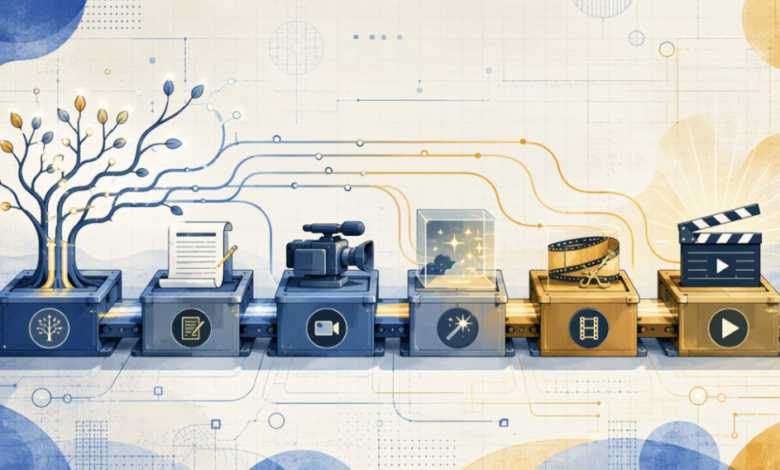
DRAMAGO, an AI-native cinematic entertainment platform, uses an internal production system called DRAMAGO AI to manage that work. Its teams take a title through six stages, from branching script to release.
Six stages from script to screen
Write the story and its branches. Writers establish the world and main storyline, then map the decisions that can change its course. Choices, quick-time events (QTEs), and discoverable clues are identified in the script. The team reviews the pacing and emotional arc of each route before production begins.
Build the asset library. Characters, expressions, costumes, locations, lighting variations, and props are organized as production assets. This gives the team a consistent reference when the same character or place appears in different scenes and branches. DRAMAGO says it can reuse roughly 30–40% of general-purpose assets across titles.
Break down and generate the shots. Directors translate the script into a shot plan, then refine individual shots for framing, action, lighting, and continuity. AI helps produce the footage, while the team can adjust the plan and each shot rather than accepting a generated sequence as final.
Edit each route. Editors assemble the footage for every branch, repair problem shots, and bring the routes into a consistent visual style. They also check that a choice leads into the next scene without disrupting the story’s pace.
Review the story, image, and interaction. Writers and directors check narrative continuity. Production reviewers look for visual defects such as flicker, clipping, or inconsistent character details. The team also tests every interactive path so a viewer cannot reach a dead end by making a valid choice.
Release and distribute. Completed titles launch in the DRAMAGO app and may be distributed through additional channels. By this stage, the team has approved both the footage and the way viewers move through it.
What makes the workflow repeatable
The six stages depend on more than a set of generation tools. DRAMAGO uses internal systems to organize assets, coordinate work across its production team, and manage review. When a route changes, the people responsible for the script, shots, edit, and interaction logic need to see how that change affects their work.
Human judgment remains central to the process. AI helps with repeatable production tasks and generating variations. Writers, directors, cinematographers, and editors decide how a scene should feel, whether a character remains believable across routes, and which cut is ready to release.
DRAMAGO estimates that its AI-based workflow reduces hard production costs by more than 80% compared with conventional shoots. That is a company estimate, not a universal cost benchmark: the comparison depends on the scope and production method of each title.
The branching structure in released titles
The results are visible in DRAMAGO’s catalog. The Queen’s Taming Rules has two endings. Sterling Lies follows three storylines through one cast. Blood on the Badge spans 87 episodes and 14 branches, with QTEs and panoramic scenes that viewers can explore.
Those numbers matter because each route needs enough story to stand on its own. The production challenge is to expand the choices while keeping characters, locations, and consequences coherent from one branch to the next.
DRAMAGO plans to extend the world of Blood on the Badge into Deadwood, its first AI-powered Story World. The drama introduces the setting and characters; the planned Story World is designed to give viewers a way to return after the episodes end.
For other production teams, the practical starting point is the branch map. Give every route an owner, establish what can be reused, and track what must be revised when a choice changes. That is how an interactive story becomes a production workflow rather than a collection of disconnected scenes.