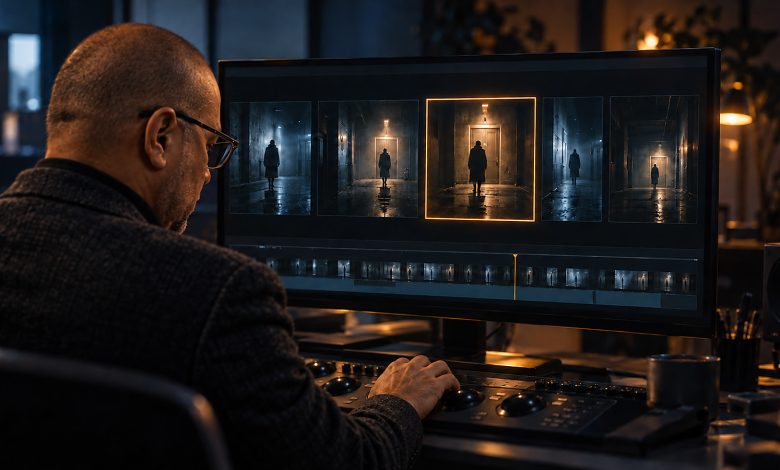
The first question I ask when a generated image looks impressive is whether it belongs in the story I wrote. A character can be perfectly lit and still appear to know something the audience should discover later. A room can be visually striking and show a door that should be locked. Choosing the right frame requires an answer to a story question, rather than an aesthetic score.
I write, narrate and edit Will Savive’s Midnight Stories, a series of short horror films that use AI-assisted visuals. In a film that lasts about two minutes, a single image can change what viewers believe happened. That makes the division of labor unusually visible: the tool can produce possibilities, but someone has to decide which possibility tells the truth of the fiction.
The story needs a decision before it needs a picture
I start with the dramatic turn. Who makes a choice, what do they know at that instant, and what will the audience understand only afterward? In a mystery, the position of a hand or the direction of a glance may be evidence. If I ask an image system for a “sinister hallway” before I know what must be hidden in it, I am letting its most likely visual answer guide the plot.
A brief script is a demanding test of this order of operations. There is little room to repair a confused clue with another scene. I write the sequence, decide what each shot must reveal, and then use visual tools to explore ways of staging it. Some outputs look excellent in isolation but fail as pieces of the film; rejecting them is part of writing.
This matters for teams beyond film. If a marketing team asks a model to generate a campaign before identifying the claim it can substantiate, it may receive polished work that makes a promise the company cannot keep. A human owner must define the decision and the evidence before production accelerates.
Give the tool a bounded job
A useful production brief states what the system may vary and what it must preserve. For one scene, the room might be negotiable while the character’s coat, the position of a key and the time on a clock are fixed. I can explore several visual compositions within those boundaries. The final cut still depends on whether the selected image makes the next action understandable.
I use generated stills and short motion to make situations possible on a small production budget, then assemble the sequence and record the narration myself. Motion can introduce a new problem: the character moves toward a threat when the script says they are retreating, or a clip ends before a spoken line has finished. The efficient answer is sometimes to revise the prompt. At other times it is to cut the shot, change the edit or record the line differently.
The practical distinction is between assistance with a task and delegation of the creative decision. An editor who rejects an inaccurate frame and changes the timing is exercising judgment. A team that accepts the first fluent output because it is cheap has removed a review step precisely where the work can mislead.
Keep a record of human choices
Documentation need not become an enterprise compliance project. A solo creator can retain a short script, a shot list, selected visual outputs and notes on material changes. Those records help distinguish an accidental continuity error from a deliberate clue, and they make it easier to explain what a tool actually contributed.
The National Institute of Standards and Technology AI Risk Management Framework treats clear human and AI roles, oversight and documentation as ways to improve accountability. The framework addresses a far wider range of systems than a short film, but the principle scales down. If nobody can explain who checked an output or why it was used, “human in the loop” is merely a label.
A simple review log might note that a generated shot changed a character’s clothing, weakened a reveal or implied a real-world claim the script never made. The log is useful only if it leads to action. The owner can regenerate, edit, disclose, or remove the material before publication.
Disclose what the audience is actually seeing
Transparency is more useful when it is specific. “Made with AI” may tell viewers less than “written, narrated and edited by a person, with AI-assisted visual scenes.” A disclosure can describe the division of work in ordinary language without presenting the tool as either an invisible secret or the film’s author.
Publication rules also matter. YouTube’s guidance on generative content requires disclosure when AI meaningfully alters or generates realistic content, including a realistic scene that did not occur. Creators should check the current requirements of each platform and use its upload controls where applicable. A fictional story can still contain photorealistic imagery that calls for a label.
Disclosure should also cover claims about the process. If a narrator is a real person, say so when relevant. If a scene is synthetic, do not present it as documentary footage. The point is to give viewers an accurate account of what they are watching, not to recite every software setting.
Authorship is a practice that can be examined
The U.S. Copyright Office’s report on AI and copyrightability says that AI assistance does not automatically prevent copyright protection for a larger human-authored work. It also says that a prompt alone is insufficient to establish authorship of an output; the human contribution to expressive elements matters. That is a legal question within a particular jurisdiction, while audience trust is a broader editorial question.
Still, the same production file can help answer both practical questions: what did the person write, select, arrange, revise, perform and ultimately approve? Those verbs describe observable work. They are more informative than a claim that the finished film is either wholly human or wholly automated.
I would judge the success of an AI-assisted scene by whether its choices hold up without the technology being the subject. Does the clue remain fair, the character act consistently, and the ending feel earned? If the human author cannot explain those choices, a faster production process has produced a less accountable story.