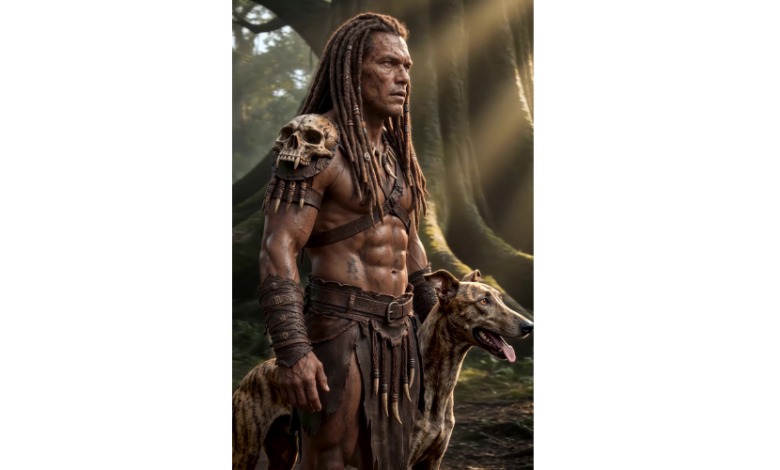
I work in marketing at PetSky Online, a pet retailer in Dubai, where Into the Wild began as a company creative project. I wanted to move beyond familiar images of an owner opening a bag of food and a pet eating it. My question was whether the brand could belong inside an adventure that people would choose to watch, with characters and a story that held their attention.
The result was an AI-assisted short film running four minutes and 32 seconds, produced for PetSky Online, which I created entirely myself from concept through final production. A dog survives a delivery aircraft crash in a vast forest, where a warrior chooses to protect him. Their journey involves giant creatures, danger and an eventual helicopter rescue, but the relationship between the two characters is the emotional centre.
The most useful lessons came from trying to turn that story into consistent images and movement. Getting a compelling individual generation was not the same as getting a usable shot for the film. I needed a process that helped each new output belong to the same world, while staying close to what I intended.
Start With the Story and the Frame
The film was intended for vertical viewing on social platforms, so I built it around a 9:16 frame. Close-ups were an important part of that choice: the audience needed to read the characters and their relationship on a phone screen. The framing was not simply an export setting added at the end.
I later tried adapting the finished film to 16:9 and was not happy with the result. Reframing the close-ups compromised compositions and cut away details that mattered. My recommendation is to decide early whether a project genuinely needs multiple formats, because a frame designed for one shape may need more than a different crop to work in another.
The marketing brief also influenced the story. I wanted the products and delivery service to be visible without making them the centre of every scene. That meant asking how they could belong within the adventure, rather than building an unrelated story and forcing the advertising into it afterwards.
References Are Part of the Creative Work
One of my strongest lessons was that a carefully written prompt could still be undermined by its reference images. I initially concentrated heavily on explaining the shot I wanted. Over time, I realised that the visual material supplied alongside those instructions deserved just as much attention.
For the human character, the combination that worked best for me was a detailed facial close-up against a plain, matte grey background, a front view of the full body without the head, and a rear view. These images had different jobs. The close-up provided facial detail, while the body views described the costume, proportions and appearance from another direction.
Leaving the head out of the front body reference was especially useful in my workflow. When I included a small face in a full-body image, some wider outputs appeared to follow that less detailed face instead of the separate close-up. Removing it reduced that competing visual information; this is my practical observation, not a claim that I know how the model processes references internally.
Animals required another consideration. For the dog and other four-legged creatures, I also needed a side body view to communicate their shape and proportions. A frontal face image alone did not give me everything I needed when the animal appeared from a different angle.
More References Need Clearer Purpose
My earlier workflow required me to combine character views into a single reference sheet. In the later video workflow I used, I could supply up to 50 references, which allowed me to keep those views separate. That number describes the setup available to me, not a capability I would assume applies to every model or interface.
The important change was not simply having room for more images. It was being able to separate information that served different purposes. My recommendation is to judge each reference by what it clarifies, rather than treating the maximum number of reference slots as a target to fill.
For another project, I would begin by identifying which aspects must remain consistent: facial identity, body shape, clothing and the animal’s appearance, for example. I would then build references around those needs. A larger collection is only helpful if the images support the intended result rather than compete with one another.
Build Reusable Instructions for the Assistant
I also created a reusable set of instructions, or a skill, for the chat assistant I used to develop prompts. I could describe a shot in my own words and ask the assistant to rewrite that description in a form better suited to the video workflow. This helped bridge the gap between the scene I imagined and the instructions I needed to communicate it.
I did not train a new AI model. The skill was an instruction layer that guided an existing assistant, and I also used shared instruction sets focused on acting and image creation. Keeping that distinction clear matters when explaining what was actually built.
The instructions became more useful as I refined them alongside the reference images. They were not a guarantee that a generation would match my intention, and the creative decisions remained mine. I still had to assess the output and decide whether it belonged in the film.
Progress Was Not a Controlled Experiment
The first 30 percent of the film took me around 20 days, while the remaining 70 percent took around 15 days. By the later stage, I had improved both the reference material and the reusable instructions. I was also working with a newer video model, which made the process feel smoother.
Those numbers are a description of this production, not a benchmark for what someone else should achieve. The scenes were different, my experience had increased and the tools had changed. I cannot isolate a single improvement and claim that it alone caused the difference.
There were moments when generation credits ran out before I had obtained the result I needed, and those were the points when I felt most discouraged. I am keeping the production budget private, but this was not a cost-free process. The experience made improving the inputs feel more important than simply hoping the next attempt would work.
Keep Human Judgement in the Loop
Making the film alone meant taking responsibility for the whole result, not only producing prompts. The story, visual choices and final production decisions all had to work together. An impressive image could still be wrong for the character, the composition or the moment in the story.
My advice to someone attempting a similar project is to separate those questions before deciding that an output is successful. Does the character still look right, does the action serve the scene, and does the composition work in the intended format? Those are useful review questions even when a tool produces something visually striking.
For me, greater control came from treating references, instructions and judgement as connected parts of production. The aim was not to remove uncertainty completely, because I could not. It was to make the next creative decision better informed, and to keep the film’s purpose visible through the experimentation.