Why Financial Data Still Requires So Much Human Work
Imagine receiving a financial-data file containing thousands of records. Before anyone can make a decision from it, someone has to understand what is actually in the file. Are important fields missing? Is the information usable? Are there inconsistencies? Does it need additional validation? And when more information comes back, can those results be trusted?
Financial services has invested heavily in APIs, cloud platforms, analytics, and automation. Yet many data operations still depend on people to connect the pieces: interpreting unfamiliar information, preparing data for different systems, checking outputs, resolving exceptions, and turning large amounts of raw information into something a decision-maker can use.
The challenge is rarely one isolated task. It is the coordination across the entire journey. A workflow may begin with an incoming file or API response, move through preparation and validation, interact with several approved systems, and end with analysis, reporting, and a business decision. Each step may be manageable on its own, but repeating the full process accurately at scale creates significant operational work.
This is where Agentic AI becomes useful. The opportunity is not simply to make AI answer questions faster. It is to let AI support a sequence of tasks while recognizing when a person should remain involved.
From AI Assistant to AI Agent
Most people first experienced generative AI as an assistant: a person asks a question, and the model responds. Agentic AI extends that idea. An AI agent can work toward a defined goal, use approved tools, perform multiple steps, evaluate intermediate results, and decide whether to continue or escalate within clearly defined boundaries.
In a financial-data workflow, for example, an agent might help understand incoming information, recognize missing or inconsistent fields, prepare data for downstream processing, check whether expected results were returned, and organize those results for review.
The value is not only that individual tasks can become faster. The larger opportunity is reducing the repetitive coordination between them. That can allow analysts and operations teams to spend less time moving information from one step to another and more time understanding what the information means.
Applying Agentic AI in Practice:
My perspective on Agentic AI comes not only from studying the technology, but also from applying it to real financial-data operations. In my professional work, I have developed AI-driven agents to support different parts of complex data workflows, particularly where analysts would otherwise spend significant time understanding incoming information, preparing data, performing quality checks, coordinating repeatable steps, reviewing returned information, and preparing results for decision-makers.
I found that the most useful approach was not to give one agent unrestricted control over an entire process. Instead, AI can support focused responsibilities within a governed workflow. Routine work can move faster, while unusual results, conflicting information, or decisions with meaningful business consequences can be surfaced for human review.
That experience shaped the central idea of this article: the challenge is not simply building an agent that can take more actions. It is designing a workflow that knows where automation adds value, where its boundaries should be, and when human judgment becomes more important than additional autonomy.
Where AI Can Help Across the Data Journey
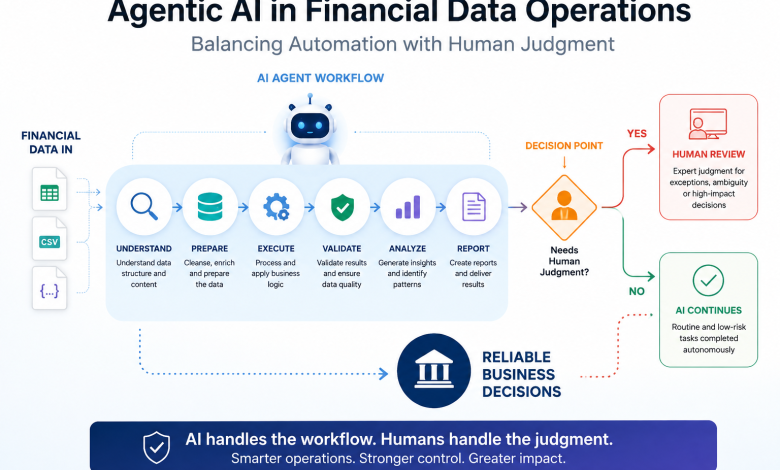
A simple way to understand the role of Agentic AI in financial-data operations is through six stages:
UNDERSTAND → PREPARE → EXECUTE → VALIDATE → ANALYZE → REPORT
At the beginning, AI can help understand incoming data and its context. During preparation, it can help standardize information and identify gaps or inconsistencies. During execution, agents can coordinate approved, repeatable tasks across systems. When results return, AI can help check completeness, consistency, and expected conditions before highlighting cases that need attention.
The final stages turn raw outputs into something useful. AI can help identify patterns, organize evidence, summarize findings, and prepare clear reports for the people responsible for the next decision.
The goal is not to remove people from this journey. AI can handle more of the repetitive operational work at scale, while people step in when experience, context, interpretation, or judgment is required
Why More Automation Isn’t Always Better
As Agentic AI becomes more capable, it is tempting to measure progress by autonomy. If a system can automate 60 percent of a process, the natural question becomes how to reach 80 or 90 percent. In financial operations, however, the percentage automated is not always the best measure of success.
Just because AI can perform a task does not mean it should perform that task without oversight. The consequences of an error are different across a workflow. Correcting a formatting issue is not the same as resolving conflicting risk information or making a consequential business decision.
A more practical approach is to consider both the repeatability of the task and the consequence of getting it wrong. Low-risk, reversible, and well-defined actions may be suitable for greater automation. Ambiguous information, material exceptions, sensitive situations, or consequential decisions deserve stronger controls and clear escalation paths.
The important question therefore changes from “How much can we automate?” to “Which work should AI handle independently, and where should a person remain responsible?”
Keeping Human Judgment Where It Matters Most
Human-in-the-loop is often used as a general principle for responsible AI, but meaningful human oversight requires more than adding an approval button. The person reviewing an exception needs enough context to understand why the system stopped and what evidence matters.
Consider an agent validating thousands of records. Most may pass routine checks, while a smaller group contains conflicting or incomplete information. Instead of asking an analyst to repeat the entire validation process, a well-designed system should identify what failed, organize the relevant evidence, and explain why the case needs attention.
The analyst can then focus on the exception rather than the routine work. In simple terms, AI handles scale while people handle ambiguity.
This division of responsibility is especially important in financial services. AI can assist with execution, organization, analysis, and explanation, while people remain accountable for decisions that require business context, interpretation, or acceptance of meaningful risk.
Building AI for When Things Don’t Go as Planned
Real financial data is rarely perfect. Files arrive with unexpected fields. Values conflict. Information is incomplete. Systems may be temporarily unavailable. External results can differ from what was expected. Business requirements can also change.
A useful Agentic AI workflow therefore cannot be designed only for the ideal scenario. It also needs clear rules for what happens when reality does not match the plan. Should the agent retry an action? Continue with available information? Request additional input? Stop the workflow? Escalate the case to a person?
Those boundaries should be considered before deployment, not after an unexpected event occurs. Humans also need enough context to investigate an exception without reconstructing the entire workflow from the beginning.
Repeated exceptions can be valuable signals as well. They may reveal weak data quality, unclear processes, or areas where automation needs better controls. Human interventions can therefore become useful feedback for improving future workflows rather than permanent manual workarounds.
Measuring Whether AI Is Actually Making Things Better
The success of Agentic AI should not be measured only by the percentage of work that becomes automated. A workflow that is highly autonomous but produces difficult-to-detect errors may create more risk than one that automates less and reliably identifies the cases that need human attention.
Useful measures can include accuracy, exception rates, successful workflow completion, time saved, frequency of human intervention, quality of escalations, traceability, and the ability to explain why an action occurred. More importantly, organizations should ask whether the automation improves the actual business outcome.
Did people spend less time on repetitive coordination? Were problems identified earlier? Were exceptions easier to investigate? Did decision-makers receive clearer information? Can the organization understand what the agent did and where a person intervened?
These questions align with broader responsible-AI principles. The National Institute of Standards and Technology’s AI Risk Management Framework emphasizes governance, measurement, and management of AI risks, while the OECD AI Principles emphasize areas such as transparency, robustness, and accountability. ISO/IEC 42001 similarly provides a management-system approach for organizations using AI.
These ideas become increasingly important as AI moves from generating recommendations to taking actions inside operational workflows.
The Future Is Humans and AI Working Together
The most useful future for Agentic AI in financial services is not necessarily one where AI replaces the people operating today’s workflows. It is one where the workflow itself becomes better designed.
AI can increasingly carry the operational weight of data-intensive processes: understanding information, preparing it, coordinating approved actions, validating outputs, identifying patterns, and producing clear summaries. People can spend more of their time handling ambiguity, investigating meaningful exceptions, understanding business context, and making decisions where judgment matters.
That changes the role of the analyst. Instead of spending large amounts of time moving information between steps, the analyst can focus on supervising the process, investigating what the system cannot confidently resolve, and applying judgment where judgment creates the most value.
The future of Agentic AI in financial operations is not about removing humans from the workflow. It is about removing unnecessary work from the human workflow.
As AI agents become more capable, the defining question for financial institutions may no longer be simply, “What can we automate?” It may be, “Where should autonomy end, and where should human accountability begin?”
References
National Institute of Standards and Technology (NIST). Artificial Intelligence Risk Management
Framework (AI RMF 1.0), 2023.
National Institute of Standards and Technology (NIST). Artificial Intelligence Risk Management
Framework: Generative Artificial Intelligence Profile (NIST AI 600-1), 2024.
Organisation for Economic Co-operation and Development (OECD). OECD AI
Principles.International Organization for Standardization (ISO/IEC 42001:2023). Information technology –