

Three checks to run on any MVP development company in the first discovery call.
Key Takeaways
- A strong development partner cuts your feature list to one core user journey before it gives you a price.
- MVP code should carry straight into version two, so ask what breaks at 10x your launch traffic before you sign.
- The repo, cloud accounts, and credentials belong in your name from day one.
Most founders bring a feature list they have refined for months to their first call with a web application development company. Every line on it feels essential, and every line costs money. A partner that prices the entire list is quoting version two and calling it a minimum viable product.
The founder learns this when the budget runs dry and real users have yet to log in. You can spot the right MVP development company in that first meeting by one behavior: what it does with that list. The checks below come from our work with startups and SMEs since 2016, including rebuilds of platforms that outgrew their first version.
Scope Cuts Come Before the Estimate
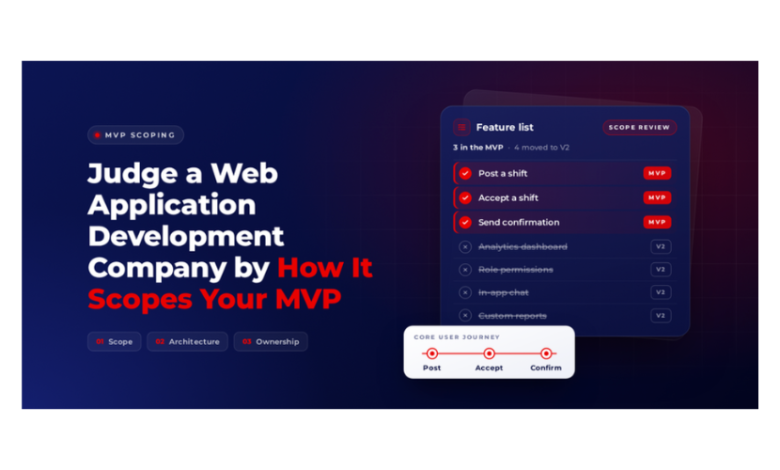
A capable team maps your wishlist to one core user journey first. For a B2B scheduling tool, that journey is short: a manager posts a shift, a worker accepts it, and the manager sees the confirmation. Everything outside that loop moves to a later list, with a reason attached to each cut.
Watch how the team talks about admin panels, role permissions, and reporting dashboards. These features feel mandatory, yet they rarely decide whether users come back. A good partner parks them and says so on the first call.
The MVP development process should start with this cut list. Any estimate that arrives before it is a guess with a number attached.
The Architecture Has to Survive the First Traction Spike
Teams rebuild throwaway MVP code right after traction arrives, just as investors and users start paying attention. Ask what breaks at 10x your launch traffic and which parts will carry into version two unchanged.
A clear answer names specific parts: the database schema, the authentication layer, the background job queue. A vague answer sounds like “we will optimize later.”
Stack choice matters here too. Custom web application development on a mainstream stack, such as React with Node.js or Laravel, keeps hiring simple when you bring the product in-house. An unusual framework can tie you to the agency that picked it.
You Own the Code, Cloud Accounts, and Credentials From Day One
The Git repository, the cloud account, the domain, and the analytics login should sit in your company’s name before the first sprint starts. Ask who holds admin access today and who holds it after handover.
A partner that keeps these until the final invoice clears has the upper hand in every later negotiation. The question comes back during investor due diligence, when a missing admin login can stall a funding round. Put the ownership clause and a handover checklist in the contract, with documentation and environment setup included.
A Platform That Outgrew Its First Architecture
A U.S. home-services platform came to us with a resident app and separate web portals for admins, service pros, and property managers. Its fragmented architecture made feature updates and maintenance difficult. Bookings overlapped because nothing tracked capacity, and prices ignored region and square footage.
Our team redesigned the system on React, Node.js, and Postgres, then added capacity management and a pricing configurator. The platform now supports more than 685,000 customers across 6,477 properties, and the new architecture lets the client add markets without another rebuild. An experienced web application development company plans for that second phase while it scopes the first.
The First-Call Checklist
Put these three questions to every partner on your shortlist and note the answers.
| Ask | Good answer | Red flag |
| What would you cut from this list? | Specific cuts tied to one user journey | “We can build all of it.” |
| What breaks at 10x our launch traffic? | Named components and a plan for each | “We will handle scale later.” |
| Who owns the repo and cloud accounts? | You, from day one | The agency, until the final payment |
The Bottom Line
Hire the team that argues with your feature list. A partner that cuts scope in the first meeting protects your runway, keeps the MVP development cost honest, and hands you a codebase you can keep building on.
Before you sign with a seasoned MVP development company, take your full wishlist to the discovery call and ask for the cut list in writing. How the team handles that request will tell you more than its portfolio.