In Los Angeles, it’s now possible to hail a Waymo robotaxi as easily as ordering a regular cab. Every journey is recorded by cameras, LiDAR and other sensors that constantly observe the vehicle’s surroundings. Most of the time, nobody thinks about those recordings. But if the car is involved in an accident, they suddenly become some of the most important pieces of evidence.
Insurers, regulators and investigators all want to know the same thing: what exactly did the robot see?
Robots are moving into the workforce at the rate of 700,000 annually, according to the International Federation of Robotics. As of now there are nearly 5 million industrial robots working in factories across the globe in different sectors. The reliance on automated machines performing a range of tasks has grown exponentially in this decade with researchers and engineers continuing to make those machines more sophisticated year by year.
Robots Are Becoming Witnesses
Johnson & Johnson’s FDA authorization of its OTTAVA robotic surgical system is one example of how robotics is moving deeper into those environments. The system is designed to assist with multiple general surgery procedures, with the company positioning data and digital connectivity as an important part of the future of robotic-assisted care.
In an operating room, it is not enough to know that a robotic system was active. Hospitals, regulators and patients may eventually need to prove what the robot observed, what instructions it received and whether it carried out the desired work as intended. If a surgical robot assists in a procedure, the record must show not just that the machine moved, but that it performed the right action at the right time in the right way.
That is a very different standard from the one used in ordinary automation. In a factory, a robot that performs a task incorrectly might damage a product. In surgery, the ability to prove what happened can become a matter of patient safety, medical liability and regulatory scrutiny.
That is a very different standard from the one used in ordinary automation. In a factory, a robot that performs a task incorrectly might damage a product. In surgery, the ability to prove what happened can become a matter of patient safety, medical liability and regulatory scrutiny.
When Machine Data Becomes Evidence
In October 2023, a Cruise robotaxi was involved in a serious accident after a human driven car knocked a pedestrian in front of the robotaxi. The vehicle ran her over and, not detecting her beneath it, tried to pull over, dragging her about 20 feet. The car’s sensors recorded the incident but the regulators later said that the company’s initial disclosures omitted key details about what happened, leading to fines and the suspension of its California operating permit.
The important thing here to note is that the robot witnessed the event perfectly with its advanced sensors. But the only complete record lived on servers controlled by the organization with the most to lose from its disclosure. Had a cryptographic proof of the sensor data been timestamped and anchored to an immutable ledger when it was created, regulators and investigators could have independently verified that the record they received had not been altered after the incident.
That matters not only when something goes wrong. Trusted, tamper-evident records also make it easier to analyze the millions of routine events autonomous systems generate every day, helping companies identify patterns, improve safety and demonstrate compliance without asking every participant to trust the same database.
Why Audit Logs Fail Between Organizations
A centralized database is workable for a company whose operations are internal and all the impact stays within that organization. One security domain, one set of incentives, one administrator. Things start to complicate the moment a machine’s observation crosses an organizational boundary.
An autonomous truck records the moment custody of a shipment changes hands and marks a timestamp. Multiple companies rely on the same machine generated images and other data, but it’s important that no single organization should have the sole authority over its authenticity in case things go awry and there’s a dispute to be settled or evidence needs to be shared with other parties.
In such cases, the record’s custodian is also an interested party and has a direct impact on larger operations and sometimes regulatory procedures. A timestamp in a private database is not exactly a proof as logs can be edited by anyone with administrative access, and the counterparty has no way to detect it. The solutions for this that exist at the moment are forensic audits, litigation discovery or simply taking the operator’s word. All three have the precedent of being slow, expensive and quite breakable.
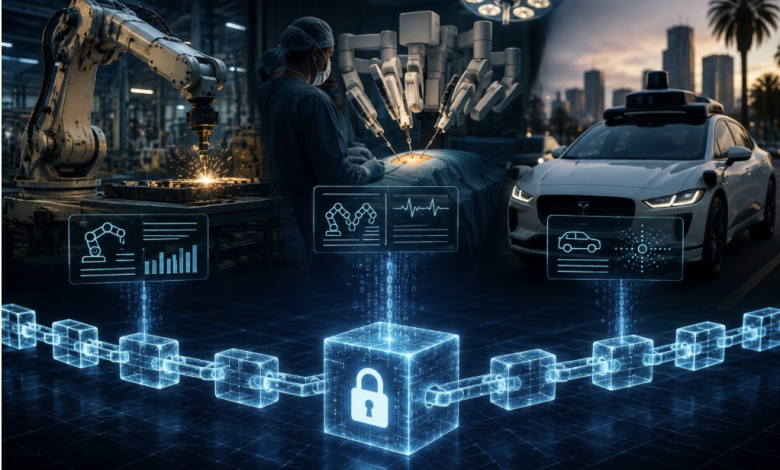
A 2025 IEEE conference paper on tamper-evident sensors and a 2026 framework for sensor data provenance published in the journal Information, talk about the same pattern. Generate a cryptographic fingerprint of the data at the moment the sensor captures an observation, then anchor that fingerprint with a timestamp and device identity to a ledger that no single participant controls. The raw data that holds all the observations never leaves the operator and only the proof does.
An Evidence Layer, Not A Bigger Database
Terabytes of LiDAR (light detection and ranging) and video stay exactly where they are as blockchain serves as a neutral anchoring point, a place where a hash of an observation can be recorded such that no operator, vendor or regulator can quietly rewrite it later.
The role for blockchain is narrower: creating a shared, independently verifiable record that no single operator can unilaterally rewrite. This matters when machine-generated data is used by multiple organizations that do not necessarily trust one another or share the same incentives. A private database can show what an operator says happened, but it cannot provide the same independent assurance to everyone else.
For example, an autonomous truck may record the moment a shipment changes hands, with the shipper, carrier and insurer all relying on that record. A cryptographic fingerprint of the observation can be timestamped on a blockchain, allowing each party to verify that the data they are shown matches what was originally recorded, without putting the underlying data on-chain.
I believe that within five years, insurers, auditors and regulators will treat unverifiable machine logs much like they treat unaudited financial statements; usable, but subject to far greater scrutiny. A company buying an industrial robot won’t end with comparing payload, range or model performance. Businesses will also need confidence that the data it generates can be trusted if it’s ever questioned by an insurer or regulators.
An anchored record cannot prove that a sensor was right, but it can eliminate the question of whether the evidence was altered after the fact and narrow disputes to what the machine actually observed. Provenance is not truth; it only proves the record wasn’t changed.