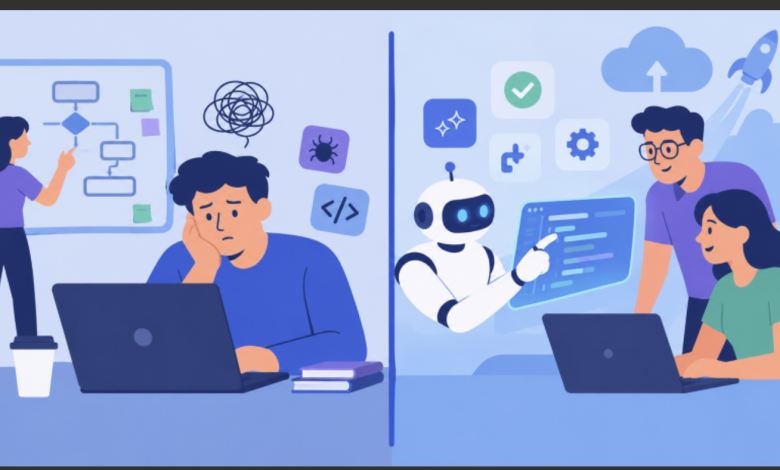
At Google Cloud Next, Sundar Pichai shared that over 75% of new code at Google is now generated by AI systems before human engineers review and refine it. The point is, the number was 25% just 18 months prior. The shift is already visible beyond engineering teams. Recently, one of our product managers at Udora built a fully functional internal admin panel using nothing but AI coding tools. It wasn’t a design masterpiece, but it solved a real operational problem, took just a few days to launch, and didn’t burn a single hour of the engineering team’s time.
It’s just a drop in the ocean that still highlights a structural shift in software engineering. Before, the relationship between business strategy and software engineering was defined by a strict resource constraint: product teams brought ideas to the table and software engineers converted them into a functioning code. Today, generative tools are removing the need for traditional programming syntax, shifting the focus toward knowing what systems to trust, how to prompt and review right, and why soft skills matter most.
Product engineer: From driving features to building full products
As the line between product and engineering blurs, product managers now use AI to build prototypes, dashboards, and internal tools themselves. This frees up engineering cycles to focus on advanced issues and polishing results.
This change gives rise to the product engineer: a hybrid professional who understands business objectives and independently builds functional solutions using AI. For startups, AI-assisted development is a huge opportunity as it makes it so much easier for different teams to validate more product ideas faster without overloading the engineering department. At the same time, as developers spend less time writing raw code, the real value comes from the ability to frame the right problem and evaluate technical outputs. That’s a real paradox of an AI era: hard coding skills aren’t dead, but they take a backseat to good judgment – knowing how to frame a problem, pick the right approach, and spot when the AI gets it wrong.
Software engineer: From writing code to building the harness
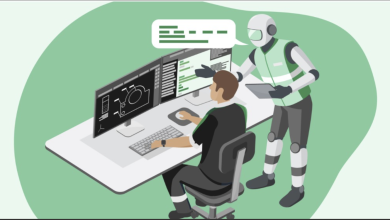
Gartner forecasts that 60% of all new software code will be AI-generated by the end of 2026. Once non-technical team members can generate code, the primary responsibility of the software engineer becomes building the environment in which others – both teams and AI agents – can build software safely.
In engineering, such a structure is known as a harness. A harness consists of system architecture, secure repositories, development pipelines, automated security guardrails, and AI agents that dictate what can and cannot be executed within the codebase.
Spotify developed an internal AI agent Honk that works with codebases, runs test suites, fixes linting errors, and opens pull requests without constant developer intervention. In the first 9 months since the drop off, it merged over 1,500 pull requests, saving 60% to 90% of engineering time during large-scale code migrations.
AI product manager: Building software for yourselves
Vibe coding changed the flow businesses have and the way engineers do their duties. Now, companies can build specific internal solutions tailored to a single process, team, or department. At Udora, we are already experimenting with this by building a sandbox where non-technical staff learn how to use AI tools to solve their daily operational friction.
Here comes a request for a new skill set: professionals who understand both business processes and AI capabilities, allowing them to spot whether a problem can be solved with the right vibe coding or there’s a need to invest in a new software solution.
Picture a 20-person department where every employee burns two hours a week on a repetitive task. Automating that single workflow reclaims 40 hours a week – effectively giving the company an entire full-time employee back without adding headcount.
It’s not about replacing major enterprise platforms. Instead, companies are surrounding their core software with a layer of fast, low-cost internal tools built directly by process owners.
AI-Augmented QA: Moving past manual testing
When developers generate code faster, quality assurance quickly becomes the next serious issue. In the traditional setup, QA teams get a build and then test it to catch bugs. But as the volume of code and frequency of releases explode, it isn’t that wise to hire more manual testers.
So, the role of a QA is also undergoing a change. Instead of manually grinding through test cases, QA engineers are building environments where AI agents execute and maintain those tests automatically. Meanwhile, team members focus on high-level system oversight: determining what actually needs to be tested, evaluating overall system reliability, and handling edge cases that require human judgment.
The end of the technical knowledge monopoly
These shifts won’t affect all technical roles equally. The heaviest pressure falls on positions centered around applying a narrow set of technical rules to repetitive tasks. Maintaining legacy systems written in older languages like COBOL or FORTRAN is a prime example. Businesses used to keep rare legacy experts just because replacing them was nearly impossible. Today, AI helps to work with older codebases thus reducing the necessity to hire narrow specialists.
Specialization isn’t dying, but the knowledge monopoly that once protected these niche roles is over. Research from the Stanford Digital Economy Lab shows that AI excels at base knowledge as standard syntax and textbook algorithms. For now, sheer value of senior engineers comes from the real-world experience and bold ideas of navigating messy, complex production systems.
The price of speed: Why AI doesn’t erase engineering rules
The most dangerous mistake leaders can make is confusing the speed of building a prototype with the speed of shipping production-ready software.
A study by METR found that professionals using AI tools took 19% longer on complex tasks within mature codebases than they expected. While later experiments showed signs of speedups, METR highlighted major measurement challenges: developers naturally shifted toward different tasks and resisted working without AI. While businesses can see an increased speed and volume of generated code, it’s getting more important to track feature reliability and the upkeep.
There is also the fundamental question of accountability. At Udora, our focus has shifted from “who wrote this code?” to “does this code meet our standard?” If a product manager builds an internal admin panel using AI, that tool can go into production on the exact same terms as developer code: it must hit company standards for architecture, security, and maintainability.
The engineer isn’t disappearing but their monopoly on code is. Microsoft’s CTO predicts that 95% of software code will be AI-generated within five years. But it just means we’ll spend far less time typing out code line by line, and more learning and reviewing, building internal micro-tools, and keeping quality and security standards.