For the past few years, industrial AI has largely lived in pilot programs. Manufacturers ran proof-of-concept projects, tested vision systems on a single line, or experimented with predictive maintenance on a handful of machines. The results were often promising, but the impact stayed contained.
That phase is ending. Manufacturing organizations are now asking a different question: not “does this work,” but “how do we rebuild our workflows around it.” This shift from experimentation to execution marks the real beginning of industrial AI’s impact on the shop floor and in the engineering office alike.
Why Execution Looks Different Than Experimentation
Execution requires investment and no small amount of risk. It requires touching core workflows in sourcing, engineering, and production planning that dozens of people depend on every day, that directly impact a company’s ability to deliver for their customers. If it fails, or the returns don’t manifest as projected, people and product and the business itself are on the line.
That means industrial AI’s next phase, rather than finding more use cases, is about redesigning the workflows those use cases sit inside of, so AI-generated insights actually change what people do next. A forecast that nobody acts on has no value, no matter how accurate it is. Execution means closing that loop between insight and action.
This is a structural challenge, not a technical one. Engineering, sourcing, and manufacturing teams often operate on different systems, timelines, and incentives. Redesigning workflows around AI means getting those functions to agree on shared data, shared definitions, and shared accountability for outcomes.
The Opportunity Hiding in Plain Sight
When people picture AI in manufacturing, they tend to picture robots on an assembly line or generative design tools sketching new parts. Those applications are real, but they aren’t where the biggest near-term opportunity lies. The bigger opportunity is in the processes nobody sees.
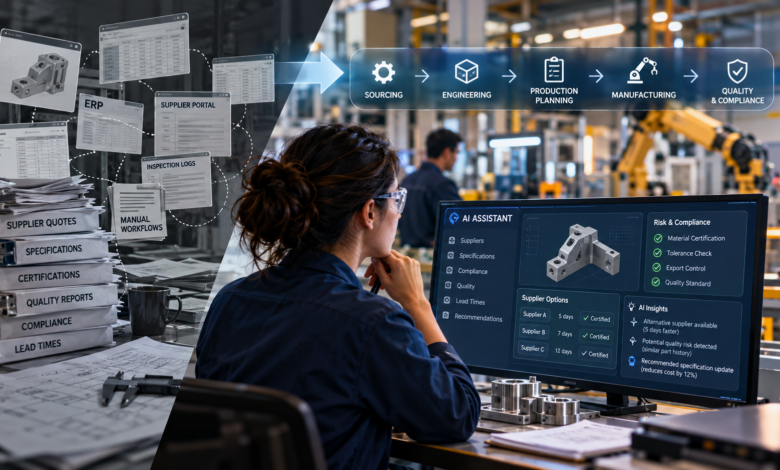
Sourcing a component involves comparing supplier quotes, checking certifications, validating lead times, and reconciling specifications across teams. Quality documentation involves compiling inspection reports, tracing nonconformances, and cross-referencing standards. These processes rarely show up in a product demo, but they consume enormous amounts of skilled labor.
AI applied to this kind of work doesn’t produce a flashy output, it produces hours back. A sourcing engineer who no longer spends a day reconciling spec sheets can spend that day negotiating better terms or qualifying a second supplier. That’s where industrial AI’s return shows up first: not in a single dramatic capability, but in the compounding effect of removed friction across dozens of unglamorous processes.
Manufacturing organizations that focus only on the visible, headline-grabbing use cases risk missing where the actual efficiency gains are sitting. The unseen middle of the process, the paperwork, the reconciliation, the back and forth between systems, is often the most automatable and the least automated.
Industrial AI Is a Different Discipline Than Consumer AI
It’s tempting to treat industrial AI as a variation on consumer AI: same underlying models, just pointed at a factory instead of a chatbot. That framing undersells how different the two environments really are, and following it leads to underestimating the difficulty of deployment.
Consumer AI tools tolerate a wrong answer. A bad movie recommendation costs nothing. A bad output in a manufacturing environment can mean a scrapped part, a missed compliance requirement, or a safety issue on the floor. The tolerance for error is fundamentally lower, and that changes how a system needs to be validated before it touches real operations.
Industrial data is also messier and more fragmented than most consumer data. It lives across CAD files, ERP systems, supplier portals, inspection logs, and paper travelers that have never been digitized. Getting that data into a usable, structured form is frequently harder than building the AI model that will eventually use it.
Finally, industrial environments carry physical and regulatory constraints that consumer software simply doesn’t. A recommendation engine doesn’t need to account for material certifications, tolerance stacks, or export controls. An industrial AI system does. Deploying AI well in this context means designing for these constraints from the start, not retrofitting them after the fact.
Building AI Around People, Not Instead of Them
The most common misconception about industrial AI is that its purpose is to remove people from the process. In practice, the more durable and successful deployments do the opposite: they remove the repetitive parts of a job so people can spend more time on the parts that actually require judgment.
Engineers didn’t get into manufacturing to reformat spreadsheets or manually cross-check part numbers against a supplier catalog. They got into it to solve hard problems: designing for manufacturability, troubleshooting a process that’s drifting out of tolerance, finding a smarter way to source a difficult component. That work requires experience, intuition, and context that AI systems don’t have and shouldn’t pretend to have.
A people-first approach to industrial AI treats automation as a way to protect time for that higher-value work, not as a replacement for the people doing it. When a system flags a likely quality issue instead of an engineer manually reviewing hundreds of records, that engineer isn’t being replaced. They’re being handed a shorter list of things that actually deserve their attention.
This distinction matters for adoption as much as it matters for outcomes. Manufacturing teams have understandably grown skeptical of technology pitched as a labor-saving measure in the sense of headcount reduction. Technology pitched as a way to give skilled people more time for skilled work tends to earn a very different reception, and it tends to actually get used.
What This Means for the Next Phase
The organizations that succeed in this next phase of industrial AI will be the ones that treat it as an operating model change, not a tooling upgrade. That means redesigning workflows so AI-generated insight leads directly to action, rather than adding another dashboard nobody checks.
It means looking past the obvious, visible applications and investing in the unseen processes, like sourcing, documentation, and quality, where friction is highest and least visible from the outside. It means recognizing that industrial environments demand a different standard of reliability and data readiness than consumer applications, and building accordingly.
Most importantly, it means keeping the goal in view: giving engineers and manufacturing teams more room for the judgment and problem-solving that only they can provide. Industrial AI’s next chapter won’t be defined by which company deploys the flashiest model. It will be defined by which companies rebuild their workflows thoughtfully enough that the technology actually earns a permanent place in how work gets done.