Three years into the AI boom, and most biopharma companies can point to a pilot. At the same time, far fewer can point to a function that works differently because of one. Medical and commercial teams have tested AI on reviews and field briefings, and plenty of those tests went well.
The more difficult challenge has been turning a promising experiment into the way hundreds of people do their jobs, in an industry where every claim needs a source and every slide may face regulatory review. The companies that have made that leap sit, for the most part, outside the industry.
Biopharma, as an industry, is not short on ambition or budget. For instance Deloitte’s 2026 Life Sciences Outlook, which surveyed biopharma and medtech executives this past year, found that only 22% say they have successfully scaled AI and just 9% report significant returns.
Additionally, KPMG’s Global Tech Report 2026 on life sciences, drawn from 124 technology leaders at biotech companies, found 44% describing limited maturity in how they fund, support or scale AI and automation.
The broader economy, at this time, is further along.
A view from the other side
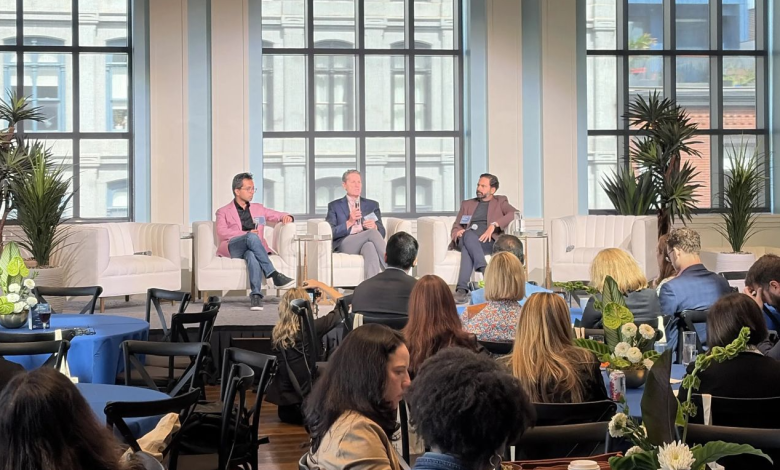
That idea anchored a conversation at Articulate 2026, Prezent’s invitation-only summit on AI and scientific communication, held at the Museum of the American Revolution in Philadelphia. About 150 senior leaders from across life sciences attended.

In a session titled “Intelligence from the Other Side: What Biopharma Can Learn from Tech,” Prezent CEO Rajat Mishra sat down with Steven Birdsall, Chief Revenue Officer at Alteryx, and Anupam Rastogi, Managing Partner at Emergent Ventures, to discuss how technology companies made AI work in practice.
Mishra’s own summary afterward was blunt. The most useful lessons about AI, he argued, will come from businesses that have already integrated it at scale.
Where they started
McKinsey’s State of AI 2026, based on 1,719 respondents surveyed, found 44% of organizations now scaling AI across the enterprise, up from 38% a year earlier. Only 6% qualify as high performers that attribute at least 5% of EBIT to AI. That small group, much of it in technology, is where biopharma’s most useful lessons may come from.
The consulting firm’s clearest finding about the 6% concerns where they began. Nearly three-quarters of high performers have fundamentally redesigned workflows around AI, against roughly a quarter of everyone else. Tech companies that made AI stick tended to pick a single process with an owner, a steady volume of repeat work and a measurable output, then rebuilt that process around the tool.
Biopharma has plenty of candidates. A medical science liaison preparing for a meeting with a key opinion leader, or a brand team assembling a slide deck that has to clear medical, legal and regulatory review, both work inside a repeatable workflow where hours disappear into formatting, version control and re-checking claims against approved sources.
Starting there gives a company something specific to redesign and a baseline to beat.
How they brought teams along
The second lesson concerns people. Another session on the Articulate agenda took on where AI meets hesitation inside biopharma, and that hesitation is rational. A field medical team trained for years to avoid off-label statements has good reason to be wary of a new system.
Tech companies that scaled AI did not wave that kind of concern away. They made adoption visible from the top and gave teams a clear sense of what the human still owns.
McKinsey ties high performance to senior leadership commitment alongside workflow redesign, and that commitment carries more weight in an industry where a single misstatement can end up in a warning letter.
None of this means biopharma should copy Silicon Valley wholesale. Mishra’s takeaway was to adopt AI with the same focus tech companies brought to it while protecting the trust and rigor the industry depends on.
Physicians, regulators and patients extend credibility to pharma communications because those materials are reviewed, sourced and accountable. An AI program that weakens that chain costs more than it saves.
The encouraging part is that the two goals point the same way. A redesigned workflow with clear human checkpoints is easier to audit than an ad-hoc one, and a metric tied to approved output rewards accuracy as much as speed.