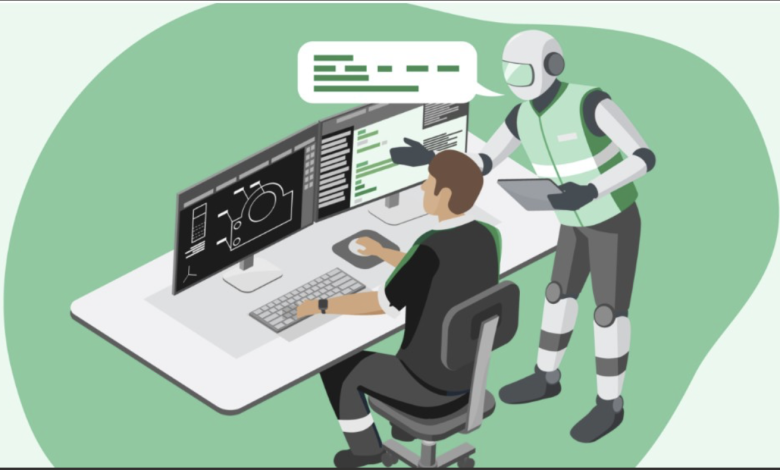
“Vibe coding” has quickly become one of the most polarizing trends in software development, completely redefining what it means to work in the field. You have groups of people who fear that by continuing to integrate AI into workflows, engineers become replaceable. Then you have the opposing argument: that AI makes engineering ten times easier, enabling quicker, seamless software development and allowing different professions to learn valuable skill sets they wouldn’t otherwise have access to.
The main issue with this discussion?
It’s being approached through such a black-and-white lens. Is AI good or bad for software engineering? Does it enable us to be more valuable, or take our jobs entirely? And at least from my point of view, like most things in life, the answer lies in the grey area.
How software roles are shifting
This new paradigm is transforming the role of engineers, from a day-to-day driven by writing code line by line to supervising and validating AI-generated systems.
Vibe coding is forcing organizations to reconsider the value software engineering brings. Recently, Gartner predicted that 60% of organizations will adopt smaller software engineering teams by 2029, up from this year’s 15%, as AI boosts developer productivity and reshapes how software gets built. But replacing software engineering roles with automation is jumping the gun entirely; companies are placing their faith in technology that still regularly produces subtle errors and security risks only experienced engineers can identify.
AI doesn’t reduce the need for experienced workers; it challenges them to tap into new skills. A recent example is IKEA introducing its AI chatbot, Billie, to automate customer service inquiries, increasing its in-house customer happiness score by nearly 30%. Rather than lay off thousands of call center workers, IKEA retrained these professionals to work as interior design sales advisors, navigating more complicated and personalized customer inquiries.
Similarly, this next phase of engineering is demanding senior engineers to increasingly act as “guardians” of architecture and correctness in AI-augmented environments, increasing their value and making their communication more critical. AI can generate initial code quickly, but this is only half of the battle. If software is being generated faster than it can be maintained and validated, operating models can’t support it, creating an increasing need for software engineers who can oversee the AI code. Within thousands of lines of code that seem correct can lie severe security vulnerabilities and unexplored edge cases.
You might be asking yourself: If AI can spit out the code, how come it can’t also maintain it, weeding out the need for human oversight? AI has limited understanding of an organization’s broader architecture. Given this, it doesn’t have the judgment skills to determine whether a shortcut it suggests today will blow up in the organization’s face in a couple of months. It also doesn’t have the historical background on why past design decisions were made, inhibiting its ability to use deliberate company choices to inform its code.
If organizations are increasingly laying off engineers with the expertise to spot these issues, errors with AI code will begin to compound in systems, building costly technical debt most startups won’t be prepared to bear.
Shifting skill expectations for entry-level engineers
Software engineering has now become less about how accurately and quickly you can code on your own, and more about how you can leverage AI to maximize code output. This is significantly altering hiring expectations for junior engineers now entering the workforce.
Junior engineers shouldn’t assume AI eliminates entry-level opportunities, despite how tech roles have specifically been impacted by layoffs these past few years. It’s about proving you can implement AI into your coding responsibly, evolving with the industry to get on board with AI integration, while showing how your judgment and validation skills can be valuable.
This includes understanding which prompts will effectively simulate accurate AI coding, recognizing when the code the LLM shared is inaccurate, and, if so, what follow-up questions to provide to ensure the next output is right.
There is a greater need for creativity, along with critical thinking, and as obvious as it sounds, even just seeing a candidate who is enthusiastic about using AI and willing to evolve with the technology is a huge competitive advantage over someone with more impressive technical skills on paper.
Enabling coding skills beyond software roles
Aside from the need for more validators, there are huge positives to vibe coding, the leading one being how it democratizes an otherwise very technical set of skills. Vibe coding lowers barriers to initial product development, encouraging departments beyond engineering to acquire these skills and help get prototypes up and running faster. Now, non-traditional builders like product managers, designers, founders, domain experts, and more can contribute.
This means product managers can prototype features before engineering even needs to get involved, designers can validate ideas faster, and ultimately, for smaller teams, a viable product can be made for early customers without requiring a full engineering team immediately. In the end, this reduces the need for early-stage financial backing to reach customers, eliminating the urgency in raising large funding rounds and enabling more startups to scale and enter production faster.
How automation can empower versus replace
Vibe coding isn’t as simple as being good or bad; it both accelerates software creation and democratizes coding, while creating a need for more guardrails and judgment only experienced engineers can provide. Instead of organizations viewing maturing AI capabilities as grounds for laying off software engineers, it is increasingly vital to realize automation is an opportunity to transition these professionals into higher-skilled roles that correct against AI’s shortcomings.
Regardless of how much AI improves over the next few years, there will always be blind spots LLMs are unable to correct without the human perspective. This requires a level of human oversight over the technology that will continue to evolve as it matures.
Similar to the .com boom, there will always be a new emerging technology that completely rewires our lifestyles. But just as we learned to integrate the internet and phones into our lives without eliminating human expertise, we can’t look to AI as the be-all and end-all, reducing the importance of human collaboration and intervention.
The organizations that see long-term success with vibe coding won’t be the ones who view AI as a means to cut their engineering teams in half for a short-term profit. It will be those that reassess the engineering skills required to validate and maintain AI-generated code, building and investing in teams who can improve these systems and are eager to evolve alongside the technology, not resist it.