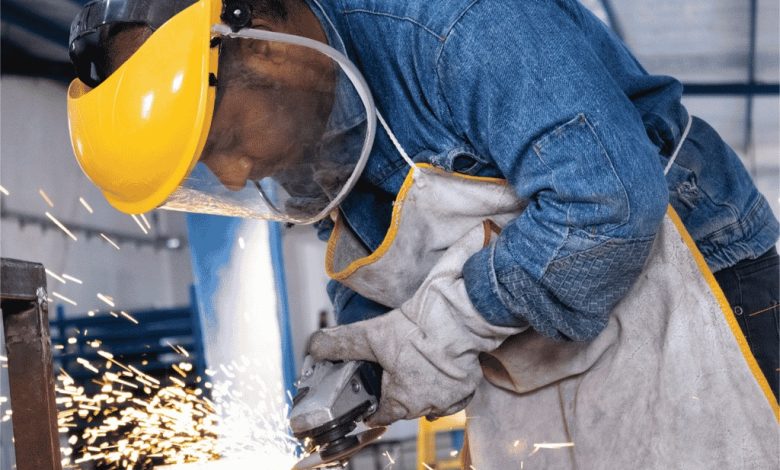
When a worker develops a musculoskeletal injury, the conversation almost always turns to what the worker did. Lift with your knees, not your back. Keep the load close to your body, or feet flat on the floor. Every one of those instructions puts the responsibility on the person doing the job as if the injury were proof they had done something wrong.
For many jobs, that simply isn’t true. There are tasks that will injure a healthy, careful, well-trained worker no matter how perfectly they move, because the job itself was never engineered for a human body. You can coach posture all day; if a task requires a shoulder held above a certain angle for a certain number of repetitions, the damage is only a matter of time.
That distinction matters, because it decides where the solution lives. The goal isn’t a worker who moves more “correctly.” It’s a job re-engineered so that doing it correctly doesn’t hurt them in the first place.
An $18 billion problem that builds up in silence
Musculoskeletal disorders – the injuries to joints, tendons, muscles, nerves, and the back that accumulate over months and years of repetitive work – are the largest category of workplace injury by cost, running roughly $18 billion a year in direct and indirect expense to U.S. employers. They rarely announce themselves. A worker feels an ache, assumes it’s part of the job, and keeps going until the damage is permanent.
The scale behind the “which body part” question is easy to underestimate. Bureau of Labor Statistics data on work-related musculoskeletal disorders show tens of thousands of cases involving the neck, shoulder and wrist each year. Every one of them is an indication of how many workplace tasks could have been assessed and redesigned before it did harm.
The real reason this problem has persisted
So why hasn’t it been? The honest answer is arithmetic. Preventing these injuries requires an ergonomic assessment, a trained evaluation of a task that finds where the body is being overloaded and how to redesign the work so it isn’t. A single large manufacturing plant can require thousands of these assessments a year, and across the country, the demand for these assessments far exceeds the number of trained ergonomists available to perform them.
The conclusion is unavoidable. There is no budget large enough to put a certified expert in front of every high-risk task in the country. Manual, expert-only assessment cannot scale to the size of the problem, and for decades, that left employers with two choices: absorb the risk, or find another way.
This is the specific gap AI was built to close. Not because it is “transformative” in the abstract, but because it is the only way to bring expert-grade assessment to a volume of work no human workforce could ever cover.
It’s telling that in the 2026 EHS 360 Benchmark Report, 44% of EHS professionals identified AI and automation as the most transformative force shaping their field over the next two years, a figure that rises to 52% among respondents at companies with more than $500 million in annual revenue. They are the ones living the scalability problem every day.
Why “AI-powered” is easier to claim than to earn
Solving it well is harder than it looks, and this is where a lot of “AI-powered” claims come apart. Assessing ergonomic risk from a video means finding the precise location of a worker’s joints in every frame, measuring the angles between them, and applying decades of ergonomic science to turn those angles into risk. The difficulty is entirely in the details:
- The right joints, not the convenient ones. Many off-the-shelf motion-capture models – built by large technology companies for general use, not for ergonomics – don’t track all the points an assessment actually needs. Measuring neck rotation, for example, requires capturing the plane of the shoulders and the plane of the head; miss those points and the angle simply cannot be calculated. Shoulder rotation and the side-to-side deviation of the wrist are among the most consistently missing and among the most injury-relevant.
- Three dimensions, not two. A single camera flattens the world. An elbow bent to a true 90 degrees can read as 40 degrees from the wrong vantage point, quietly understating real risk. Credible assessment has to reconstruct movement in three dimensions, not two.
- Motion and force, not just snapshots. How fast a joint moves, and how hard a worker is gripping or pushing, are central to injury risk – and both are far harder to capture than a still pose.
- The cause, not just a score. Knowing a shoulder is at high risk helps no one until you know why. Is it the weight of the object, or the posture the task forces on the worker? The two demand completely different fixes. An assessment that stops at “this is risky” hasn’t finished the job; the point is to name the cause, prescribe the change, and confirm the redesign actually brought the risk down.
The hardest frontier is the hand. Grip-intensive work – the repeated gripping, pinching, and wrist deviation behind conditions like carpal tunnel – has long been the least measurable and the most overlooked, because whole-body angle assessment can’t see what the hand is doing. It is also some of the most damaging work there is. Closing that gap is where much of the field’s recent progress has gone.
Engineer the job, don’t surveil the worker
One line is worth drawing clearly, because this technology can cut two ways. Assessing a task means recording a worker performing it once, so the job can be redesigned. That is a fundamentally different thing from mounting a camera to watch workers continuously for what they are doing “wrong.”
The first re-engineers the work; the second revives the very mindset, “blame the worker,” that the field should be leaving behind. The purpose of the technology is to fix the job, not to monitor the person.
Why general-purpose AI isn’t the shortcut
It is tempting to assume the newest general-purpose AI models can now do all of this out of the box, but they can’t. Well, not yet, and not for the parts that matter most. General models are designed to do thousands of things acceptably in order to serve the largest possible audience; capturing ergonomics-grade joint angles or identifying grip types is a narrow, specialized problem they were never built for.
In safety-critical work, “acceptable most of the time” is the wrong standard, because the small fraction that gets wrong is a worker who gets hurt. The value comes from models built deliberately for the specific task, as well as from the human expertise encoded into them.
The point
None of this removes the professional from the work. It does the opposite: it takes the judgment of a scarce expert and extends it to a scale that expert could never reach alone, and it frees the safety professionals we do have from manual data collection to spend their time where it counts – redesigning the work itself.
The goal was never smarter software. It is a worker whose job was built so their body doesn’t pay for it – who finishes a career without the slow, avoidable injuries we have spent far too long accepting as the cost of the work. We finally have the tools to get there. It’s time to stop asking workers to carry a problem that was never theirs to fix.