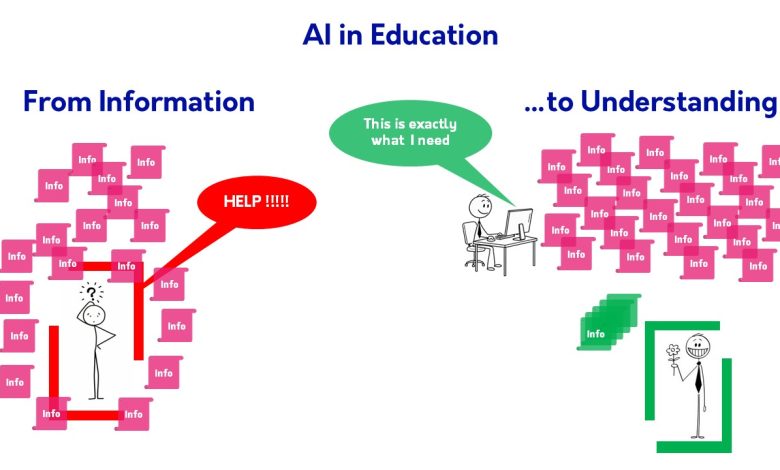
Information has never been more accessible. The internet, search engines, social media and generative AI give students and educators access to an extraordinary amount of knowledge, often within seconds.
Yet access to information and understanding are not the same thing.
Finding reliable information, checking it, organizing it and putting it into context can take considerable time. As AI makes information retrieval faster, the challenge for education is increasingly shifting from finding information to making sense of it.
AI can solve one problem while creating another
Generative AI has transformed how we search for answers. A student can ask a question and receive an explanation almost instantly, rather than navigating through dozens of search results.
That is a significant improvement in convenience, but it does not necessarily create a good learning experience. Individual AI responses can be fragmented, repetitive or disconnected from one another, leaving learners with information without a clear path for understanding the larger subject.
Education requires more than answers. Learners need context, connections between concepts, opportunities to explore a subject progressively and resources they can return to later.
This suggests an important next step for educational AI: moving from AI as an answer machine to AI as a learning organizer.
From searching to structured learning
Imagine a student wanting to understand Genghis Khan. A conventional search might produce thousands of results, while a generative AI system can quickly answer questions about his life and the Mongol Empire.
But a meaningful learning experience could go much further.
It could begin with the historical context, introduce Genghis Khan’s rise to power, explain military and political organization, explore the expansion of the Mongol Empire, examine economic and cultural consequences, and then introduce different historical interpretations.
The objective isn’t simply to generate more content. It is to organize information into a logical progression that helps the learner build understanding.
This approach can also make educational resources more adaptable. Instead of relying exclusively on broad textbooks designed for a large audience, educators and students could create focused resources around specific subjects, questions or levels of knowledge.
Personalization without abandoning judgment
AI also creates the possibility of making learning resources more personalized.
Different learners have different levels of background knowledge, interests and amounts of available time. Some prefer reading, while others absorb information more effectively through audio or interactive experiences.
AI can help adapt the format and depth of information to those different needs. It can also make it easier to create focused learning resources that can be saved, annotated, shared and revisited.
But personalization should not mean handing educational decisions entirely to an algorithm.
The quality of AI-generated content remains a fundamental concern. AI systems can produce inaccurate information, repeat misconceptions or present uncertain claims with unwarranted confidence.
UNESCO’s guidance on generative AI in education and research emphasizes the importance of a human-centered approach, including human agency, inclusion and responsible use.
Humans remain essential
The most productive debate about AI in education should not be whether AI will replace teachers. It should be about which parts of the learning process AI can improve while keeping human judgment at the center.
AI is exceptionally useful for searching large quantities of information, organizing material, identifying patterns and producing different versions of content.
Teachers and subject-matter experts provide something different: context, judgment, nuance and an understanding of the learner.
A teacher can recognize when a student is struggling despite giving the correct answer. They can challenge an assumption, introduce an unexpected perspective or connect an abstract concept to a student’s experience.
The goal should therefore be collaboration rather than substitution.
Start with the learning problem
For educators and companies developing AI-powered learning tools, one principle should come first: start with the learning problem, not the technology.
It is tempting to adopt every new AI capability. But innovation only creates educational value when it helps learners understand something more effectively, makes quality knowledge more accessible or frees educators to spend more time teaching.
Quality controls are equally important. AI-generated learning materials should be evaluated for accuracy, relevance, clarity, consistency and unnecessary repetition, particularly when addressing rapidly changing subjects.
The U.S. Department of Education’s Artificial Intelligence and the Future of Teaching and Learning similarly emphasizes responsible AI implementation and maintaining educators’ central role.
The opportunity ahead
The first wave of generative AI in education has largely been about access: ask a question and get an answer.
The next wave should be about understanding.
The most valuable educational AI systems may not be those capable of generating the most content. They may be the ones that help learners navigate the enormous amount of content already available, organize it into meaningful learning journeys and identify where deeper exploration is worthwhile.
AI can dramatically reduce the time spent searching, sorting and formatting information. The opportunity now is to use that capability responsibly to make learning more focused, accessible and adaptable—while recognizing that technology is a means, not the objective.
The ultimate measure of educational AI should not be how much information it can produce.
It should be how much more effectively people can understand, remember and apply knowledge.
About the Author
Eric Carmes is an entrepreneur, executive coach and technology leader with three decades of experience in innovation, business transformation and international growth. He is the Founder and CEO of Encyclo-AI, an EdTech company focused on helping individuals and businesses learn faster in a world overwhelmed by information.
Previously, Eric spent more than 20 years at 6WIND, which he co-founded, serving as COO and later CEO and leading its international expansion, technology partnerships, telecom licensing agreements and fundraising. He is also a Partner and Executive Coach at VISCONTI Partners and holds a degree in networks and telecommunications from CentraleSupélec.