Most AI visibility tools stop at the scoreboard. They can show that your brand is missing from an answer, but they still leave your team to work out which cited page matters, whether it is influenceable, who can get you on it, and how to prove the work got done. After working through the product, I think GetMentions AI is worth serious attention if what you need next is managed action, not one more reporting layer.
Quick Verdict
- Shortlist it if you already track a real prompt set and the bottleneck is acting on citation gaps.
- The strongest part is the closed loop from source analysis to managed insertions, editorial placements, and YouTube mentions.
- The main caveats are practical ones: standard plans include any 4 of 6 standard answer engines, not all 6, and placement pricing is quoted per opportunity.
- If your team wants to move from “we are missing here” to “request the placement now,” this is one of the more interesting products in the category.
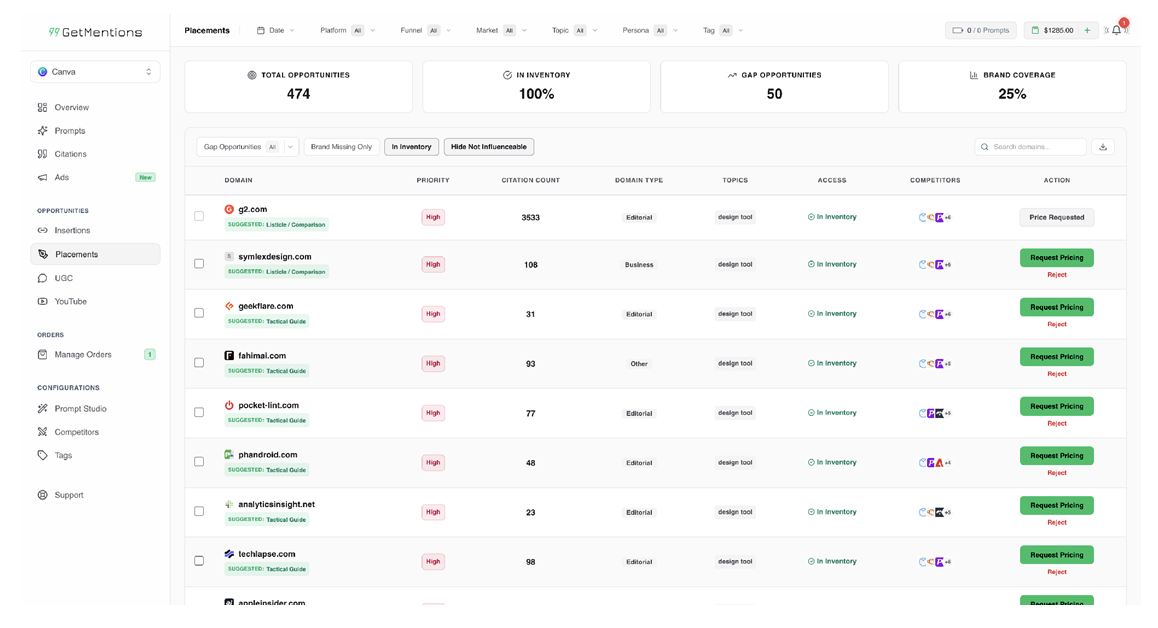
The screen that sold me was not the headline visibility chart. It was the stored answer view and the source-level gap list beside it. I could read the verbatim AI response, inspect the cited URLs behind it, filter to pages where the brand was missing, and move straight into an action flow. That is a real product difference.
What GetMentions AI Is, Really
GetMentions AI is an AI visibility platform that tracks how your brand appears across ChatGPT, Gemini, Google AI Mode, Google AI Overviews, Microsoft Copilot, and Perplexity, then opens up the cited domains, URLs, communities, and videos shaping those answers. It tracks visibility score, average rank, and sentiment, but the bigger story is the source layer underneath.
AI search is already an operating reality, not an experiment. An AP-NORC survey found that 60% of adults had used AI to search for information. Bain says about 80% of consumers rely on zero-click results in at least 40% of their searches, and a Pew Research Center study found links inside Google AI summaries were clicked in just 1% of visits. If you care about demand capture now, citation presence is not a side metric.
How It Handles Your Prompt Set
I started where most teams should start: with a real prompt set, not a blended market score. You point GetMentions AI at a domain and it proposes topics, buyer personas, competitors, and a starting prompt set. Before the first run, you can review and edit every part of that setup.
Good AI visibility tracking lives or dies on whether the tool can reflect your actual buying questions, not a vendor-defined view of the market.
If you already have a prompt library, you can import it by CSV. If you do not, the domain-led setup gets you moving quickly without locking you into it. Prompts can then be grouped by topic, persona, tag, and funnel stage, which makes a growing library much easier to manage.
I also like that the brand layer is not naive. Product names, legal names, abbreviations, and common misspellings can be tracked as one brand. For teams working across markets, the prompt structure also sits cleanly alongside country and language tracking, instead of treating international coverage like an afterthought.
Where The Product Becomes Different
Most tools can show you the answer. Fewer can turn the source layer into a worklist.
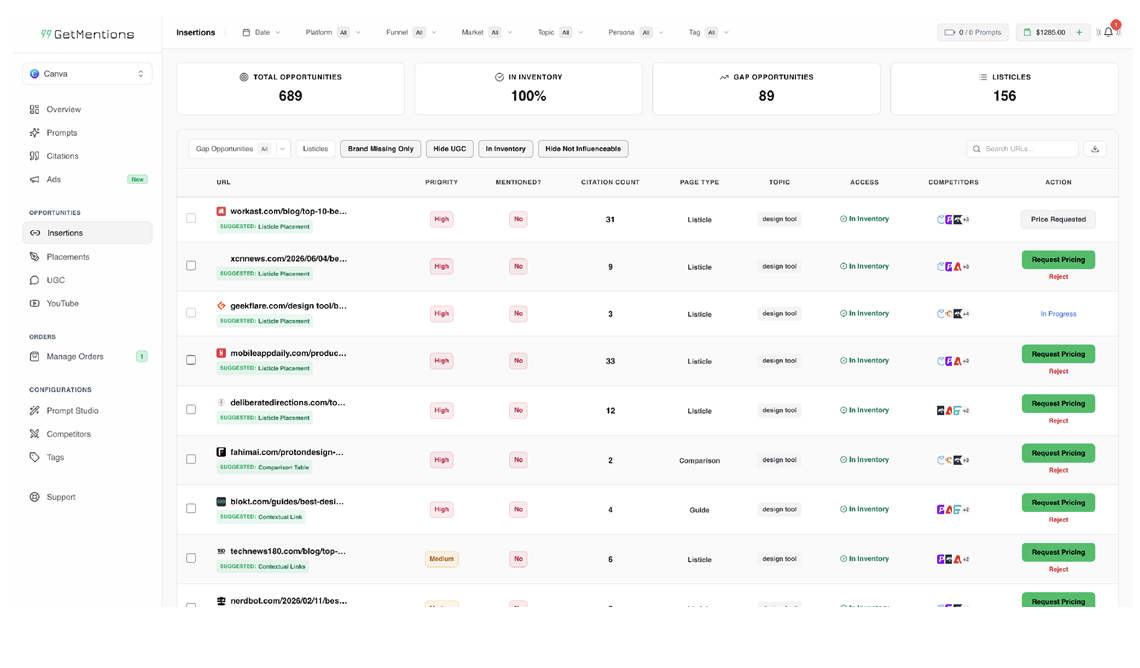
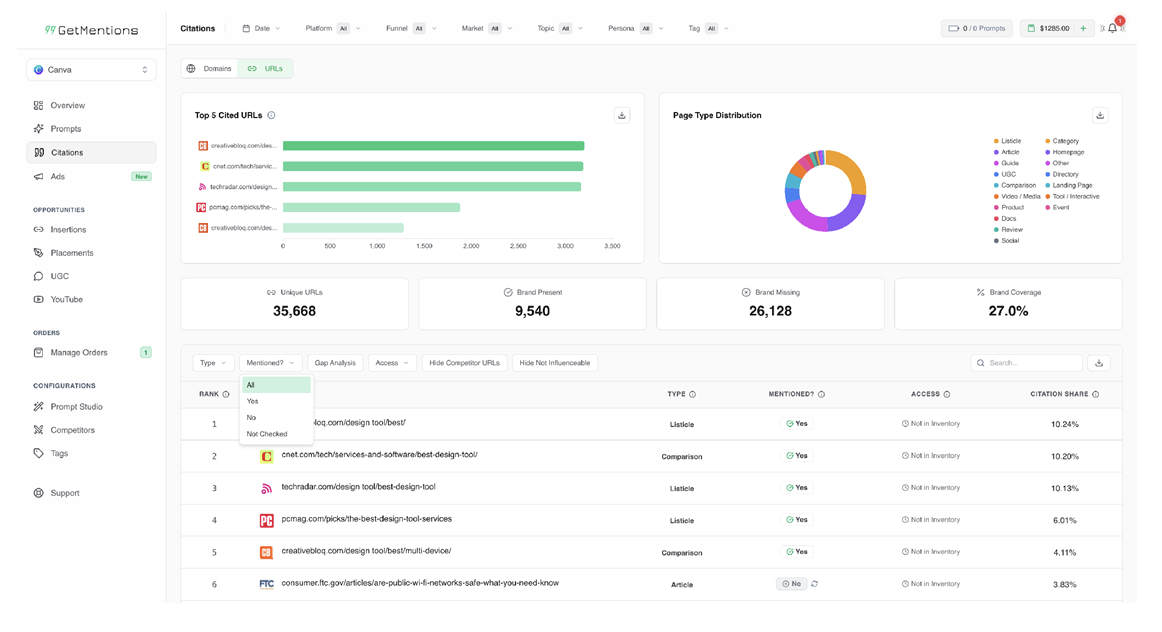
In GetMentions AI, I kept coming back to the citation view. It drops from domain level to URL level, shows whether the brand is present on each cited source, shows where competitors appear instead, and labels opportunities before you act on them. A source can be marked in-network, outreach-based, or not influenceable. That single distinction saves a lot of wasted effort.
If your team wants to request managed placements on AI-cited sources from the same screen that shows the gap, this is the reason to pay attention. The platform scores opportunities by citation velocity, funnel stage, competitor presence, and influenceability. In plain terms, it is trying to answer the only question that matters after monitoring: what should you act on first?
The supply side also has real weight behind it. Public materials put the execution network at more than 192,000 opportunities across websites and YouTube channels. That execution focus also makes more sense in context: GetMentions AI was founded by OutreachX founder Anirudh Agarwal, so publisher outreach and placement operations are part of the team’s existing background. The execution layer is a core product bet, not a services add-on taped to a dashboard.
Small percentages matter here. In one tracked account I analyzed, the platform identified influenceable opportunities across about 8% of cited sources. That sounds small until you think about how answer engines build responses. A common rule of thumb in this market is that roughly 70% of cited sources are effectively not influenceable at all. If you can move even 2% to 3% of the source layer on prompts that shape consideration, you are not just watching a score move. You are changing the evidence the model keeps finding.
What You Can Actually Request Through It
The Opportunities area splits into four surfaces, and each one is specific about what you are ordering:
- Existing-page insertions. Your brand added to pages already shaping AI answers: listicles, comparisons, reviews, guides, and resource pages. This is the most direct lever in the product, because the page is already being cited, so you are editing evidence the engines already read.
- Editorial placements. New content on relevant domains: guides, listicles, reviews, comparisons, and thought-leadership pieces. Slower than an insertion, but it builds citation surface you own a mention on from day one.
- YouTube mentions. Placements in reviews, top-list videos, comparisons, tutorials, and explainers, on channels AI answers already cite.
- UGC insights. Reddit, Quora, forums, and similar sources are tracked for insight only. There is no managed posting, outreach, or engagement here, and the product is upfront about that line.
This is not vague “outreach support.”
What stood out just as much is how much of the workflow stays inside the product. From the opportunities list, I could request pricing or outreach on a specific page or channel, review the offer, approve it, keep questions and guidelines attached to the order thread, and follow the job through production to a live URL or live video. Payment can run through a prepaid wallet, and each order includes an invoice.
For YouTube, the managed workflow goes further than a simple channel list. It covers creator communication, pricing, briefing, and coordination, which matches how the launch was described in Yahoo Finance. YouTube is not a decorative extra in AI search. Pew found Wikipedia, YouTube, and Reddit were the most frequently cited sources in the Google AI summaries it examined, together accounting for 15% of cited sources. Separately, the Reuters Institute found that 77% of people consume online news video each week, with YouTube used by 34% for news.
So yes, I think treating video as part of the source layer is the right call.
That UGC boundary is the fit question in miniature. If your strategy depends on managed UGC execution, this is not that product. If it depends on getting placed on the websites and channels already shaping AI answers, it is much closer.
Can You Trust The Data Enough To Act On It?
In this category, trust does not come from a polished score. It comes from receipts.
GetMentions AI stores the AI answer as written, not just a metric derived from it. It keeps the cited sources with that answer, shows citation share and brand coverage at source level, and lets you trigger a recheck after a placement goes live, so you do not have to wait for the next scheduled run to confirm that the brand mention appears on the page.
One answer is not a rank. AI systems retrieve, compare, and rewrite on every run. Google Search Central has said its generative search features are rooted in core ranking and quality systems, and that the system generates multiple related searches to gather more evidence. If a tool cannot show you the answer text and the source layer it captured, it is hard to defend any follow-on work.
GetMentions AI is strongest here when it stays close to the evidence. Read the saved answer. Inspect the cited page or video. Filter to what is missing. Recheck after action. That is a more defensible loop than treating AI visibility as one blended number.
GetMentions AI Pricing
As of August 2026, the public self-serve plans split every tier into weekly and daily refresh. Read both, because cadence changes price materially.
| Plan | Prompts | Brands | Markets | Weekly | Daily |
| Starter | 50 | 1 | 1 | $25/mo | $85/mo |
| Growth | 100 | 2 | 3 | $45/mo | $155/mo |
| Pro | 200 | 3 | 5 | $80/mo | $289/mo |
| Scale | 350 | 5 | 10 | $135/mo | $479/mo |
| Enterprise | Custom | Custom | Custom | Custom | Custom |
Three details matter if you are budgeting this:
- Every tier includes all features, unlimited users, and any 4 of the 6 standard platforms: ChatGPT, Gemini, Google AI Mode, Google AI Overviews, Microsoft Copilot, and Perplexity. Enterprise adds Claude, Grok, Llama, Mistral, Qwen, DeepSeek, and Kimi via API.
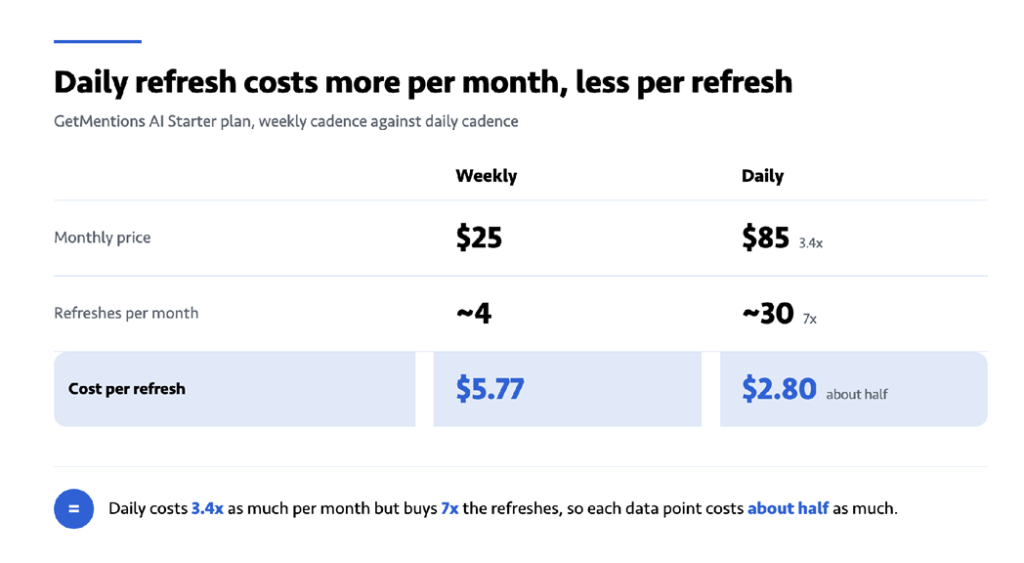
- Starter is $25 per month on weekly refresh or $85 per month on daily refresh. That is 3.4 times the monthly price for 7 times the refreshes, so daily works out to about 0.49 times the per-refresh cost.
- Insertions, editorial placements, and YouTube mentions are quoted per opportunity, so the software cost is public and the execution spend is separate.
| Cost layer | How it is priced |
| Core subscription | Public monthly price, everything included |
| Existing-page insertions | Quoted per opportunity |
| Editorial placements | Quoted per opportunity |
| YouTube mentions | Quoted per opportunity |
What GetMentions AI Does Well
Three strengths stand out:
- It closes the loop from stored answer to citation gap to request flow without pushing you back into CSV exports, email threads, and manual tracking.
- The source layer is operational. Brand-present and brand-missing filters, influenceability labels, order threads, wallet payment, invoices, and rechecks are the details that make the workflow usable after the demo.
- The team packaging is clean. Every plan includes unlimited users, and agency access supports view-only clients while strategists keep edit rights. The AI Ads Tracker adds a paid-answer layer next to the organic one, even with its narrower scope today.
GetMentions AI Limitations
The tradeoffs are clear:
- Standard plans include any 4 of the 6 standard platforms, not all six by default.
- Placement pricing is quoted per opportunity, so you cannot fully model insertion, editorial, or YouTube spend from the public site alone.
- The AI Ads Tracker covers ChatGPT today.
- UGC is insight only. There is no managed posting, outreach, or engagement on Reddit, Quora, forums, or similar sources.
- This is still a newer product. If you need public case studies or independent benchmark tests before a first conversation, the public proof layer is thin.
When To Use GetMentions AI
This is the right fit when:
- you already have a fixed prompt set and the hard part is acting on citation gaps
- you want one workspace for monitoring, source analysis, stakeholder access, and managed placements
- you need strategists and clients in the same system without per-seat friction
Wait if:
- you need every standard platform on day one without an add-on conversation
- most of your plan depends on managed UGC participation rather than websites, editorial placements, and YouTube
- you need published execution prices before a first conversation
Bottom Line
GetMentions AI is worth a serious look if your team has outgrown monitoring and needs a way to act on the source layer. You can inspect cited URLs, see whether they are influenceable, request managed insertions, editorial placements, or YouTube mentions, and then track the work to a live page or video without leaving the platform.
FAQ
Do standard plans include all six AI platforms?
No. Standard plans include any 4 of ChatGPT, Gemini, Google AI Mode, Google AI Overviews, Microsoft Copilot, and Perplexity. Enterprise adds seven more models by API: Claude, Grok, Llama, Mistral, Qwen, DeepSeek, and Kimi.
What am I paying for on the monthly plan versus per placement?
The monthly plan covers tracking, citation intelligence, the request and order workflow, UGC insights, the AI Ads Tracker, and unlimited users. Insertions, editorial placements, and YouTube mentions are quoted separately per opportunity.
Can I verify a placement before the next scheduled run?
Yes. Citation Intelligence includes a recheck function so you can confirm that a brand mention appears on the page after it goes live. That is useful when you do not want to wait for the next weekly or daily refresh.
Does the platform handle YouTube outreach or just show cited channels?
It handles the managed workflow for supported YouTube opportunities. That includes creator communication, pricing, briefing, coordination, and tracking through to a live video URL.
Is this a fit if my team works heavily through Reddit and Quora?
Only partly. The platform tracks Reddit, Quora, forums, and similar UGC sources for insight, but it does not provide posting, outreach, or engagement services there. It is a stronger fit when your action plan centers on websites, editorials, and YouTube.
Can agencies add clients without extra seat costs?
Yes. Every plan includes unlimited team members, and agency access includes view-only client seats while strategists keep edit rights. That makes it much easier to keep reporting and approvals in one place.