

How Inventor Vatsal Soin Governs AI Hallucination with Numbers 0 and 1: The 0→1 Doctrine
By Vatsal Soin
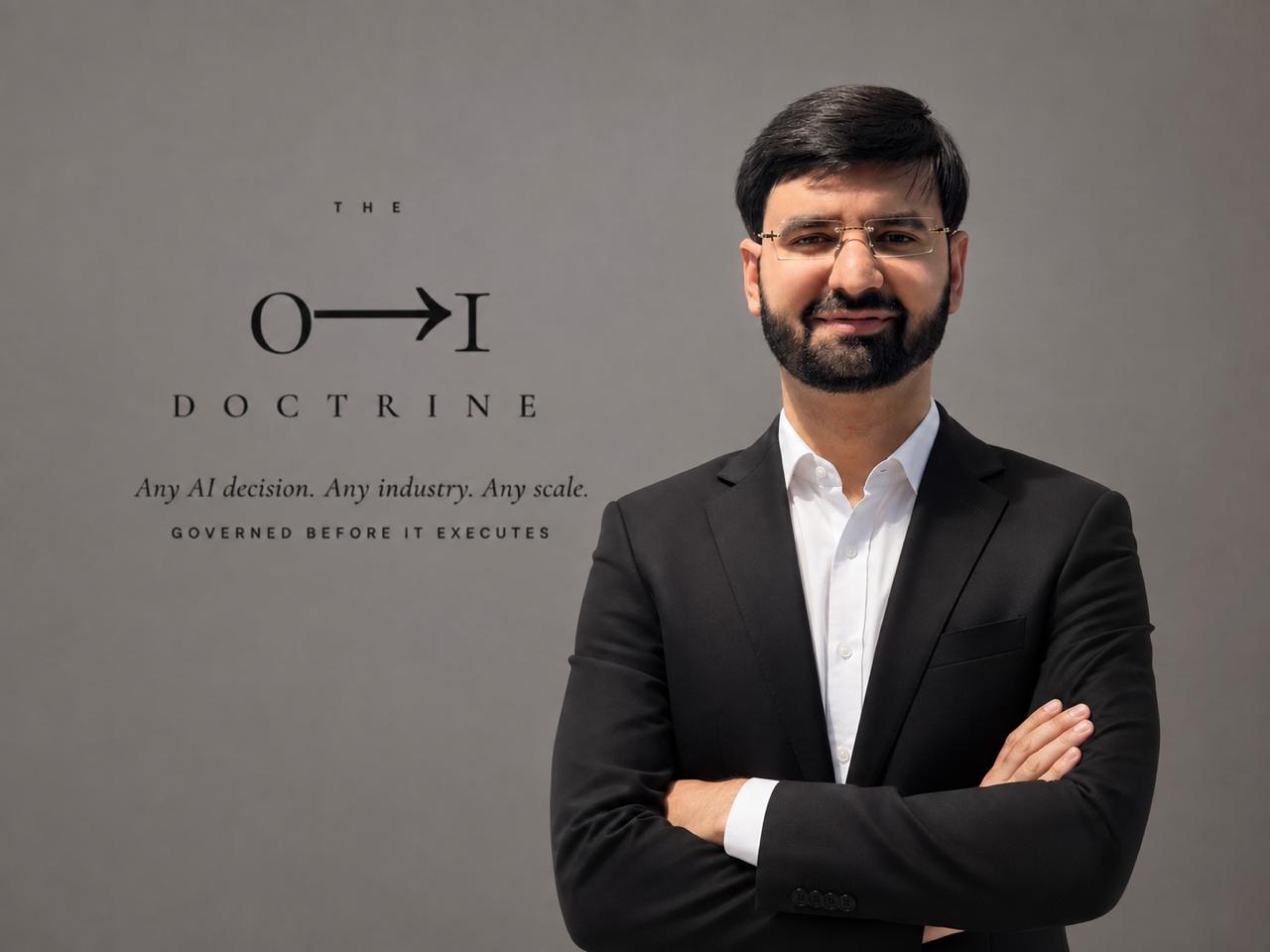
Before AGI, before Singularity resolves, hallucination remains the same unsolved failure at every scale, from one fact to an entire system. This invention answers with a Digital Lingua Franca — a common language every AI-proposed fact must speak: a value between 0 and 1, matched against a verified source, then checked before it reaches consequence, scaling across every product, service, and asset it governs.
Live: www.0to1doctrine.com
A national supreme court recently set aside two tribunal rulings after discovering they rested on court precedents that never existed. It is one domain among several where the same failure recurs at very different scales.
“A hallucination is confident because nothing checked it before it moved. That gap — not the AI’s reasoning — is what this invention closes.”
A confident model is still one that is 99 percent sure. This invention was never built to argue with the 99 — only to stand at the 1, watching for the exact moment a proposed fact tries to cross into a filing, a chart, or a ledger.
A PATTERN, NOT AN INCIDENT
In each case, the underlying claim was checkable. A citation either exists in a legal database or it does not. A source either matches a real publication or it does not. The failure was never a lack of ground truth — it was that nothing checked the claim against that truth before it was published, filed, or relied upon.
WHY MORE CAPABLE DOES NOT MEAN MORE HONEST
Independent benchmarking this year found frontier reasoning models hallucinating on direct factual questions at rates ranging from roughly one in five to nearly nineteen in twenty. Several newer, more capable models hallucinated at rates more than double their predecessors on the same test.
WHAT THIS INVENTION ACTUALLY CHECKS
The invention does not read an AI’s reasoning. It checks what the AI is proposing to be true.
This architecture does not attempt to detect a hallucination by analysing language, tone, or confidence. It takes the specific, checkable claim an AI is proposing — a citation, a source, a figure — normalises it to a value between 0 and 1, and compares it against a verified band before the claim becomes a filing, a payment, or a record.
The Human Oversight Pathway is the one place a hallucinated claim never fully resolves on its own. When a proposed fact cannot be matched to any verified index, it is not rejected by default and not approved by default — it is held, by name, for a person.
FIVE DOMAINS, BILLIONS AFFECTED
The same check, run across domains spanning billions of people — losses that scale with population, not headlines.
A legal citation proposed by an AI drafting tool cites a court ruling that does not exist — invented, complete with a plausible case name and date, normalising to [0.41, 0.47] against a verified case-law band of [0.55, 0.80].
No overlap. The citation was never real. Filing blocked before submission. PRAT, the Predictive Risk Advisory Token logs the event against this tool’s history — one fabricated citation is an incident; a rising rate across filings is the pattern PRAT is built to flag first, before it compounds.
A clinical note proposed by an AI medical scribe records a drug allergy the patient never reported — fabricated during transcription, normalising to [0.79, 0.86] against the verified patient-record band of [0.50, 0.77].
No overlap. The allergy does not exist in any prior chart entry. Note held before it enters the record. EMERGE, Emergent Meta-Environmental Response and Governance Envelope, watches whether this same fabrication recurs across other patients using the same tool — one invented allergy is an error; a correlated cluster is the earlier warning EMERGE exists to catch.
An aviation closure-rate reading proposed by an AI flight-operations assistant states a separation figure the radar never recorded — invented to fill a data gap, normalising to [0.83, 0.90] against the verified band of [0.50, 0.79].
No overlap. Radar shows no such reading. Clearance held before the gap becomes consequential.
An agrifood supply-chain report proposed by an AI logistics system cites a harvest yield from a region with no reporting station — a plausible number with no real source, normalising to [0.82, 0.89] against the verified band of [0.50, 0.78].
No overlap. No harvest data exists for that claim. Shipment held before resources move on a number nobody measured.
An insurance claims summary proposed by an AI underwriting assistant references a policy clause that was never written — invented to justify a payout, normalising to [0.81, 0.87] against the verified band of [0.50, 0.78].
No overlap. The clause does not exist in the actual policy. Payout held. PRAT tracks whether this invented-clause pattern recurs across other claims from the same model — one case is an error; a repeating shape is drift PRAT surfaces early.
WHAT THIS DOES NOT CLAIM
This does not claim to read an AI’s mind or guarantee hallucination never occurs — only that a specific claim matches a verified source, or it does not, resolved every time.
Catching every falsehood would be unverifiable; catching specific claims is smaller, and confirmable.
BEFORE AGI, BEFORE SINGULARITY
None of this depends on how the debate over AGI or a coming Singularity eventually resolves. The check does not get smarter as the proposing system gets smarter, and it does not need to — it was never trying to out-think the system, only to verify what it proposed.
WHAT CAPITAL IS ACTUALLY PRICING
These are old risks, produced faster than human review was built to catch. The cost was never the hallucination — it was the gap before someone noticed.
That gap is what capital prices. Checking claims first prices differently than only responding fast afterward.
The EU AI Act now requires documented risk controls for these decisions.
“AI hallucinates. Losses compile day by day into billions, likely more in the coming era of AGI and beyond. The answer sits at the origin of counting itself — 0 and 1.”
Live: www.0to1doctrine.com
This can be tested, live, via API, governed against ungoverned, side by side.
THE INVENTOR
Vatsal Soin is a serial inventor with patent filings across six continents, spanning multiple domains — grants in the US, India, Japan, and South Africa. An alumnus of Nanyang Technological University, Singapore. His latest grant, as recent as August 14, 2026, introduces an AI-powered footwear system and Global Sharable Size Card invention.
Selected References
Granted: US Patent 12,446,652 B2 · Japan Patent 7560909 · India Patents 454081 and 599317 · Filed: PCT/IN2025/051943 · US 19/489,595 · India 202511115781 · Australia AU2022450649
DISCLAIMER: Informational only. Not certified. No endorsement implied. Not investment advice. Examples and band values are illustrative. Vatsal Soin · © 2026 All Rights Reserved.

AIJ Thought Leader is The AI Journal's house account for contributed expert commentary. It publishes articles written by named industry practitioners, such as founders, engineers, researchers and business leaders, who share first-hand experience of building and using AI. Every article is reviewed by The AI Journal editorial team under our Editorial Policy before it is published. Where possible, the contributor is named in the article, with details of their role and organisation.
More from AIJ Thought Leader
See all AI & Technology
AI could move healthcare from reacting to disease to preventing it
 AI & Technology
The Need for Hybrid Version Control: Ensuring Stability as Human–AI Systems Evolve
 AI & Technology
Competitor Ads Analysis in the AI Era: How DTC Brands Read Their Rivals’ Ads
 AI & Technology
Are You Ready for AI or is it FOMO?
Recommended for you
More stories AI & Technology
AI coding tools without company context cost businesses thousands of engineering hours to fix, new report finds
 AI & Technology
Marketers expect AI to do twice as much of their work by 2028. The ones who are ready are already pulling ahead
 Agentic
What Property Management Reveals About the Next Phase of Agentic AI
 Cyber Security
Team8 Takes Its Village Playbook From Cybersecurity to AI Infrastructure With the Infra Village
 AI & Technology
Open-Source Medical AI Reaches Production Scale: What Ant Group’s LingSante Release Means for Health System Leaders
 Future of AI