AI detection is now a regular step in workflows it never touched previously – academic submissions, editorial review, content audits, hiring pipelines. The tools that handle this have become much more capable, but not all of them have become more accurate.
This article takes a look at the best AI content detection tools currently on the market. The tools do different things and demand different sorts of explanation, thus each entry is structured accordingly. If you ever questioned what is the best AI detector for your specific workflow, it really depends on whether you require sentence level analysis, institutional integrations, fact-checking or just a fast free check.
1. GPTZero
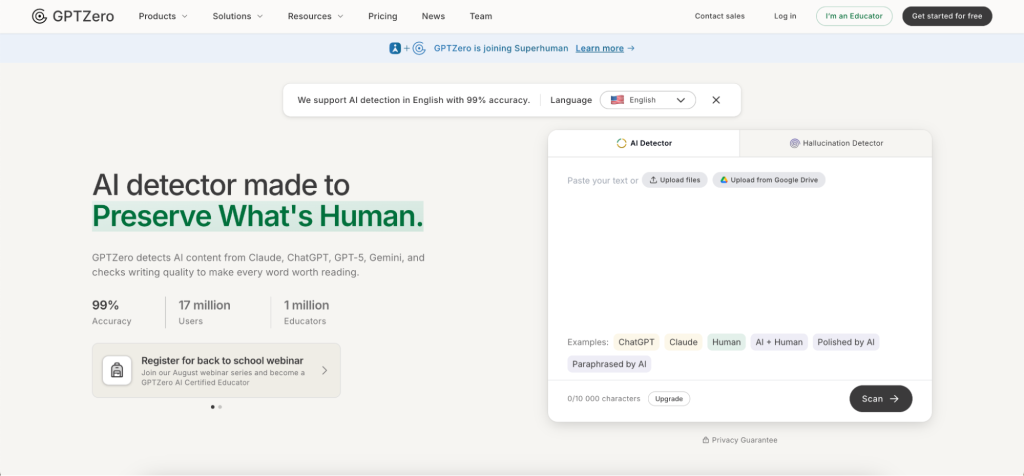
Originally focused on academic work, GPTZero has grown into a broader broad-based writing review tool. As a best chatgpt detector alternative it looks for output from main models – GPT-4, Claude, Gemini, and others – and provides a sentence-level analysis rather than simply a single aggregate score.
Key points:
- Individual sentence AI scoring, paragraph-by-paragraph breakdown
- Hallucination Detector Flags Potentially Factually Wrong Claims
- Institutional submissions authorship verification
- Integrations with Canvas, Google Docs and Zapier
- Free tier limited to a number of monthly scans; educational programs from $10/mo
One of the primary limitations is the possibility of AI detector false positive results on organised academic writing. Especially writers of English, who are not native speakers, may perceive flags on pure human texts. A most reliable AI checker choice for academic purposes, but not the best for ESL cases.
2. Getsolved
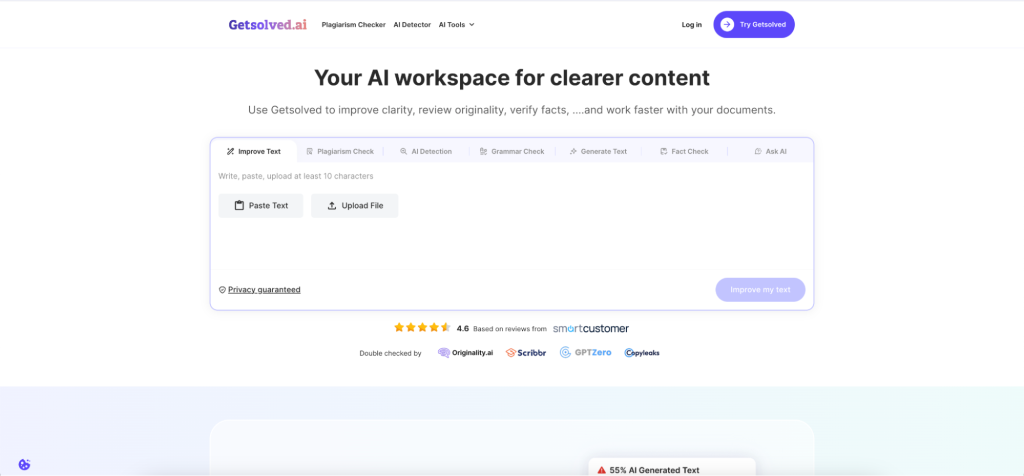
Most AI detection tools accomplish one thing. Getsolved is based on a distinct premise: testing for AI content, fact checking, plagiarism checking, and paraphrasing for clarity are all part of the same editorial workflow.
The detection side parses the sentence structure, meaning pattern and probability distribution of the complete document. Users who want to scan text for AI at getsolved.ai get a percentage score plus highlighted passages that give enough detail to understand why some sections were detected and not just that they were. The fact-checker checks statements against authoritative sources at the same time, which is important for research papers where both correctness and originality need to be checked. Paraphrasing is in the same environment, thus altering marked areas isn’t a matter of moving platforms.
Free Tier is available. Paid plans increase usage limitations and allow batch processing.
| What it includes | Available on free plan |
| AI detection using sentence-level highlights | Yes |
| Plagiarism detection | Yes |
| Fact check | Yes |
| Paraphrasing tool | Yes |
| Large document processing | Paid only |
3. Copyleaks
Copyleaks supports more languages than other AI text detection tool options in this category (over 30), and the sentence-by-sentence reporting is more granular than the aggregate scores most competitors default to. It’s an originality AI alternative that incorporates both source matching and AI detection, which might come in handy when an institution is reviewing your text and documentation matters.
Advantages:
- Institutional submission workflows with LMS integration
- 25,000 characters free no login required
- API for custom tool builds
- Supported in 30+ languages
Disadvantages:
- Paraphrased AI text detection isn’t as strong as core accuracy metrics would suggest
- Scalable pricing for high-volume institutional use
Best AI detection tool for schools and agencies who need detection within existing workflows rather than a standalone checker.
4. Grammarly AI Detector
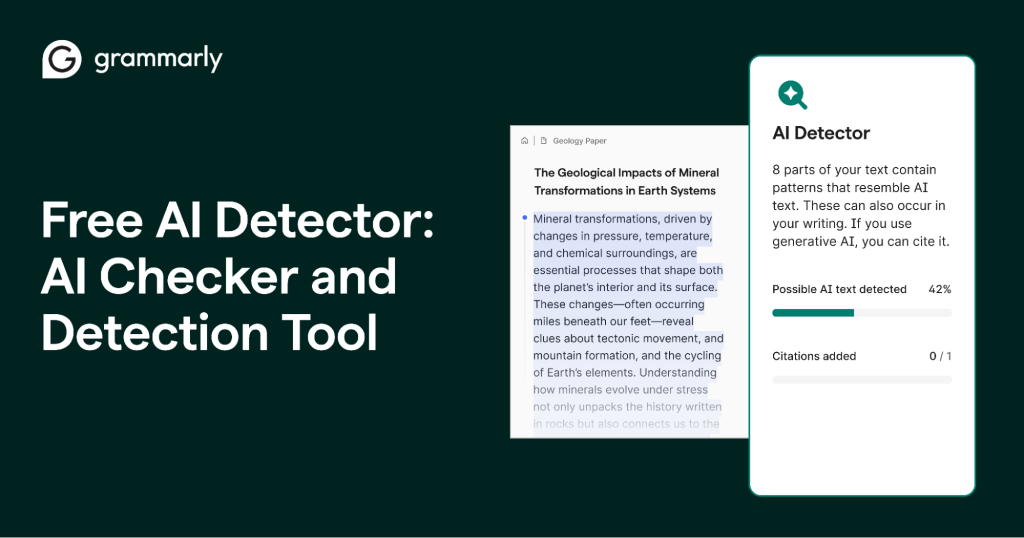
The same platform that corrects grammar and rewrites your text is where Grammarly’s detecting power lives. The best AI checker output provides a percentage score with lower AI detector false positive rates than previous generation tools and flagged text can be edited on the spot with the built-in rewriter – no export, no tab switching.
If you’re already in the Grammarly ecosystem, this is the least friction-filled alternative. The authoring feature and plagiarism detection are extra value without any further setup. The catch: AI detection is available only on paid Grammarly plans. For users who just need occasional detection, the expense of a complete subscription to get access to one service may not make sense.
Not the most specialised best AI content detector for research-grade work. A convenient choice for everyday writing routines.
5. QuillBot AI Detector
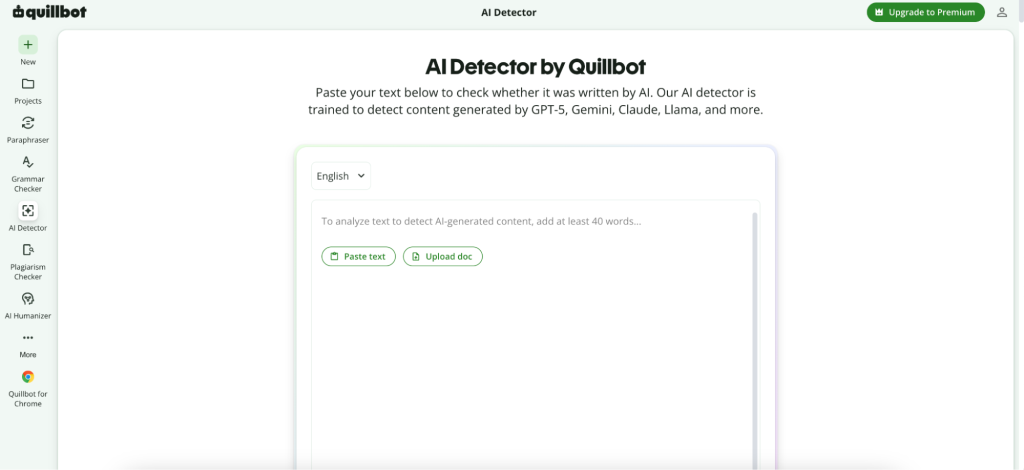
QuillBot’s approach is simple: paste some text, get a score from 0-100, view an explainer card explaining why the score came out the way it did. Privacy-first design ensures that the text you enter is not retained or used for training.
Free. No account needed. Multilingual. Reports for download on the premium plan.
Hard to beat as a best free ai detector for rapid individual checks. Accuracy applies to pure AI-generated content, but sections that are mixed human-AI and substantially paraphrased text are more difficult – this is true across the category, but QuillBot proves it more than certain alternatives. For institutional or high stakes assessment, something with more in-depth contextual analysis is worth the price.
6. Winston AI
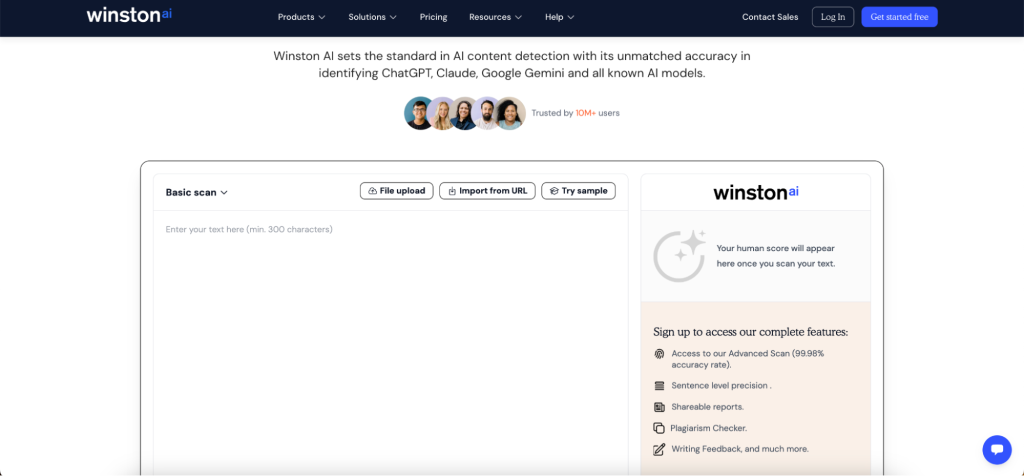
Do chatgpt detectors work consistently? Winston is one of the strongest cases they can. It stakes its claim to accuracy – a higher reported detection rate for pure AI-generated material in the industry. The AI prediction map shows which portions were assessed AI-generated vs. human-written, which makes it easier to find individual passages rather than interpret a total score.
Top use cases:
- Educators reviewing student contributions at scale
- Content agencies that require auditable, reportable results
- Teams which employ paraphrased content detection alongside normal AI checks
File upload, URL import, plagiarism detection, Chrome plugin and Google Classroom connection provided. Individual plans start at roughly $18 a month. The pricing builds up for heavy users – the cost model is more geared towards teams than personal needs with varying monthly needs.
7. Scribbr
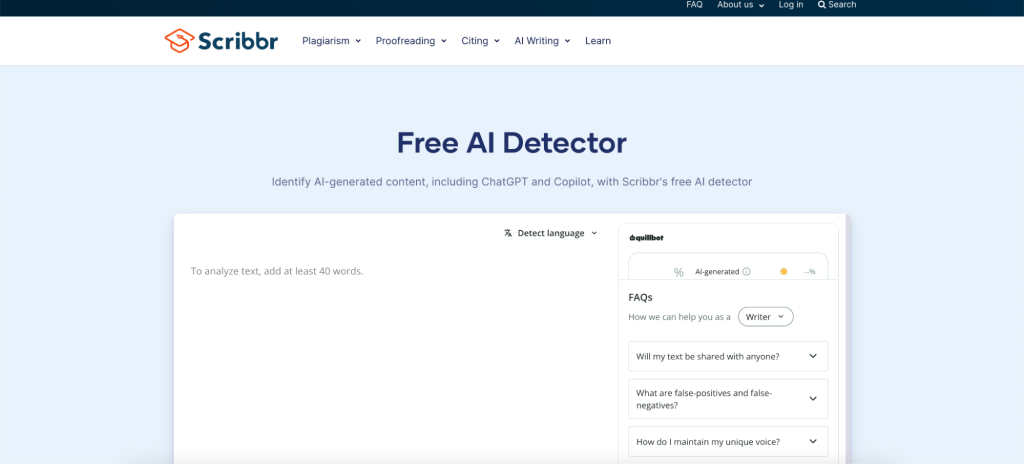
Free, no sign up, confidential. That mix makes Scribbr the most user-friendly free AI content detection tool on this list.
The output distinguishes between human written, AI authored and AI honed writing – a useful distinction that not all top AI detectors make. It gives you paragraph-level comments on what needs attention. There is no saving of submissions and the free version has no word restrictions.
What it doesn’t have: API access, LMS integrations, advanced reporting, or institutional implementation. That doesn’t matter to students who are checking their own work before they submit it.
8. Pangram Labs
Boasting a 99.98% accuracy rate verified by researchers at the University of Maryland and the University of Chicago, Pangram Labs is widely regarded as one of the most reliable AI detectors for academic and professional use. It prioritizes transparency by providing interpretability features that highlight exactly which sections of a document were likely generated by AI, rather than just providing a binary score.
- Multi-Modal Detection: Capable of scanning both text (including ChatGPT, Claude, and Gemini) and AI-generated images.
- Academic Integration: Built for institutional use with direct integrations for Canvas, Moodle, and Google Classroom.
- Data Privacy: Ensures that submitted content is never used for model training, maintaining strict confidentiality.
- Sentence-Level Analysis: Offers granular scoring and authorship verification tools for detailed reporting.
Best for: Universities and enterprises requiring third-party verified accuracy and data privacy.
Pangram Labs offers a free tier with 2,000 words per day. Premium individual plans start at $20 per month, with custom institutional licensing available for schools and districts.
Comparison of the Tools
| Tool | Free Plan | Sentence-Level | Plagiarism | Fact-Check | Best For |
| GPTZero | Limited | Yes | Yes | No | Academic review |
| Getsolved | Yes | Yes | Yes | Yes | Students, researchers |
| Copyleaks | Yes (limited) | Yes | Yes | No | Institutions, multilingual |
| Grammarly | Paid only | Yes | Yes | No | Everyday writing |
| QuillBot | Yes | Yes | No | No | Fast free checks |
| Winston AI | Trial | Yes | Yes | No | Educators, agencies |
| Scribbr | Yes | Yes | No | No | Individual students |
FAQ
What is the best AI detector for students? The best ai detector for students is Getsolved – brings together detection, plagiarism and fact-checking all in one location. Scribbr is the greatest 100% free solution that doesn’t require an account.
How accurate are chatgpt detectors in practice? Most chatgpt detection tools fare well on unedited AI output. The most difficult ones are paraphrased material, blended human-AI writing, and ESL content. Expect good results on clean generated text. Be careful with anything borderline.
Which ai detector is best for institutions? The strongest LMS integrations and institutional reporting are found in GPTZero and Copyleaks. Winston AI is something to consider for agencies doing mass checks.
Do these tools save my text? QuillBot and Scribbr do not keep contributed text. For unpublished or sensitive work, please review the privacy policy of any platform you submit to.
How do ai checkers check for ai content? Most look at ambiguity, burstiness, token likelihood and sentence rhythm – patterns that statistically differ between human-written and AI-written text. The most accurate AI detector tools use several signals, not just one metric.
Last Verdict
For single students: Scribbr or Getsolved. For ESL authors who desire fast results: QuillBot. For institutional evaluation by educators: GPTZero or Copyleaks. For content teams requiring auditable outputs: Winston AI. If you’re currently using Grammarly for writing, the easiest addition is the built-in detector.
The best AI detectors are the ones that work for you today, not the ones that claim the highest accuracy rate on their own webpage.