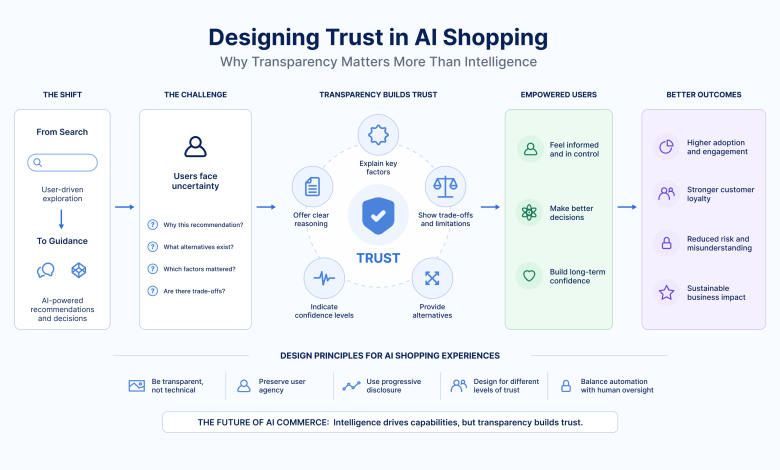
Artificial intelligence is rapidly transforming how consumers discover, evaluate, and purchase products online. Search bars are evolving into conversational assistants. Product recommendations are becoming increasingly personalized. In some cases, AI is even making decisions on behalf of users.
As organizations race to build more intelligent shopping experiences, many discussions focus on model performance, recommendation accuracy, and automation capabilities. While these advancements are important, a more fundamental challenge is emerging: trust.
The future success of AI-powered commerce may depend less on how intelligent systems become and more on whether users understand, trust, and feel comfortable interacting with them.
The Shift from Search to Guidance
Traditional e-commerce platforms have historically relied on user-driven exploration. Consumers entered keywords, applied filters, compared products, and made their own decisions.
AI changes this relationship.
Instead of simply responding to a query, AI systems increasingly act as guides. They summarize options, explain trade-offs, recommend products, and generate personalized suggestions. In some scenarios, AI can complete tasks that previously required multiple searches and comparisons.
This shift reduces effort and saves time. However, it also introduces a new challenge: users may not fully understand how recommendations are generated.
When consumers cannot determine why a recommendation appears, confidence can quickly decline.
Intelligence Alone Does Not Create Trust
Many organizations assume that more accurate AI systems naturally lead to greater user trust. In practice, the relationship is more complicated.
Research across human-computer interaction has consistently shown that users evaluate technology based on both performance and transparency. A highly accurate recommendation may still be rejected if users perceive it as unpredictable or difficult to understand.
Consider a common shopping scenario. A user asks an AI assistant to recommend a laptop for remote work. The system provides a single recommendation without explaining its reasoning.
Even if the recommendation is objectively correct, users may hesitate because important questions remain unanswered:
- Why was this option selected?
- What alternatives were considered?
- Which requirements influenced the recommendation?
- Are there trade-offs that should be considered?
Trust emerges when users can understand the decision-making process, not simply the outcome.
Transparency Reduces Uncertainty
Transparency does not require exposing complex machine learning models or technical details. Instead, it involves communicating enough information for users to feel informed and in control.
Effective AI shopping experiences often provide context such as:
- Key factors influencing recommendations
- Product strengths and limitations
- Alternative options for different priorities
- Confidence levels when information is uncertain
This approach allows users to participate in the decision rather than passively accept it.
Importantly, transparency can also improve user satisfaction when recommendations are imperfect. People are generally more forgiving of mistakes when they understand how and why they occur.
The Growing Importance of User Agency
One of the most overlooked aspects of AI design is user agency.
As AI systems become increasingly capable, there is a temptation to automate larger portions of the customer journey. While automation can improve efficiency, excessive automation may create discomfort.
Consumers often want assistance, not replacement.
Successful AI experiences preserve meaningful opportunities for users to explore alternatives, adjust preferences, and make final decisions themselves. Rather than removing human involvement, effective systems augment human judgment.
Designers should view AI as a collaborative partner rather than a substitute decision-maker.
Building Confidence Through Progressive Disclosure
Not every user requires the same level of explanation.
Some consumers want quick recommendations and minimal details. Others prefer deeper insight before making a purchase.
Progressive disclosure offers an effective solution. AI systems can present concise recommendations initially while allowing users to access additional reasoning when desired.
This design approach keeps interfaces simple while supporting users who seek greater transparency.
The result is a more flexible experience that accommodates different levels of trust, expertise, and decision-making styles.
The Future of AI Commerce
AI will continue to reshape digital commerce in profound ways. Conversational interfaces, multimodal search, personalized discovery, and autonomous purchasing agents are likely to become increasingly common.
As these technologies mature, competitive advantage will extend beyond model capability alone.
Organizations that focus exclusively on intelligence risk overlooking a critical component of adoption. Consumers must not only receive useful recommendations; they must also feel confident in the systems providing them.
The most successful AI-powered shopping experiences will be those that balance intelligence with transparency, automation with user control, and efficiency with trust.
In the years ahead, trust may become the defining design challenge of AI commerce. Companies that solve it effectively will be better positioned to create experiences that users not only use, butgenuinely rely upon.