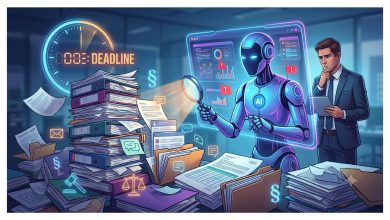
Everyone is talking about AI, and while there is plenty of substance in its transformative potential, it is equally important to avoid the hype bubble.
I see AI as a major inflection point in the organisational landscape – and therefore a crossroads moment for leaders.
As leaders today, we face a fundamental choice: to think of it as a means to reduce human cost and improve organisational efficiency. Or, to see it as a way to amplify the effectiveness and long-term legacy of our organisations.
I would suggest being careful with the former, even though it is powering the short-term business cases of many AI Labs. We have all seen examples of where human connection has been eliminated through the desire to automate too much and too fast. A simple example is my (now former) co-working space that tried to harness AI to automate a new pricing rollout. I was double-charged, subject to confusing pricing information, and therefore subject to some embarrassing moments entering the workspace as a result. I am no longer a customer.
The other approach is to really focus on effectiveness. In the many leadership teams I support, I often see a similar trend: an Executive Assistant who has enormous potential and could have significantly more impact across the organisation. Can AI help them refocus their time from primarily supporting the CEO with administrative tasks to helping the whole leadership team become more effective and focused on the long-term? There is still a human driving the relational aspects, while AI can help make process-driven tasks easier and more efficient.
OpenAI’s Sam Altman has recently admitted that the predictions of a job bloodbath are overblown. I would argue that that is a profoundly good thing in that it really keeps the relational and accountability elements of human leaders very much at the forefront.
As leaders, we also need to be careful about what psychologists call Cognitive Offloading – literally losing our ability to think deeply because we become over-reliant on AI. We are seeing early but strong signs of this risk playing out in education and in the early workforce, and the trend is not far from senior workforces either.
Use AI to organise things for you, do your research, help you refine your points, even harness it as a sparring partner (though I personally prefer a human one). But don’t use it to do your thinking for you. It won’t match yours in the way that you really mean it – and more importantly, it can weaken our own critical thinking and creativity “muscles”.
Leverage the time it frees up for you to invest in longer-term thinking and deep work around your company’s enduring future.
So, yes, AI represents a crossroads moment for leaders. Harness it to help you become a more effective leader and enable your team to achieve even more with your current resources. See it less as an opportunity to save costs and more as an opportunity to create an even greater impact on the world and build a more intentional legacy. And to free up your time so you can find the journey of being a leader more fulfilling in the process.