The global supply chain never sleeps and neither do the expectations placed on businesses that move goods from point A to point B. As customer demand for faster deliveries grows and operational complexity intensifies, companies across every sector are turning to purpose-built logistics software development services to stay competitive.
But not all logistics platforms are created equal. Whether you are an enterprise freight carrier, a mid-size 3PL provider, or a last-mile delivery startup, your software must be packed with capabilities that drive efficiency, visibility, and profitability. Choosing a platform that lacks the right features can cost you clients, compliance, and capital.
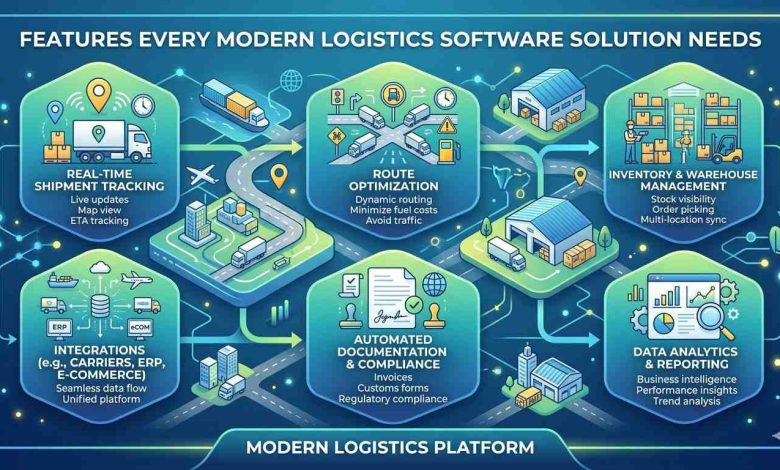
In this guide, we walk you through the 10 must-have features that every modern logistics software solution needs and why each one matters to your bottom line.
1. Real-Time Shipment Tracking and Visibility
In today’s on-demand economy, customers expect to know exactly where their shipment is at every moment. Real-time tracking is no longer a premium add-on; it is a baseline expectation for any serious logistics management software.
Why Real-Time Visibility Is Non-Negotiable
Modern logistics platforms must offer live GPS tracking, automated status updates, and multi-stop shipment visibility. This capability allows dispatchers to proactively address delays, reroute vehicles, and notify customers before issues escalate.
Key Capabilities to Look For
- Live GPS tracking for all fleet vehicles and shipments
- Event-triggered alerts for delays, exceptions, and delivery confirmations
- Customer-facing tracking portals for self-service visibility
- Integration with third-party carrier APIs for multi-modal tracking
2. Transportation Management System (TMS) Integration
A robust Transportation Management System (TMS) is the operational backbone of any modern logistics solution. It centralizes carrier selection, route planning, freight audit, and shipment execution into a single platform dramatically reducing manual effort and costly errors.
Core TMS Functions Every Logistics Platform Must Include
- Carrier rate comparison and freight cost optimization
- Load planning and consolidation tools
- Automated freight invoice auditing and payment
- Multi-modal transport management (road, air, ocean, rail)
- Compliance documentation and customs management
If your current system lacks native TMS capabilities, partnering with an experienced logistics software development company can help you build or integrate a custom TMS tailored to your operational model.
3. Warehouse Management System (WMS) Capabilities
Logistics operations do not begin and end on the road. Efficient warehouse operations are equally critical to your supply chain performance. A built-in or tightly integrated Warehouse Management System (WMS) ensures smooth coordination between inbound, outbound, and storage activities.
WMS Features That Drive Operational Efficiency
- Inventory tracking with barcode and RFID scanning
- Automated slotting and pick-path optimization
- Inbound and outbound dock scheduling
- Returns management and reverse logistics workflows
- Real-time inventory level monitoring and alerts
WMS and TMS Integration: The Power Combination
When WMS and TMS capabilities are integrated within a single logistics software solution, you achieve end-to-end supply chain visibility from receiving dock to customer doorstep. This integration eliminates data silos and accelerates order fulfillment cycles.
4. Route Optimization and Intelligent Dispatch
Fuel costs, driver hours, and customer delivery windows create a constant juggling act for logistics operators. Advanced route optimization within transportation and logistics software applies AI and machine learning algorithms to calculate the most efficient delivery sequences, reducing cost-per-mile and improving on-time delivery rates.
What Smart Route Optimization Delivers
- Dynamic rerouting based on real-time traffic and weather conditions
- Multi-stop route sequencing for maximum drop density
- Automated dispatch assignment based on driver availability and proximity
- Time-window compliance for priority deliveries
According to industry benchmarks, effective route optimization can reduce fuel consumption by up to 20% and improve driver productivity by 15% both of which directly impact profitability in high-volume logistics environments.
5. Fleet Management and Driver Performance Monitoring
Your fleet is one of your largest assets and operating costs. Modern logistics management software must include comprehensive fleet management tools that give you full control over vehicle health, compliance, and driver behaviour.
Essential Fleet Management Features
- Vehicle preventive maintenance scheduling and alerts
- Driver Hours of Service (HOS) compliance tracking
- Telematics integration for speed, idle time, and harsh braking reports
- Electronic Logging Device (ELD) compliance management
- Fuel consumption tracking and cost allocation per vehicle
Driver Safety and Coaching Tools
Beyond compliance, driver performance dashboards allow operations managers to identify risky driving patterns, reward top performers, and reduce insurance liability, all critical outcomes for any fleet-dependent logistics business.
6. Advanced Analytics and Business Intelligence Dashboards
Data is the new fuel of the logistics industry. Your transportation and logistics software must transform raw operational data into actionable intelligence through powerful analytics and customizable dashboards.
Analytics Capabilities That Create Competitive Advantage
- KPI dashboards for on-time delivery rates, cost-per-shipment, and carrier performance
- Predictive analytics for demand forecasting and capacity planning
- Financial reporting for freight spend analysis and budget variance
- Customer-level profitability reporting
- AI-driven anomaly detection for proactive issue resolution
Businesses that invest in data-driven logistics software development gain a significant advantage in identifying inefficiencies that manual reporting simply cannot detect fast enough.
7. API Integration and Third-Party Ecosystem Connectivity
Modern logistics operations rely on a diverse ecosystem of tools ERPs, CRMs, e-commerce platforms, customs systems, and carrier networks. Your logistics software must support open API architecture and pre-built integrations to connect seamlessly with your existing technology stack.
Critical Integration Points for Logistics Platforms
- ERP systems (SAP, Oracle, Microsoft Dynamics)
- E-commerce platforms (Shopify, WooCommerce, Magento)
- Carrier portals and freight marketplaces
- Customs and trade compliance platforms
- Payment gateways and freight invoice systems
For businesses looking to build a deeply integrated solution, understanding your logistics software development budget early in the project helps ensure you allocate resources for essential integrations without compromising core feature development.
8. Order Management and Customer Portal
Customer experience is increasingly a differentiator in the logistics industry. A self-service customer portal within your logistics software solution empowers clients to place orders, track shipments, download documents, and manage their account without requiring manual intervention from your team.
Must-Have Order Management Features
- Online order placement and freight quoting
- Automated booking confirmation and proof of delivery (POD)
- Document management bills of lading, customs forms, invoices
- Customer-specific rate management and contract pricing
- Dispute resolution and claims management workflows
Self-Service Portals: Reducing Customer Service Overhead
Companies that deploy self-service customer portals in their transportation and logistics software report a significant reduction in inbound customer service calls, allowing operations teams to focus on exceptions rather than routine status inquiries.
9. Compliance, Documentation, and Risk Management
The logistics industry is one of the most heavily regulated sectors globally. From Department of Transportation (DOT) compliance to international customs regulations and hazardous materials handling, your logistics management software must keep your business protected and audit-ready at all times.
Compliance Features Every Logistics Platform Needs
- Automated regulatory document generation (BOL, CMR, AWB)
- Dangerous goods classification and compliance checks
- Driver licensing and certification expiry tracking
- GDPR and data privacy compliance for customer data
- Insurance certificate management and renewal tracking
Risk Management and Supply Chain Resilience
Beyond day-to-day compliance, modern transportation and logistics software should include supply chain risk monitoring features identifying disruptions in carrier networks, weather events, geopolitical risks, and port congestion so your team can activate contingency plans before they impact customers.
10. Scalable Cloud Architecture and Mobile Accessibility
Finally, the best logistics software solution is one that grows with your business. Cloud-native architecture ensures that your platform can scale to handle increased shipment volumes, new geographic markets, and expanding customer bases without requiring costly infrastructure upgrades.
Why Cloud-First Logistics Software Wins
- Elastic scalability to manage peak season demand spikes
- Automatic updates and new feature rollouts without downtime
- Redundant infrastructure for high availability and disaster recovery
- Reduced upfront capital expenditure versus on-premise deployment
Mobile Apps: Empowering Drivers and Field Teams
A cloud-based logistics management platform paired with native mobile apps for drivers, warehouse staff, and field operatives creates a fully connected operation. Mobile access to dispatch instructions, proof of delivery capture, and real-time communication eliminates paper-based workflows and accelerates data capture accuracy.
Why Choosing the Right Development Partner Matters
Having the right feature set is only half the equation. The other half is building or selecting a platform that implements these capabilities reliably, securely, and in a way that aligns with your specific workflows. Cookie-cutter software often falls short when it comes to the unique operational nuances of your business.
A purpose-built transportation and logistics software solution developed by experienced professionals gives you control over every feature, integration, and user experience decision. Explore iQlance’s full suite of logistics software development services to learn how we help logistics businesses build software that is fast, scalable, and built for the long haul.
Final Thoughts
The logistics industry is at an inflection point. Companies that invest in modern, feature-rich transportation and logistics software today will be the ones capturing market share, retaining customers, and operating profitably tomorrow.
From real-time tracking and TMS integration to AI-powered analytics and cloud scalability, the 10 features outlined in this guide represent the minimum viable capability set for any serious logistics operator in 2025 and beyond. Evaluate your current platform against this checklist and where gaps exist, act decisively.
Whether you are upgrading a legacy system or building a custom solution from the ground up, ensuring your platform includes these critical features is the first step toward a logistics operation that is truly built to scale.
Author Bio:
Mr. Krunal Vyas is an entrepreneur & founder of iQlance Solutions – A leading web & mobile app development company. He has 14+ years of experience in offering splendid IT services to worldwide clients. The informative articles he shares, reflect his skills in technical terms, project management and business development for the website & mobility solutions.