“In business, trust is the differentiator. It’s definitely not about who can build the most advanced model. It’s more about who can demonstrate control over how it is used.”
There’s a growing tendency in business to equate technical sophistication with progress. Faster models, sharper outputs, more automation, where on the surface it looks like advancement. But capability on its own isn’t the measure that truly matters.
The next phase of AI won’t be defined by how intelligent a business and its systems appear it’ll be by how responsibly and intelligently it behaves.
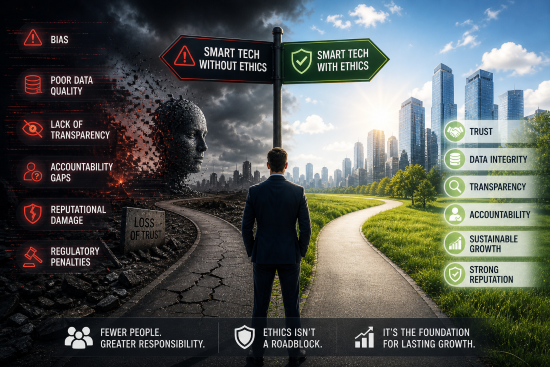
What sits behind technology is now under scrutiny, with data quality, transparency, and accountability no longer being secondary considerations; they’re central to whether AI can be relied upon. When those elements are weak, the consequences are predictable, as outputs become inconsistent, bias is amplified and decisions are made without clarity or explanation.
These cases are already visible across various sectors from finance to healthcare, where poorly governed systems have produced outcomes that are not just inaccurate, but unacceptable. In finance for example, where AI-led decisioning has already faced regulatory scrutiny, has seen firms forced to review or scale back systems where bias and lack of transparency became evident. Tools aren’t publicly withdrawn necessarily, just quietly restricted once trust becomes a concern.
In some instances, systems have had to be withdrawn entirely, in particular in healthcare. In others, the damage has been reputational, eroding confidence among customers and partners.
Commercial implications
The commercial implications are clear to see. Trust, once lost, is difficult to recover. Businesses that deploy AI without a clear ethical framework may gain short-term advantage, but they introduce long-term fragility. Customers become wary and partners may hesitate.
When regulators step in, what begins as innovation quickly becomes unwanted and damaging exposure.
It is becoming clear that trust is the real differentiator. It’s definitely not about who can build the most advanced model, but who can demonstrate control over how it is used. This is particularly relevant as AI moves closer to decision-making roles, shaping customer interactions, operational processes, and strategic direction. The closer technology moves to judgement, the more scrutiny it attracts.
Business growth doesn’t have to mean higher headcount
Alongside this shift sits another, quieter change is the long-held belief that growth requires scale in headcount, is beginning to break down.
For decades, the equation was simple. More people meant more output, more capacity, more growth. That model is now being challenged. AI and automation are allowing businesses to achieve more with fewer people, reducing the reliance on large teams to deliver results.
In theory, this should create leaner, more efficient organisations. But it also raises a different kind of risk.
When fewer people are responsible for overseeing increasingly powerful systems, the margin for error narrows. Decisions that might previously have passed through layers of human judgement are now being shaped, or even made, by technology. If the underlying data or logic is flawed, there are fewer checkpoints to catch it.
Ethics provides structure
This is where ethics becomes structural. A lean, technology-enabled business without clear ethical guardrails will easily become exposed, by moving quickly, but in the wrong direction. It can scale, but with embedded flaws. And when issues arise, they do so at speed and at scale.
The organisations that will succeed in this environment are not those that simply reduce headcount or accelerate automation. They are the ones that recognise that as human oversight becomes more concentrated, the quality of that oversight must increase. Fewer people does not mean less responsibility it means more.
There is also a misconception that ethics slows progress. In practice, the opposite is true. Organisations that take a considered approach, by investing in data integrity, establishing clear governance, and maintaining appropriate levels of human oversight, and building systems that last. They are not forced into reactive corrections or reputational repair. They move with confidence, rather than speed alone and ethics in this context is building infrastructure.
It defines how data is sourced and used and shapes how models are trained and evaluated. It determines how outputs are interpreted and acted upon and without it, even the most advanced systems become unreliable.
The future
As AI becomes more embedded, regulatory frameworks will evolve. Clients and customers will demand greater visibility and assurance and businesses will be asked what their technology can do, how it does it and on what basis decisions are being made.
At that point, it’s ethical standards that will be a requirement. The market will divide between those who prioritise capability and those who prioritise control. One group will move quickly but inconsistently, dealing with the consequences as they arise. The other will build more deliberately, by creating systems that are trusted, resilient, and scalable.
The businesses that succeed will be the ones that ensure those systems operate with clarity, accountability, and intent, as well building smart systems.