
Why are enterprises spending millions on AI and still struggling to automate work?
For years, enterprise leaders have reasonably believed that AI would revolutionize productivity, and while doing so, slash operational costs. Yet, despite massive investments, many organizations face a frustrating reality: business processes remain stubbornly slow.
As of today, most enterprises can instantly retrieve customer records, analyze data in real time, and generate reports in seconds. The problem is that information alone doesn’t move work forward. Every critical business process still relies on a sluggish, manual chain of decisions, handoffs, and validations that span multiple people, legacy systems, and departments.
The real opportunity isn’t building smarter systems that can answer questions more effectively. It is building systems that can actively participate in getting work done. This is why the conversation is shifting from static AI to agentic AI.
Why Traditional Automation Reached Its Limits
It’s no secret that enterprises have actually spent decades deploying robotic process automation (RPA) and business process management (BPM) tools to streamline operations. These technologies worked exceptionally well, but only when the rules were rigid, and the path forward was entirely predictable.
The main point about traditional automation is that it was mainly built for tasks, not for context. Meaning that the breakdown happens when a workflow encounters the unpredictable, dynamic realities of everyday operations. Let’s take a few examples.
- Commercial Underwriting:
A submission arrives from a broker and immediately stalls because it requires manual document reviews, risk evaluations, and pricing model validations across a dozen disconnected applications.
- Customer Onboarding:
One customer may provide flawless documentation. However, another customer submits incomplete information that requires custom follow-up and situational verification.
- Logistics & Supply Chain:
A provider encounters sudden shipment disruptions due to weather, labor shortages, or regulatory changes. This would require real-time problem-solving rather than a fixed script.
Because traditional workflows cannot navigate these situational shifts, they hit a wall. Organizations have successfully automated isolated, repetitive tasks, but they have struggled to automate the decision-making and coordination activities that connect those tasks into a meaningful business outcome.
Agentic AI matters because it is designed to bridge this exact gap, moving beyond rigid “if-then” rules to handle the context-driven coordination that real-world work requires.
The Difference Between Automation and Agency
Traditional automation excels at following rigid instructions. Agentic systems are designed to evaluate context, determine appropriate actions, and coordinate activities across multiple workflows. Rather than waiting for a human to orchestrate every step, AI agents actively advance the work.
The fundamental shift here is moving from alerts to actions. Traditional workflows are reactive; they detect a data mismatch or a broken link, halt the process, and ping an employee to fix it. Agentic workflows are proactive; they identify the anomaly, navigate connected systems to retrieve the missing context, validate the fix against company guidelines, and present a completed solution for human sign-off.
The differentiator here is agency. Which is why forward-looking organizations view agentic AI as a fundamental evolution of operational automation, rather than just another iteration of conversational chatbots.
What Agentic AI Looks Like Inside Today’s Enterprise
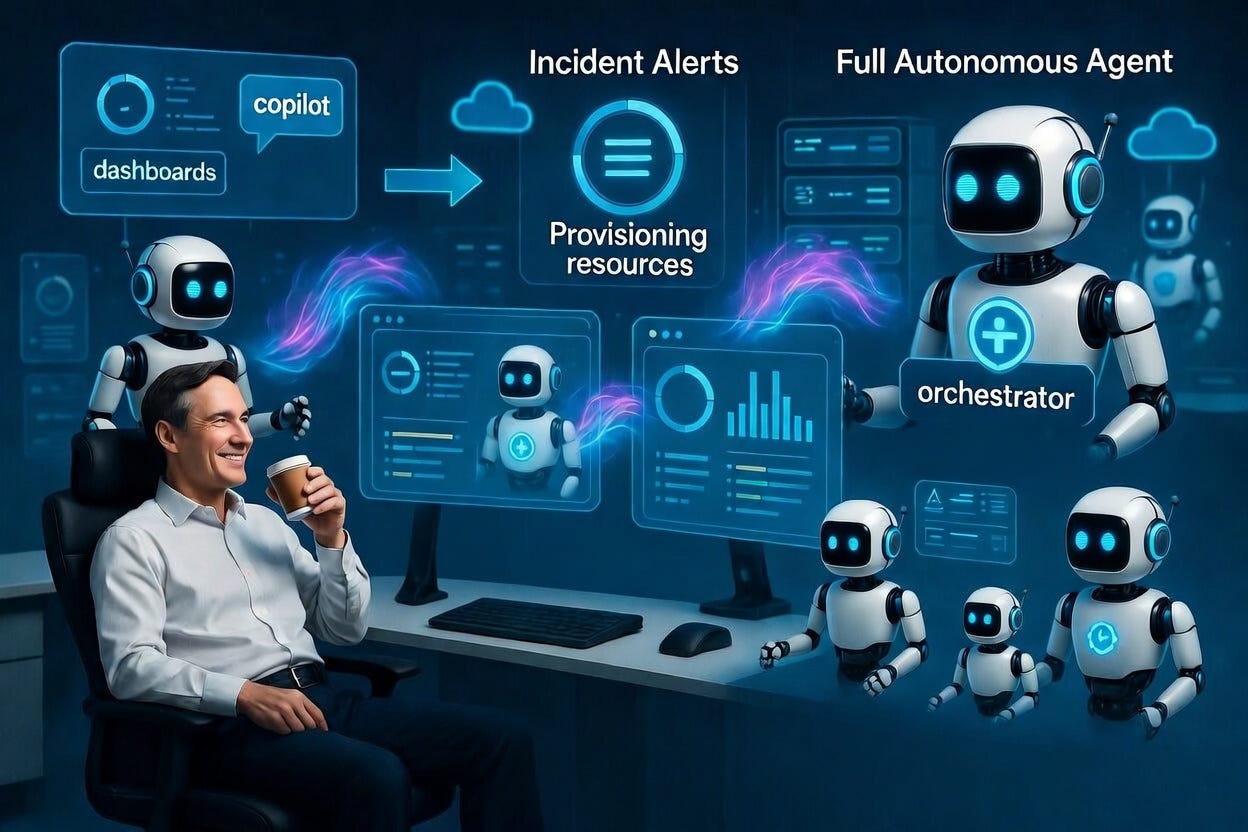
A common misconception is that agentic AI’s primary value lies in total autonomy. While autonomous execution is a powerful goal, the immediate enterprise benefit is the drastic reduction of operational friction across complex, human-in-the-loop processes.
We can consider the underwriting function within an insurance organization as a good example. Underwriters routinely spend a massive portion of their day gathering, organizing, and validating documentation before they can ever apply their actual expertise to a risk.
An enterprise agentic solution flips this dynamic entirely. Task-specific AI agents can ingest incoming submission packets, extract data, flag missing information, and simultaneously pull external risk indicators. By the time the underwriter opens the file, they are greeted by a highly structured, pre-validated assessment.
This exact same principle applies across customer service operations, where automation has historically been confined to answering routine, low-stakes questions.
Agentic systems expand this capability from merely replying to inquiries to managing entire end-to-end workflows. When a complex issue arises, an AI agent can independently investigate the root cause across back-end systems, cross-reference organizational policies, and coordinate the necessary fixes across departments.
Whether it is preparing a risk profile for an underwriter or resolving a multi-system issue for a customer, the outcome is identical. The technology handles the messy coordination layer of business, transforming employees from manual data coordinators into high-value decision-makers.
Why are Multi-Agent Systems Becoming Essential?
Enterprise processes rarely depend on a single person performing a single task. Most workflows involve multiple participants, each contributing specialized expertise at different stages of the process.
The same reality applies to AI.
Expecting one agent to handle every aspect of a complex workflow is neither practical nor desirable. Different business activities require different capabilities, data sources, and decision frameworks. This is why multi-agent systems are rapidly emerging as the preferred architecture for enterprise deployments.
Within a claims workflow, one agent may focus on document analysis while another retrieves policy information. A third agent may perform fraud detection, while a fourth evaluates settlement recommendations. Each agent contributes a specific capability, but the overall outcome depends on effective coordination between them.
AI orchestration plays a crucial role in coordinating multiple specialized capabilities into a cohesive workflow that aligns with business objectives. The true value of agentic AI lies not in individual agents operating in isolation, but in the seamless synchronization of tasks to deliver an accurate, end-to-end outcome.
Organizations scaling enterprise AI increasingly recognize that orchestration is just as vital as the underlying models. The future of enterprise AI will be defined less by individual algorithms and more by how effectively organizations coordinate intelligence across complex operational environments.
The Real Challenge Is Deployment
The market is currently flooded with platforms claiming to offer the best agentic AI tools. New vendors appear almost weekly, each promising transformative outcomes through autonomous workflows.
Yet technology is rarely the primary obstacle.
The more difficult challenge involves integrating AI into existing business environments without disrupting operations. Most enterprises operate across a combination of cloud platforms, SaaS applications, legacy systems, proprietary databases, and industry-specific technologies. Deploying agentic AI requires these disparate environments to work together seamlessly.
Consequently, organizations are increasingly prioritizing agentic AI implementation services alongside platform selection. Success depends on understanding business processes, identifying automation opportunities, establishing governance frameworks, integrating systems, and continuously optimizing workflows after deployment.
An organization can buy an agentic AI platform technology in a matter of weeks. Creating sustainable business value from that investment requires a far more deliberate approach.
To turn these investments into actual business value, organizations must shift from software selection to deployment readiness across three critical pillars: operational mapping, integration-first architecture, and dynamic governance frameworks. This approach ensures agents don’t just automate broken processes, but actively orchestrate multi-system workflows, bypass legacy bottlenecks, and maintain human-in-the-loop guardrails for high-risk decisions.
Measuring Value Beyond the Hype
As executive teams evaluate agentic AI pricing, they are increasingly focused on one question: what measurable business outcomes will this investment generate?
This is a healthy shift in perspective.
The most successful organizations are moving beyond technical vanity metrics to focus on hard operational performance. They measure what really moves the needle, like reductions in manual effort, improvements in cycle times, exponential gains in employee productivity, and measurable spikes in customer satisfaction. Ultimately, they evaluate AI by a single, unyielding metric: total process efficiency.
This is driving the demand for frameworks like the agentic AI ROI calculator. Enterprises are no longer accepting AI on faith. They want clear evidence that intelligent automation drives financial performance rather than just adding technological overhead.
Ultimately, agentic AI must face the same unyielding scrutiny as any strategic capital investment: Does it reduce friction? Does it improve efficiency? Does it accelerate outcomes? Does it successfully offload routine cognitive work, allowing employees to focus on high-value strategy?
If the answer is yes, the technology ceases to be an expensive experiment to become an indispensable enterprise asset.
Organizations That Can Operationalize Intelligence Will Emerge As Real Winners
The next competitive advantage will belong to leaders who can embed intelligence directly into real-world business operations.
Enterprises that successfully deploy agentic AI will create operating models that adapt faster, respond more effectively, and execute with greater consistency than traditional approaches allow.