There have never been more people trying to break into AI at once. Founders are racing to raise seed and Series A rounds before the window closes, close enterprise pilots before a competitor gets there first, and hire scarce technical talent before it’s poached by a bigger name. Every one of those goals now has a corresponding conference, sometimes three or four of them on the same weekend.
That abundance is its own problem. A founder with a ten-person team doesn’t have the time to fly to every AI event that promises access to investors or customers. The real skill this fall isn’t showing up; it’s picking the two or three rooms where the right conversation is more likely to happen.
Four events on the US calendar between August and October 2026 make the case for how different that calculus can be depending on what a founder actually needs: capital, customers, talent, or community.
Artificial intelligence conferences have multiplied so quickly over the past two years that no single event can claim to represent the industry anymore.
Instead, the calendar has split into lanes. Enterprise strategy, technical research, founder community, each with its own venue, audience, and vocabulary. Four events on the US calendar between August and October 2026 illustrate that split clearly.
Ai4, Las Vegas
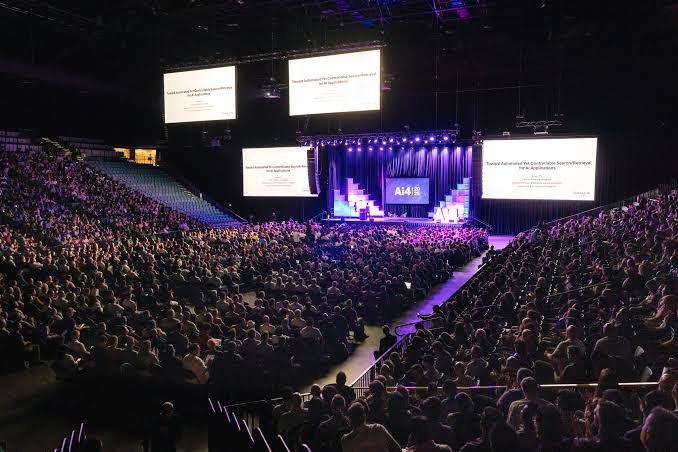
Ai4, starting August 4-6 at The Venetian in Las Vegas, is projected to draw more than 12,000 attendees, 1,000 speakers and 400 exhibitors, making it, by attendance figures alone, the largest AI-focused gathering in the country.
The audience is corporate rather than technical. Twenty industry tracks cover financial services, healthcare, cybersecurity, retail, manufacturing, energy, insurance and national security, and past participants have included Google, Amazon, Microsoft, Capital One, Walmart and J.P. Morgan.
An invitation-only “AI House,” presented with KPMG, and a dedicated AI Policy Summit signal where the conference sees its real audience: executives responsible for adoption and governance decisions.
The AI Conference, San Francisco
Seven weeks later, The AI Conference runs September 29 through October 1 at Pier 48 on San Francisco’s waterfront, and its programming reads like the inverse of Ai4’s: five tracks on AGI, large language models, agentic systems, infrastructure and applied AI, aimed at engineers and researchers rather than executives.
The event begins with an invite-capped “Day Zero”, workshops paired with a live hackathon for founders, before the main two-day program takes over. Confirmed speakers include Stanford HAI’s Peter Norvig, Illia Polosukhin (a co-author of the transformer paper that underpins modern generative AI), and Modular chief executive Chris Lattner, alongside researchers from Anthropic, OpenAI and Google DeepMind.
Organizers expect roughly 5,500 attendees, a fraction of Ai4’s crowd but a notably more technical one.
TechCrunch Disrupt, San Francisco
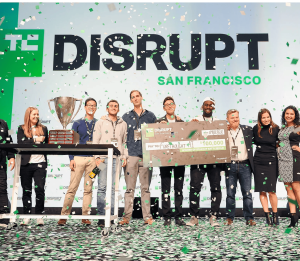
Two weeks after that, the conversation moves from research to capital. TechCrunch Disrupt, running October 13-15 at Moscone West, it’s a long-running startup and venture capital event, now in a market where AI dominates nearly every session on the agenda.
More than 10,000 founders, investors and operators are expected to attend, with AI threaded through sessions on security, agentic systems, and its spread into robotics and industrial applications.
The centerpiece remains the Startup Battlefield pitch competition, which carries a $100,000 equity-free prize and has historically produced alumni that went on to raise a combined $32 billion. For founders, Disrupt’s value has less to do with technical depth than with density, with a high concentration of active investors in one room.
One Way Summit, San Francisco: the founders themselves
The final event on this list, One Way Summit, held October 28–29 at the Commonwealth Club, is the flagship event of One Way Ventures, focused specifically on immigrant entrepreneurs building companies in the US. That focus isn’t a niche one: new research from the National Foundation for American Policy found that immigrants have founded or co-founded 59% of America’s privately held billion-dollar startups, and that the country’s most valuable AI companies are disproportionately among them.
U.S. billion-dollar companies with at least one immigrant founder with the highest valuations include SpaceX, Anthropic, OpenAI, Databricks, and Stripe. Given how much of the current AI boom traces back to immigrant founders, the summit has become a genuine adjacent stop on the fall circuit rather than a curiosity.
The 2026 edition, its second, doubles in length to two days and expects more than 1,000 attendees, up from roughly 500 at last year’s inaugural gathering. Speakers are drawn from OpenAI, Duolingo, Mercury and Fastly, and the event will host its first international pitch competition, co-run with Startup Grind. One Way Ventures managing partner Eugene Malobrodsky has described the timing — a week before the 2026 midterms, amid tightening immigration policy — as no accident, framing the summit as both a business event and a statement about who is still building in America.
The takeaway
Together, the four events map onto distinct parts of the AI economy rather than competing for the same audience: Ai4 for enterprise buyers, The AI Conference for the people building the technology, TechCrunch Disrupt for the money financing it, and One Way Summit for the founders navigating it.
Anyone weighing which to attend is better off asking which part of that chain they actually sit in, rather than trying to cover all four.
Article co-authored by Juan Pablo Aguirre Osorio