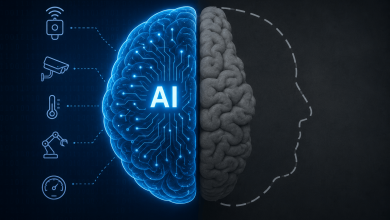
AIoT connections are forecast to increase from 1.4 billion at the end of 2023 to 9.1 billion in 2033. This trajectory marks a fundamental shift in how AIoT is creating business value, as AI revolutionises traditional processes, transforming the IoT into fleets of intelligent, responsive systems. The potential of AI within the IoT is extensive, from strengthening security and enabling automation, to providing enhancements for efficiency, productivity and resilience. As industry pressure to innovate accelerates, the increasing relationship between these technologies marks a defining new era of intelligent connectivity.
Utilising the value of data
The IoT can be a fragmented and complex landscape of networks, devices, cloud environments and enterprise processes. Amongst this often-siloed landscape, the IoT constantly generates and transmits vast quantities of information. With global data volumes reaching an estimated 181 zettabytes last year, enterprises operating at scale must be able to interpret their IoT data effectively, or they will not see the full value of their IoT deployments.
Whilst historically the IoT has predominantly had the role of connecting devices and gathering and transmitting data, there is increasing industry pressure for enterprises to innovate with intelligent solutions. That way, systems can better inform decisions to drive outcomes. While extracting value from IoT data at scale can be a challenge for many businesses, AI technologies provide a means to meet this demand and turn vast quantities of data into valuable insight.
Enterprises are therefore increasingly prioritising AI-ready infrastructure that supports the collection, transmission, processing and integration of data into their system to enable AI-driven insights. In doing so, they create a foundation for intelligent analysis equipped to identify patterns and trends in device fleets. By utilising AI in the IoT, enterprises will ultimately be able to transform their data into an increasingly valuable asset that drives efficiency and long-term value.
AI boosts IoT efficiency (but only if you can trust and explain it)
The sheer volume of data generated across IoT environments makes manual intervention costly, time-consuming and increasingly ineffective. Without automation, faults can be missed and performance issues can escalate unnoticed. AI is stepping in to address this through real-time monitoring, predictive maintenance and automated fault resolution.
By analysing data on device performance, usage and lifecycle maturity, AI can generate continuous insights and identify potential issues before they occur. This enables organisations to shift from reactive to proactive operations, reducing downtime and lowering operating costs. The impact is particularly clear in sectors such as healthcare, where resilience is critical, and logistics, where even minor disruptions can ripple across supply chains.
Enterprises can apply rules-based automation to support policy-driven fleet management and eSIM orchestration, with many capabilities gradually moving towards greater automation. In practice, adoption is iterative, starting with defined rules and oversight, before layering in AI-driven insights such as real-time usage, performance monitoring and anomaly detection.
This approach allows organisations to address issues earlier while continuously optimising connectivity across the device lifecycle. As confidence grows, automation can scale, enabling IoT environments to respond more dynamically to changing conditions with less manual intervention and improved cost efficiency.
However, this shift needs to be handled carefully. As AI becomes more embedded in operational decision-making, concerns around accuracy, LLM hallucinations and misinterpreted inputs become more material. Transparency and explainability are essential, not just to build trust, but to ensure organisations understand how decisions are made and where human oversight remains critical as they scale.
AI-enabled IoT security
A significant area where AI can elevate the IoT is security. Last year, we witnessed a significant rise in cyberattacks, with the NCSC reporting that cybersecurity has become a matter of national resilience. The report identified an almost 50 per cent year-on-year rise in ‘highly significant’ incidents which have the potential to disrupt essential national services such as energy networks and healthcare systems, which rely heavily on the IoT.
As digitalisation accelerates, more critical functions depend on connected devices. This growing reliance inevitably broadens the threat surface and demands a new level of vigilance across industries. The IoT is an increasingly attractive target for attacks, due to the nature of devices operating outside traditional IT security perimeters, which are usually unmanned, and often globally distributed. While private IP addressing and private APN approaches play a valuable role in limiting exposure, they offer limited visibility into device behaviour once traffic is flowing, particularly as deployments grow more complex.
AI, however, is likely to become an essential IoT security enhancement, thanks to its ability to detect what we cannot. It can be particularly effective in anomaly and threat detection, identifying the first signs of cyberattacks and enabling rapid mitigation. AI systems can detect suspicious IPs, device backdoors and evidence of misconfigured devices, flagging these irregularities in real-time and enabling for corrective actions to be decided upon and implemented. Using AI as a means to elevate IoT security allows enterprises to effectively prevent and respond to cyberattacks, avoiding costly and reputational damage.
The future of intelligent connectivity
The convergence of AI and IoT is transforming industries, creating a new era of intelligent, connected systems. As organisations continue to scale their deployments across the globe, those that invest in AI-driven IoT today will be best positioned to unlock the full value of their data, streamline operations and ultimately build more resilient, intelligent systems for the future.