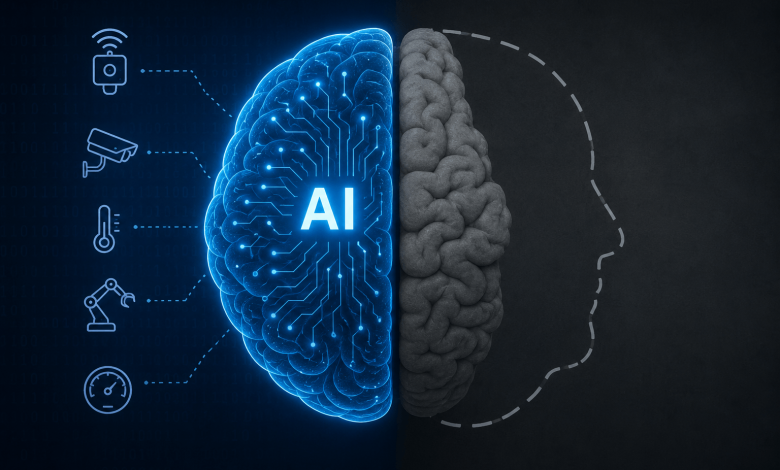
By 2026, there are an estimated 18.8 billion connected IoT devices generating data at a volume no human team could meaningfully process. That data — from factory sensors, hospital monitors, logistics trackers, agricultural probes, and smart grid controllers — is the raw material of industrial intelligence.
And most of it is being thrown away.
Not literally. The data lands in a storage system somewhere. But without the right AI layer to interpret it at speed, it expires. A temperature anomaly in a cold storage unit that gets flagged 90 minutes after it occurs isn’t intelligence — it’s a post-mortem.
This is the tension that most enterprise technology conversations still refuse to confront directly: AI and IoT are frequently treated as adjacent disciplines, developed by different teams, funded by different budgets, and integrated loosely — if at all. That structural separation has a cost. And 2026 is the year it’s becoming impossible to ignore.
The Myth of the AI-First Strategy
When organisations declare an ‘AI-first’ strategy, they typically mean one of two things: deploying large language models for internal productivity, or running predictive analytics on historical datasets. Both are legitimate. Neither is enough.
The mistake is treating AI as a layer you bolt on top of existing data infrastructure. AI is a reasoning system. It needs fresh, continuous, real-world inputs to operate in real-world contexts. The only way to get real-world data in real time — at scale, across physical operations — is through IoT.
Consider what an energy company is actually dealing with. Twelve thousand remote sensors across a wind farm network, each reporting every six seconds. That’s not a data warehouse problem. It’s a live inference problem. The question isn’t ‘what happened last quarter?’ It’s ‘is turbine 847 showing early fatigue signatures that will compound into a failure within 72 hours?’
That question can only be answered by an AI model that has been trained on historical fault patterns and is receiving live sensor feeds in real time. Strip out the IoT layer, and the AI is working blind.
AIoT: The Integration That Changes the Equation
The term AIoT — artificial intelligence of things — has been circulating in technical circles for several years. But it’s worth being precise about what it actually describes.
AIoT is not simply connecting AI software to IoT hardware. That’s a cable, not a strategy.
AIoT means training machine learning models on the specific data patterns that IoT devices produce, deploying inferencing capability close to the data source, and building feedback loops where the AI’s outputs actively influence device behaviour in real time.
In practical terms: a conveyor belt sensor doesn’t just report vibration data to a central server. An on-device AI model analyses that data, identifies an anomaly pattern consistent with bearing wear, and triggers a maintenance alert — without waiting for a round trip to the cloud. Response time drops from minutes to milliseconds. The operational difference isn’t incremental; it’scategorical.
Three sectors are producing measurable results from this convergence today.
Manufacturing is the clearest case. Predictive maintenance enabled by AIoT is reducing unplanned downtime by figures that independent analysts now place consistently above 30%. More importantly, it’s shifting the entire maintenance model from scheduled service intervals to condition-based intervention — a change that requires AI’s pattern recognition and IoT’s real-time sensing working in lockstep.
Healthcare is close behind. Remote patient monitoring devices — wearables, implantable sensors, continuous glucose monitors — produce data streams that are medically meaningless without the AI layer. The value isn’t in a raw glucose reading; it’s in the AI-identified trend that precedes a hypoglycaemic episode by 40 minutes and can trigger an alert or an automatic insulin adjustment through a connected pump. That’s a feedback loop that only exists because AI and IoT are working as a single system.
Supply chain and logistics follows the same pattern. Real-time tracking of cold chain assets, predictive routing based on live traffic and weather data, automated exception handling for customs or compliance triggers — none of it works without persistent IoT visibility and AI inference running continuously against that visibility.
The Edge Imperative
Cloud-first became the dominant infrastructure doctrine in the 2010s, and for understandable reasons. But it created a latency dependency that’s actively incompatible with time-sensitive physical operations.
Processing a sensor reading from a factory floor in a cloud data centre 800 miles away is not real-time operation. It’s a delay, and in many physical environments that delay is the difference between catching a fault and explaining one.
Edge computing — deploying compute capacity at or near the IoT device — solves the latency problem but introduces a new challenge: AI models compact enough to run on constrained hardware. This is where model compression, quantisation, and the development of edge-native AI architectures become non-negotiable engineering priorities rather than nice-to-have optimisations.
The organisations getting AIoT right aren’t choosing between cloud AI and edge inference. They’re designing architectures where lightweight edge models handle time-critical decisions locally, while more computationally intensive models run in the cloud for longer-horizon pattern analysis. The two layers communicate continuously, each informing the other’s outputs.
This is not a simple architecture to build. It requires decisions about model synchronisation, data governance across distributed environments, security at the device level, and organisationalalignment between teams that have historically operated in separate silos. But the operational capability it creates is qualitatively different from anything achievable with either system working alone.
The Data Quality Problem Nobody Talks About
There’s a quiet crisis in the AIoT space that doesn’t get nearly enough attention: IoT data is noisy, inconsistent, and frequently wrong.
Sensors drift. Connections drop. Firmware updates introduce unexpected changes in output format. Network latency creates gaps in time-series data that corrupt model training if not handled correctly. Physical environments — vibration, temperature, electromagnetic interference — introduce artefacts that look like signals but aren’t.
Any AI model trained on raw IoT data without robust preprocessing is learning from a dataset that includes a non-trivial proportion of noise, errors, and anomalies unrelated to the underlying physical phenomena. The outputs of that model will reflect that contamination.
Data quality engineering — cleaning, normalising, validating, and labelling IoT data streams — is not a preprocessing step you hand off to a junior analyst. It’s a core competency requiring domain knowledge about the physical systems producing the data, statistical rigour, and engineering discipline. Organisations treating data quality as an afterthought are building AI systems on unstable foundations. Model performance metrics look fine in testing. They degrade in production because the production data environment is messier than the controlled dataset used for validation.
What Getting This Right Actually Looks Like
The enterprises making serious progress on AIoT share a few structural characteristics.
They’ve committed to unified data architecture from the start — not separate data lakes for operational technology and information technology, but a single coherent data fabric that connects both. This is architecturally harder but operationally essential. When your AI models can draw simultaneously on live sensor data, maintenance history, supply chain records, and ERP data, the quality of the inference is fundamentally different.
They’ve invested in the edge layer as a first-class infrastructure priority. Edge gateways with AI inferencing capability are provisioned and managed with the same organisational rigour as cloud infrastructure — not treated as experimental hardware sitting on a factory floor somewhere.
They’ve built genuine feedback loops. Not one-way pipelines where IoT data flows into AI systems, but two-way systems where AI outputs influence device behaviour, and those behaviouralchanges generate new data that refines the model over time. This is the distinction between a reporting system and an intelligent system.
And they’ve aligned AI and IoT teams around shared operational outcomes, rather than letting them operate on separate technology roadmaps that converge only at the level of a dashboard.
The organisations still treating AI as a data science function and IoT as an operations technology function — with limited structural connection between the two — are building capability in the wrong unit of analysis. The competitive advantage isn’t AI. It isn’t IoT. It’s the integrated system where each amplifies the other.
The question isn’t whether AI and IoT will converge in your industry. That convergence is already happening, and the enterprises that started building three years ago have a lead that’scompounding every quarter.
The question is whether you design that convergence deliberately — or inherit someone else’s architecture after the window for differentiation has closed.