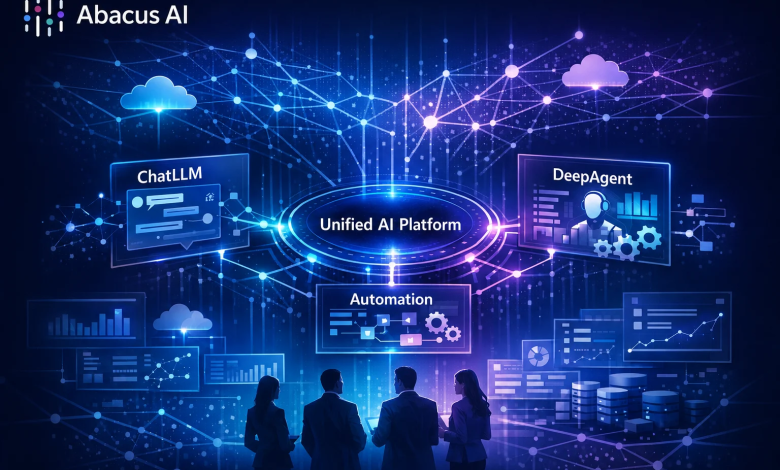
Artificial intelligence tools have become essential for modern businesses, but most organizations still rely on multiple disconnected systems for different tasks. One platform is used for chat based AI, another for automation, and separate tools are used for building and deploying AI agents. This fragmented setup slows down workflows and increases complexity.
Abacus AI is designed to solve this problem by offering a unified AI platform that brings everything into one ecosystem. Instead of switching between different tools, users can access AI models, build agents, and automate workflows from a single environment.
In this review, we explore Abacus AI in detail, including its features, latest updates, real world use cases, and how it compares with leading competitors in the AI space.
What is Abacus AI
Abacus AI is an end to end artificial intelligence platform designed for developers, startups, and enterprises that want to build and deploy AI powered applications without relying on multiple external tools.
Unlike traditional AI chat systems, Abacus AI functions as a complete infrastructure layer where users can create intelligent agents, run workflows, and manage AI operations at scale.
The platform focuses on unification, allowing teams to replace fragmented AI tools with a single, integrated system.
ChatLLM: A Multi Model Intelligence Layer
ChatLLM is one of the core components of Abacus AI and serves as a multi model AI interface that provides access to different advanced language models within a single system.
Instead of relying on a single AI model, users can explore ChatLLM documentation and understand how it intelligently routes queries to the most suitable model based on the task. This improves accuracy, flexibility, and performance across writing, coding, analysis, and research use cases.
This makes it especially valuable for users who want the power of multiple AI systems without switching between different platforms.
DeepAgent: Building Autonomous AI Systems
DeepAgent takes Abacus AI beyond traditional chat interfaces by enabling the creation of autonomous AI agents that can execute tasks independently.
These agents can interact with systems, manage workflows, and perform actions without constant human input.
For example, a business can use DeepAgent overview to build an onboarding system where AI automatically guides new users, answers questions, and triggers backend processes such as account setup or notifications.
This transforms AI from a passive assistant into an active operational layer inside business systems.
Latest Features and Product Updates
Abacus AI has been rapidly evolving with new features that expand its capabilities beyond a standard AI platform.
Abacus Claw latest release focuses on improving AI driven development workflows and helping teams build more advanced automation systems with greater efficiency.
Abacus AI Desktop brings AI capabilities directly into a desktop environment, allowing users to move beyond browser based workflows and integrate AI into daily system usage.
Abacus Studio platform provides a structured environment for building, testing, and deploying AI applications, making it especially useful for startups and product teams that need faster development cycles.
Key Use Cases
Abacus AI is built for real world applications rather than just conversational use.
One of its most powerful applications is AI agent development, where businesses can build intelligent systems that handle customer interactions, internal support, and decision making processes automatically.
Another major use case is workflow automation solutions, where repetitive manual tasks are replaced with AI driven processes that operate based on context instead of fixed rules.
Many organizations also use Abacus AI solutions overview to replace multiple AI tools by consolidating chat, automation, and development into a single platform.
Startups benefit from faster product development cycles without needing large engineering teams or complex infrastructure setups.
Enterprises use Abacus AI case studies as inspiration to deploy AI copilots that assist employees, streamline operations, and improve productivity across departments.
Abacus AI vs Competitors
Abacus AI competes with several leading AI platforms, but its biggest advantage is that it combines multiple capabilities into a single unified system rather than focusing on just one area.
ChatGPT by OpenAI: ChatGPT is widely used for conversational AI and content generation, but it primarily focuses on chat based interactions. In contrast, Abacus AI goes beyond chat by offering multi model access, AI agents, and full workflow automation in one platform.
Claude by Anthropic: Claude is known for strong reasoning abilities and enterprise grade safety. However, it is still mainly centered around conversational intelligence. Abacus AI differentiates itself by focusing on execution, allowing users to build and deploy AI agents that actively run business workflows.
Gemini by Google: Gemini benefits from deep integration within the Google ecosystem, which makes it powerful for users already within that environment. Abacus AI, on the other hand, offers a more unified and tool independent platform where all AI capabilities are centralized in one place.
Perplexity AI: Perplexity is primarily designed for research and AI powered search. While it excels at information retrieval, it does not focus on workflow automation or agent based execution. Abacus AI expands beyond research into operational AI systems that can perform tasks.
Zapier: Zapier is a popular automation tool based on rule based workflows. It is highly effective for simple automation, but it lacks native AI intelligence. Abacus AI introduces AI driven automation where systems can make context aware decisions rather than following fixed rules.
DataRobot: DataRobot focuses heavily on enterprise machine learning and model deployment. While powerful for ML operations, it is less focused on modern AI agents and workflow automation. Abacus AI provides a more flexible, agent first architecture designed for real time AI operations.
Who Should Use Abacus AI
Abacus AI is designed for multiple types of users depending on their needs and goals.
AI builders and developers can use it to create and deploy AI agents without managing multiple tools or complex infrastructure, which significantly speeds up development cycles.
Startups and product teams benefit from reduced costs and faster execution since they can build AI powered systems without large engineering teams.
Enterprise and operations teams use Abacus AI to automate internal workflows, deploy AI copilots, and improve productivity across different departments.
Advanced AI users who have outgrown basic tools like ChatGPT will find Abacus AI a more powerful and scalable alternative for complex workflows.
Pricing Overview
Abacus AI offers flexible pricing models designed for individuals, teams, and enterprise organizations.
The pricing structure is designed to reduce dependency on multiple tools by consolidating AI chat, automation, and agent development into a single platform.
This approach helps organizations lower costs while improving operational efficiency.
For detailed plans, users typically refer to Abacus AI pricing page to understand different tiers and usage options.
Final Verdict
Abacus AI is not just another AI tool. It is a complete unified artificial intelligence platform designed for modern AI driven operations.
With ChatLLM enabling multi model intelligence, DeepAgent powering autonomous workflows, and continuous expansion through tools like Abacus Claw and Abacus Studio, it represents a shift toward fully integrated AI systems.
For developers, startups, and enterprises, Abacus AI offers a powerful combination of flexibility, scalability, and automation.
In a fragmented AI landscape, its biggest strength is bringing everything together into one cohesive ecosystem.