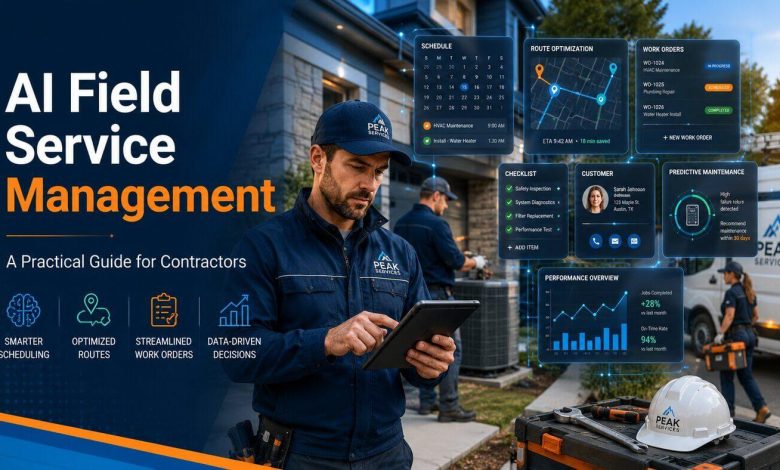
Field service has always been a business of moving targets.
A service call runs long. A technician needs a part that is not on the truck. A customer wants an arrival update. The dispatcher is juggling emergencies, maintenance calls, and a schedule that looked better at 7 a.m. than it does by lunch.
That is where AI field service management is starting to prove useful for contractors.
For HVAC, plumbing, electrical, refrigeration, mechanical, and service contractors, artificial intelligence is not just a technology buzzword. It is becoming part of the everyday tools used to schedule jobs, dispatch technicians, manage parts, communicate with customers, and protect margins.
The key is simple: AI should help the business run better, not make it more complicated.
What Is AI Field Service Management?
AI field service management is the use of artificial intelligence inside field service software to help contractors make faster, smarter decisions.
A standard field service management system stores job information, technician schedules, invoices, service history, and customer records. An AI-powered system goes further. It can look for patterns, recommend next steps, predict job needs, and help teams act before small problems turn into expensive ones.
In plain jobsite terms, AI can help answer questions like:
- Which technician is best for this call?
- How long will this job probably take?
- What parts may be needed?
- Which customer needs a follow-up?
- Where are we losing time?
- Which calls are likely to become callbacks?
That kind of information matters because service work is won or lost in the details.
Why Contractors Are Paying Attention
Contractors are under pressure from every direction. Labor is tight. Fuel is expensive. Customers expect faster communication. Equipment is more complex. Margins are not getting any easier.
The U.S. Small Business Administration notes that small businesses can use AI tools to solve many types of operational challenges, while also weighing the risks and benefits carefully. That is a good way for contractors to look at it: AI is not magic, but it can be useful when applied to real business problems.
Where AI Helps Most in Field Service
| Business Area | How AI Helps | Contractor Benefit |
| Scheduling | Matches jobs with technician skill, location, and availability | Fewer delays and tighter routes |
| Dispatching | Recommends real-time schedule changes | Better response to emergencies |
| Technician Support | Surfaces job history, manuals, photos, and likely fixes | Faster diagnosis and fewer calls to the office |
| Customer Communication | Automates reminders, updates, and follow-ups | Better customer experience |
| Inventory | Predicts commonly needed parts by season or job type | Higher first-time fix rates |
| Reporting | Spots trends in callbacks, labor hours, and job profitability | Better management decisions |
Smarter Scheduling and Dispatching
Scheduling has always been part science, part judgment, and part daily rescue mission.
AI field service management software can help dispatchers build better schedules by analyzing technician location, skill set, job type, customer priority, traffic, and estimated job duration.
That does not replace a good dispatcher. It gives that dispatcher better information. When an emergency call comes in, AI can suggest which technician can respond with the least disruption to the rest of the day. When one job runs over, it can help adjust the board before the whole afternoon falls apart. Platforms such as ServiceTitan, Workiz, and Aptora are already building these capabilities into modern field service management software.
For contractors running multiple trucks, that can mean fewer windshield hours, less overtime, and more completed calls.
Better Support for Technicians in the Field
Good technicians are hard to find. Once you have them, you want them solving problems, not wasting time digging for information.
For example, an HVAC technician arriving at a no-cooling call may see that the same system had capacitor issues last summer, a dirty coil two years ago, and a maintenance visit three months ago. The U.S. Department of Energy notes that regular air conditioner maintenance helps systems run efficiently and effectively, which makes accurate service history even more valuable.
That kind of context helps technicians make better decisions at the equipment, not after the fact.
Fewer Callbacks, Cleaner Documentation
Callbacks hurt twice. First, they cost money. Second, they weaken customer confidence.
AI field service management tools can help reduce callbacks by standardizing checklists, flagging repeat issues, and reminding technicians to document important job details before closing the call.
When software prompts technicians to capture the right information every time, the office gets cleaner records, customers get clearer explanations, and managers get better data.
Customer Communication Without More Office Burden
Today’s customers expect updates. They want appointment reminders, technician arrival windows, repair explanations, and follow-up messages.
AI can automate much of that communication.
But there is a line contractors should not cross. AI can help request honest reviews, but it should never create fake ones. The Federal Trade Commission’s rule on consumer reviews and testimonials addresses deceptive practices involving fake or false reviews.
In other words, use AI to communicate better. Do not use it to manufacture trust.
Managing AI Risk the Smart Way
Contractors do not need to become software engineers, but they do need to ask practical questions before adopting AI tools.
The National Institute of Standards and Technology developed an AI Risk Management Framework to help organizations think through AI-related risks.
For contractors, the questions are straightforward:
- Who owns the customer data?
- Can the system explain its recommendations?
- Does it integrate with accounting and CRM tools?
- Can technicians actually use it in the field?
- Does it make the business simpler or more complicated?
The right AI field service management platform should support the way the company works. It should not force the company to rebuild its entire operation around the software.
SEO and Marketing Benefits for Contractors
There is also a marketing advantage. Better job documentation can turn into better service pages, stronger FAQs, cleaner customer communication, and more useful website content.
Google’s SEO guidance emphasizes helpful, reliable, people-first content, not content created only to manipulate rankings.
That matters for contractors. Real service data can help answer real customer questions, such as how often equipment should be maintained, when a repair makes sense, or what causes common system failures.
Google’s SEO Starter Guide also stresses creating helpful, reliable content for readers.
Good operations can support good marketing.
The Bottom Line on AI Field Service Management
AI field service management is not about replacing dispatchers, technicians, or service managers.
It is about giving them better information.
For contractors, the best uses are practical: tighter schedules, faster dispatching, stronger technician support, cleaner documentation, better customer updates, smarter inventory, and fewer callbacks.
The winners will not be the contractors chasing every new feature. They will be the ones using AI to solve real problems in the field.
In the trades, a tool earns its place by doing the job. AI is no different. Used wisely, it can help contractors run cleaner calls, protect profit, and deliver the kind of service customers remember.