Online education has already solved one hard problem: access. A learner can find a course on almost any subject, at almost any level, from almost anywhere. The harder problem now is attention. Many digital courses still feel like watching someone else learn in public. The material may be excellent, but the experience is often solitary, linear, and easy to abandon when the learner gets confused, bored, or unsure how to apply what they have just heard.
That gap matters because learning is rarely just the transfer of information. In a good classroom, students hear an explanation, ask a follow-up question, watch an example unfold, compare ideas with peers, and test their understanding. The social and interactive parts help people notice misconceptions and build confidence.
From Passive Content to Active Learning Spaces
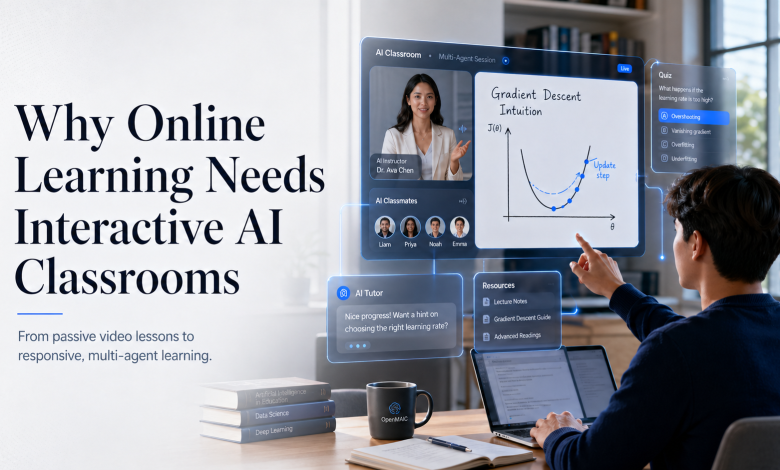
The next step for online education is not simply better recordings, sharper slides, or shorter lessons. It is the creation of learning spaces that respond while the learner is still thinking. Instead of delivering the same sequence to everyone, an effective AI-powered classroom can adapt the rhythm of a lesson, introduce examples, invite questions, and turn abstract ideas into interactive practice.
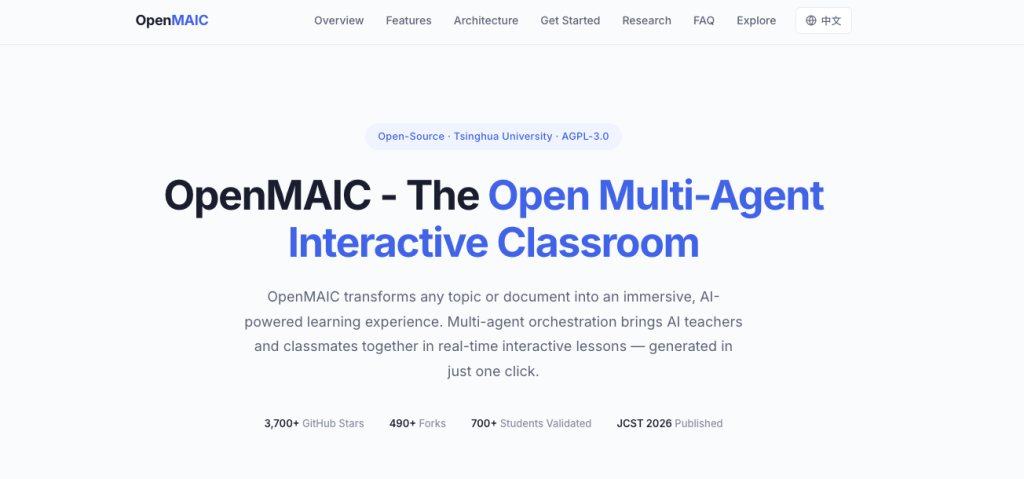
This is where OpenMAIC’s AI classroom (Open Multi-Agent Interactive Classroom) serves as a blueprint for the category. Developed by researchers at Tsinghua University, the platform moves beyond the ‘chatbot’ model by orchestrating a symphony of AI agents—teachers, TAs, and even digital classmates—to recreate the social friction and support of a physical room. It doesn’t just deliver content; it builds an environment that responds while the learner is still thinking.
That distinction changes the learner’s role. A student is no longer only consuming a lesson; they are participating in one. They can ask for clarification when a concept feels unclear, see a diagram built step by step, or encounter an alternative viewpoint through a simulated discussion. These small moments are often what make a lesson stick.
Why Multi-Agent Learning Feels Closer to a Real Classroom
A single AI tutor can help answer questions, but many classroom experiences depend on more than one voice. A teacher may introduce the core idea, a classmate may ask the question others were afraid to ask, and another student may challenge an assumption. That mix of roles gives learners more ways into the material.
Multi-agent learning tries to recreate that dynamic. Instead of relying on one assistant to do everything, different agents can take on different educational functions. One may lead the lecture, another may summarize, another may quiz the learner, and another may argue from a contrasting perspective. For subjects that benefit from debate, design critique, problem-solving, or project work, that diversity can make the learning experience richer.
It also helps with pacing. In many online courses, the learner has to decide when to pause, rewind, search elsewhere, or give up. In an interactive classroom, the system can create more frequent checkpoints. A short quiz can reveal whether a learner understood the last concept. A whiteboard explanation can slow down a difficult step. A discussion can connect the topic to a realistic scenario before the lesson moves on.
Better Learning Materials Should Be Easier to Create
The promise of AI in education is not only for students. Teachers, trainers, and content creators often spend significant time turning raw knowledge into usable learning materials. A strong lesson may require slides, examples, exercises, assessments, visuals, and follow-up explanations. For a corporate trainer or university instructor, that preparation can become a bottleneck.
AI-generated classrooms can reduce that friction by turning a topic or document into a structured learning flow. A dense research paper, a technical onboarding guide, or a new internal process can become a guided session with explanations, checkpoints, and interactive elements. This does not remove the need for human judgment. It changes where that judgment is spent: educators can review, refine, and contextualize the generated lesson.
For organizations, this has practical value. Onboarding can become more consistent without becoming impersonal. Product training can include scenario-based questions rather than static documentation. Technical teams can turn complex concepts into guided walkthroughs for new members. The learning material becomes easier to maintain because it is generated from the knowledge source rather than manually reconstructed every time.
Open Source Makes Educational AI More Inspectable
As AI moves deeper into education, trust becomes more important. Schools and organizations need to understand how a system is built, what models it can use, how content is generated, and whether the experience can be adapted to local needs. Open-source education platforms can make that conversation more concrete because teams are not limited to a black-box product.
That is another reason OpenMAIC’s AI fits naturally into the broader education technology conversation. As an open-source multi-agent AI classroom platform, it gives institutions a way to experiment with AI teachers, classroom agents, model orchestration, and interactive learning workflows while retaining more control over deployment, customization, and integration. For researchers, it also creates a shared foundation for studying how multi-agent learning affects engagement, comprehension, and classroom design.
Open source does not automatically make a learning system good, but it can make improvement more collaborative. Developers can inspect architecture, educators can adapt workflows, and researchers can test assumptions. In a field as sensitive as education, that openness matters.
The Classroom Interface Is Becoming a Medium
The most important shift may be conceptual. For years, online learning platforms have mainly organized content: videos, readings, assignments, comments, and grades. AI makes it possible to organize interactions instead. A lesson can become a sequence of teaching moments, questions, responses, simulations, and reflections that change according to the learner’s needs.
That does not mean every course should become a theatrical AI classroom. Some topics still work well as concise tutorials. But when learners need explanation, feedback, discussion, and confidence, the classroom metaphor remains powerful. It gives structure to uncertainty. It makes room for questions. It reminds us that learning is often social even when it happens alone on a screen.
The future of online education will likely combine many formats: expert-led courses, self-paced reading, human mentorship, AI tutoring, simulations, and collaborative projects. The winners will not be the platforms that add the most AI features. They will be the ones that make learners feel less stranded in front of content and more supported inside a learning process.
In that sense, the next generation of educational technology is not just about producing more lessons faster. It is about making digital learning feel more alive, more responsive, and more human in the moments when learners need help most.