AI has fundamentally transformed how businesses operate, but it has also introduced a complex web of new regulatory requirements and security risks. As organizations rush to adopt generative AI and machine learning models, enterprise buyers and regulators are demanding strict proof of AI governance, data privacy, and security compliance.
If your organization is building, deploying, or integrating AI without a dedicated compliance strategy, you are exposing your business to massive regulatory fines, security breaches, and lost enterprise deals. The introduction of frameworks like ISO 42001 and regulations like the EU AI Act mean that manual compliance tracking is no longer a viable option.
To navigate this landscape, companies are turning to AI compliance tools. These platforms serve a dual purpose: they use artificial intelligence to automate traditional compliance workflows like SOC 2 and ISO 27001, and they provide the governance infrastructure needed to ensure your own AI systems are safe, ethical, and legally compliant.
After evaluating the market landscape, I’ve identified the ten best AI compliance tools and software platforms available in 2026. These solutions will help you automate evidence collection, govern your AI models, and build trust with enterprise buyers.
What to look for in AI compliance software
The market for AI compliance tools is expanding rapidly, but not all platforms offer the depth required for enterprise-grade governance. A basic risk register is not enough to satisfy modern auditors or sophisticated procurement teams.
When evaluating AI compliance software, here are the critical capabilities you must look for:
- AI-Powered Automation – The platform should utilize AI to automate tedious tasks like evidence collection, control mapping, and security questionnaire responses, drastically reducing manual workloads.
- Support for AI-Specific Frameworks – Your chosen tool must support emerging AI standards like ISO 42001 (Artificial Intelligence Management System) and the NIST AI Risk Management Framework (RMF), alongside traditional standards like SOC 2 and ISO 27001.
- Dedicated Expert Support – Software alone cannot navigate the nuances of AI regulation. The best platforms pair their technology with dedicated compliance experts who guide your strategy and manage your audit timelines.
- Continuous Control Monitoring – AI models and cloud infrastructures change daily. You need a platform that monitors your systems in real time and alerts you to compliance drift before it becomes an audit failure.
- Model Inventory and Risk Mapping – For companies building AI, the platform must offer tools to inventory your machine learning models, assess their specific risk levels, and track their compliance with regional laws like the EU AI Act.
- Transparent Pricing Models – Avoid vendors that hide their costs behind complex, modular pricing tiers. Look for transparent pricing that includes expert support and essential frameworks without surprise fees.
1. Scytale: Best Overall AI GRC Platform
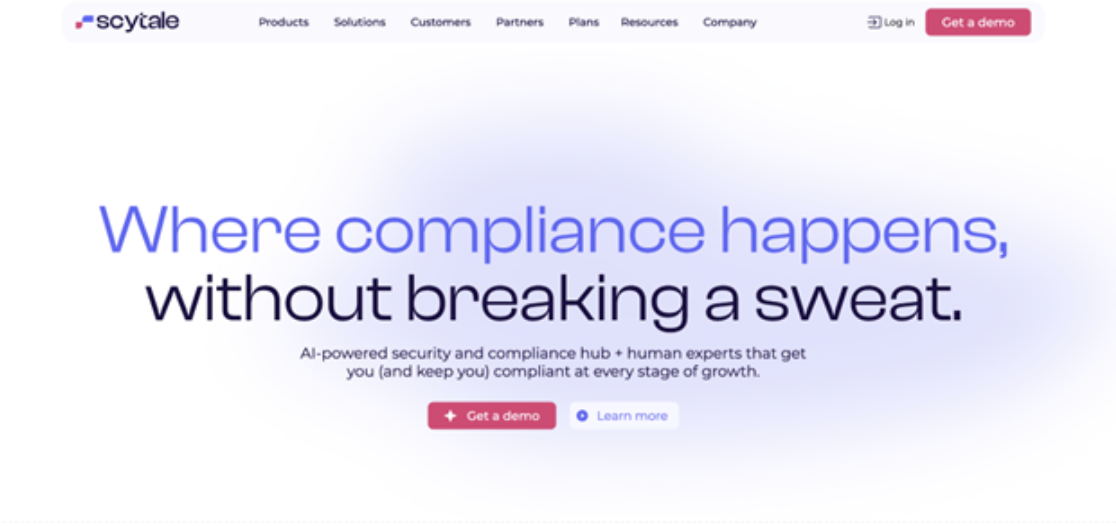
Scytale stands out as the best AI compliance tool by combining an AI GRC platform with hands-on support from experienced compliance experts. Instead of leaving teams to interpret frameworks and manage audits on their own, Scytale provides both the technology and guidance needed to move through compliance with clarity and control.
A multi-agent suite runs continuously across your environment, automating time-consuming tasks like evidence collection, control mapping, and security questionnaires. It also gives real-time visibility into your compliance posture, so teams always know where they stand instead of scrambling before an audit.
Scytale supports modern compliance, including AI governance, across 80+ frameworks such as SOC 2, ISO 27001, PCI DSS, GDPR, HIPAA, CCPA, ISO 42001, and SOX ITGC, so teams can manage everything in one place instead of stitching together multiple tools.
What sets Scytale apart is how automation is paired with expert support. GRC specialists work alongside your team to scope, implement, and prepare for audits, helping reduce delays, avoid rework, and keep your compliance program on track.
Standout feature: Continuous compliance powered by AI agents, alongside dedicated GRC experts who guide your audit readiness and manage key milestones.
Plans and Pricing
- Custom pricing tailored to your company size and specific framework requirements
- Dedicated GRC expert support is included in the core subscription, not sold as an expensive add-on
- Highly transparent pricing structure with no hidden implementation fees
Frameworks Supported
80+ frameworks including, SOC 2, ISO 27001, ISO 42001, EU AI Act, HIPAA, GDPR, PCI DSS, and SOX ITGC.
Key Capabilities
- Continuous compliance with real-time monitoring and AI-driven insights into your controls, risks, and overall security posture
- AI-powered automation across core workflows, including evidence collection, access reviews, continuous monitoring, and vendor risk management
- Built-in AI GRC agent (Scy) that identifies gaps, answers compliance questions, and provides actionable recommendations based on your environment
- Support for AI governance frameworks like ISO 42001, helping teams manage and certify AI systems alongside existing compliance programs
- Multi-framework management with intelligent cross-mapping to eliminate duplicate work across standards like SOC 2, ISO 27001, GDPR, and HIPAA
- Customizable Trust Center to clearly showcase your security, compliance, and AI governance posture
- Dedicated GRC experts providing tailored guidance on both traditional compliance and emerging AI regulatory requirements
2. Credo AI
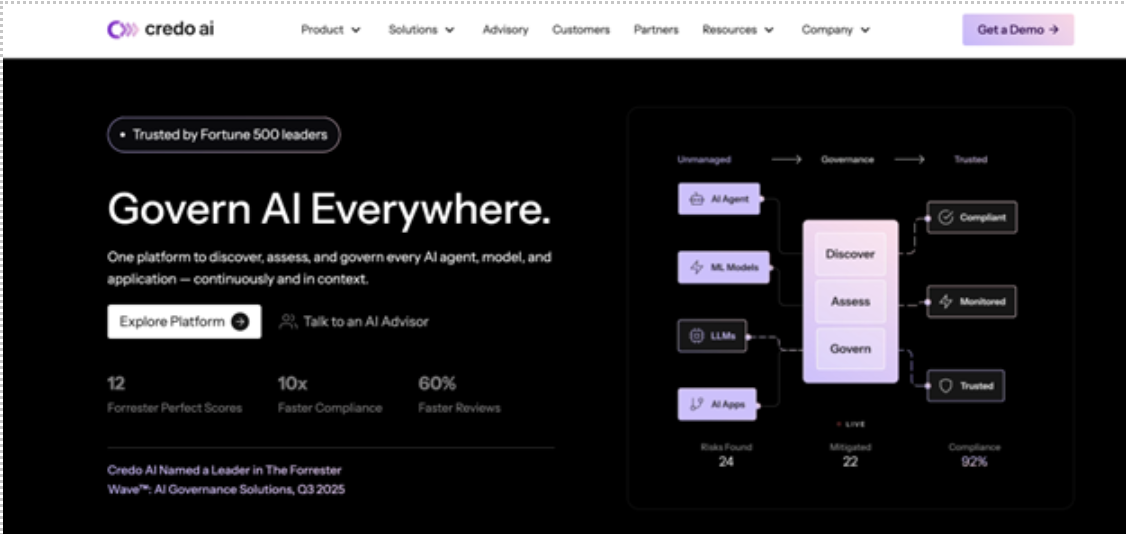
Credo AI is a purpose-built platform designed specifically for AI governance, risk management, and compliance. Unlike general GRC tools, Credo AI focuses entirely on helping organizations manage the unique risks associated with developing and procuring artificial intelligence systems.
The platform provides a comprehensive system of record for all AI applications within an enterprise. It allows teams to track machine learning models, assess their risk levels, and ensure they align with internal ethical guidelines and external regulatory requirements. Credo AI is particularly known for helping multinational companies prepare for the stringent requirements of the EU AI Act.
By standardizing AI governance across data science, legal, and compliance teams, Credo AI ensures that innovation does not outpace security. However, because it is highly specialized in AI model governance, organizations will still need a separate platform like Scytale to manage broader information security frameworks like SOC 2 or ISO 27001.
Standout feature: Context-specific AI risk assessments that automatically adapt based on the model’s use case, deployment environment, and regional regulatory requirements.
Plans and Pricing
- Enterprise-focused pricing model based on the number of AI models and use cases managed
- Custom quotes required for all tiers
- Implementation and onboarding services are typically priced separately
Frameworks Supported
EU AI Act, NIST AI RMF, ISO 42001, and various regional AI regulations and ethical guidelines.
Key Capabilities
- Centralized AI registry for tracking all internal and third-party AI tools
- Automated risk assessments tailored to specific AI use cases
- Policy enforcement workflows for data science and engineering teams
- Vendor risk management specifically designed for AI supply chains
- Out-of-the-box reporting for the EU AI Act and NIST AI RMF
- Collaboration hubs bridging the gap between technical and legal teams
3. Secureframe
Secureframe is a robust compliance automation platform that heavily leverages artificial intelligence to streamline security audits and risk management. It is designed for fast-growing technology companies that need to manage multiple compliance frameworks simultaneously without overwhelming their engineering teams.
The platform utilizes AI to automate evidence collection, map controls across different regulatory standards, and continuously monitor cloud infrastructure for misconfigurations. Secureframe’s AI capabilities shine in its questionnaire automation feature, which uses machine learning to instantly draft accurate responses to complex enterprise security assessments based on your existing compliance data.
Secureframe excels at reducing the duplicate work associated with multi-framework compliance. By collecting evidence once and applying it across SOC 2, ISO 27001, and GDPR, it saves teams hundreds of hours. While it offers excellent software automation, companies with complex environments may find they need more hands-on advisory support than the platform’s standard tier provides.
Standout feature: AI-powered security questionnaire automation that learns from your past responses and compliance documentation to instantly fill out vendor assessments.
Plans and Pricing
- Tiered pricing structure based on company size and the number of frameworks required
- Multi-framework bundles are available for scaling companies
- Custom quotes are required, with premium support available at higher tiers
Frameworks Supported
SOC 2, ISO 27001, HIPAA, GDPR, PCI DSS, NIST frameworks, and custom control sets.
Key Capabilities
- Continuous monitoring of cloud infrastructure and identity providers
- AI-driven automation for responding to enterprise security questionnaires
- Automated vendor risk management and third-party assessments
- Built-in employee security awareness training and policy acknowledgment
- Cross-framework evidence mapping to reduce redundant audit tasks
- Over 200 native integrations with popular business and developer tools
4. OneTrust
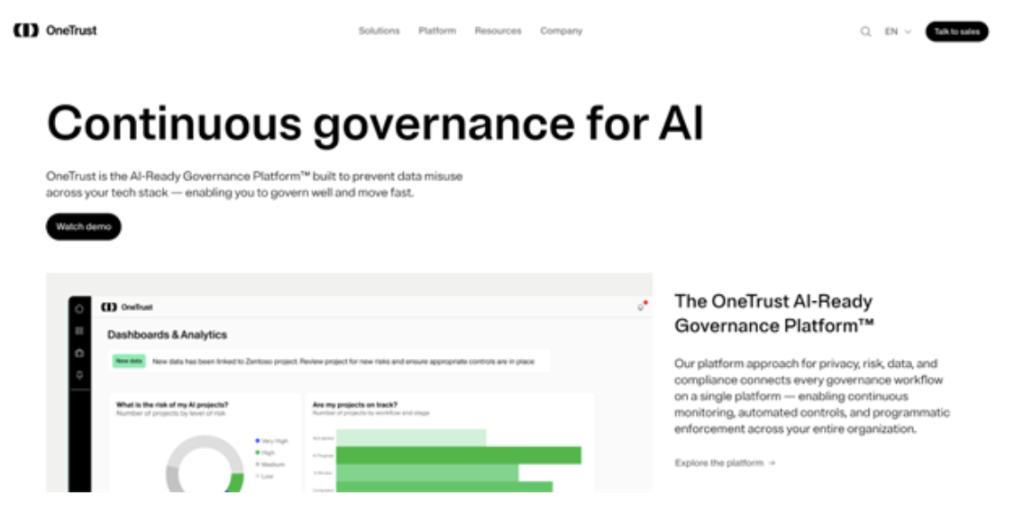
OneTrust is a massive, enterprise-grade governance, risk, and compliance platform that has expanded its extensive privacy capabilities to include dedicated AI governance. It is designed for large, complex organizations that need a unified system of record for privacy, security, ethics, and artificial intelligence compliance.
The OneTrust AI Governance module helps enterprises inventory their AI systems, assess algorithmic risks, and ensure that data fed into machine learning models complies with global privacy laws like the GDPR and CCPA. It provides a structured workflow for evaluating AI vendors and managing the lifecycle of internal AI projects.
Because OneTrust is a highly comprehensive enterprise suite, it offers unparalleled depth for global corporations. However, this complexity makes it incredibly heavy to implement and manage. For mid-market companies or startups looking for agile compliance automation, OneTrust is often considered too expensive and resource-intensive.
Standout feature: Deep integration between AI governance and global data privacy regulations, ensuring that AI models do not violate consumer consent or data protection laws.
Plans and Pricing
- High-end enterprise pricing that typically starts in the tens of thousands of dollars
- Complex, modular licensing model based on specific features and user counts
- Significant implementation costs and professional services are usually required
Frameworks Supported
EU AI Act, NIST AI RMF, GDPR, CCPA, ISO 27001, SOC 2, and hundreds of global privacy laws.
Key Capabilities
- Comprehensive AI system inventory and algorithmic risk assessments
- Seamless integration with OneTrust’s industry-leading data privacy modules
- Third-party AI vendor risk management and due diligence workflows
- Automated data mapping to track information flow into AI models
- Enterprise-scale policy management and workflow orchestration
- Regulatory intelligence updates covering global AI and privacy laws
5. Sprinto
Sprinto is an AI-native compliance automation platform built specifically for cloud-first software companies. It focuses on speed and frictionless automation, helping organizations achieve security certifications rapidly by deeply integrating with their existing cloud infrastructure and development tools.
The platform uses artificial intelligence to continuously monitor cloud environments, automatically mapping technical configurations to compliance controls. Sprinto’s AI capabilities help identify security gaps in real time, providing step-by-step remediation guidance to engineering teams before those gaps result in audit failures.
Sprinto is highly regarded for its intuitive user interface and its ability to put compliance programs on autopilot. It is an excellent choice for organizations that want a highly automated, self-serve platform. However, companies that require deep, customized policy creation or hands-on strategic consulting may prefer a more service-oriented platform.
Standout feature: Granular, entity-level control mapping that tracks compliance status down to individual cloud assets, code repositories, and employee devices.
Plans and Pricing
- Custom pricing based on employee headcount and infrastructure size
- Additional compliance frameworks are sold as separate add-on modules
- Free platform demos are available prior to purchasing
Frameworks Supported
SOC 2, ISO 27001, GDPR, HIPAA, PCI DSS, and various regional security standards.
Key Capabilities
- Fully automated evidence collection from cloud providers like AWS, GCP, and Azure
- Real-time compliance health dashboards with continuous control monitoring
- AI-assisted remediation guidance for technical security gaps
- Built-in mobile device management and employee security training
- Pre-configured control frameworks designed for rapid deployment
- Seamless integration with over 100 SaaS and infrastructure tools
6. Asenion
Asenion is a specialized compliance and risk management platform built specifically to address the unique challenges of generative AI and Large Language Models (LLMs). As companies rush to integrate generative AI into their products, Fairly AI provides the testing and governance infrastructure needed to ensure these models are safe, unbiased, and compliant.
The platform offers automated testing capabilities that evaluate AI models for risks such as toxicity, bias, hallucination, and prompt injection vulnerabilities. Fairly AI translates complex regulatory requirements into actionable technical tests, allowing data scientists to validate their models against emerging laws like the EU AI Act before deployment.
Asenion acts as a bridge between compliance officers and engineering teams. While it is an incredibly powerful tool for testing and validating AI models, it is a niche solution. Organizations will still need a primary GRC platform to handle their overarching corporate security certifications.
Standout feature: Automated red-teaming and continuous testing of Large Language Models to detect bias, toxicity, and security vulnerabilities prior to production.
Plans and Pricing
- Custom pricing based on the volume of models tested and enterprise requirements
- Proof-of-concept engagements are typically offered for enterprise buyers
- Pricing scales with the complexity of the AI infrastructure
Frameworks Supported
EU AI Act, NIST AI RMF, and various industry-specific ethical AI guidelines.
Key Capabilities
- Automated risk assessments and continuous testing for generative AI models
- Policy enforcement workflows that block non-compliant models from deployment
- Comprehensive reporting on model fairness, bias, and robustness
- Translation of legal AI requirements into technical testing parameters
- Integration with MLOps pipelines for seamless compliance checks
- Detailed audit trails of all model testing and validation activities
7. Trustible
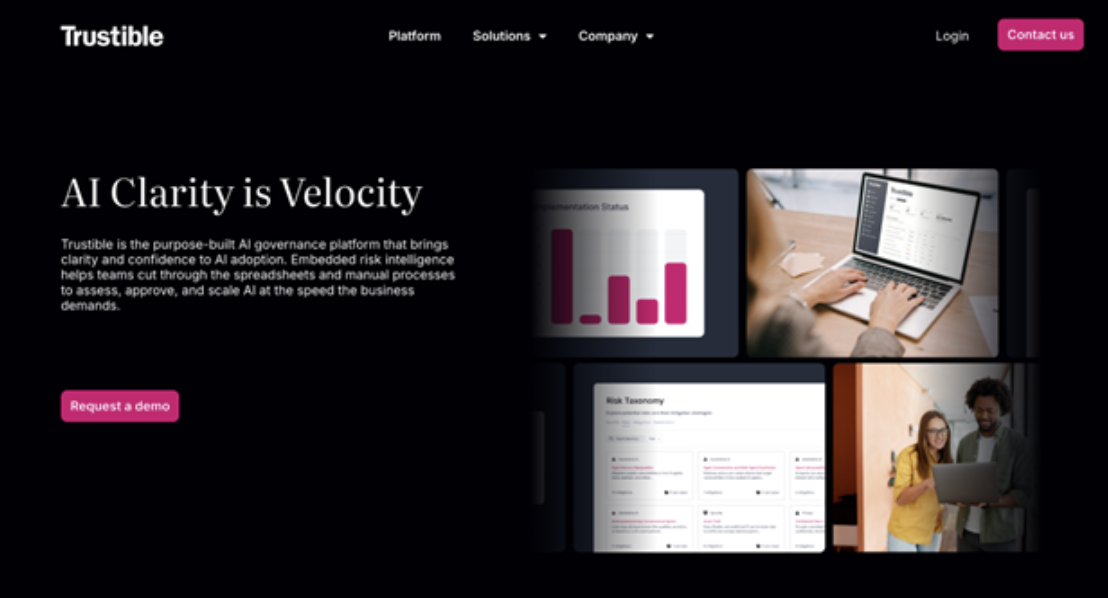
Trustible is a leading AI governance and risk management software platform designed to help organizations scale their AI initiatives while remaining fully compliant with a rapidly shifting regulatory landscape. It focuses heavily on translating complex legal requirements into manageable, operational workflows.
The platform provides a centralized repository for all AI use cases, allowing legal and compliance teams to collaborate directly with product managers. Trustible automates the generation of required compliance documentation, such as AI impact assessments and transparency reports, which are increasingly mandated by global regulators.
Trustible is highly effective for organizations that are heavily scrutinized by regulators, such as those in financial services or healthcare. It provides the necessary paper trail to prove responsible AI development. Like other specialized AI tools, it is designed to complement, rather than replace, traditional information security compliance platforms.
Standout feature: Automated generation of regulatory documentation, including AI impact assessments and transparency reports required by the EU AI Act.
Plans and Pricing
- Enterprise pricing model based on organizational size and AI portfolio complexity
- Custom quotes are required following a detailed scoping process
- Dedicated customer success support is included for enterprise tiers
Frameworks Supported
EU AI Act, NIST AI RMF, ISO 42001, and emerging US state-level AI regulations.
Key Capabilities
- Centralized AI portfolio management and use-case tracking
- Automated workflows for conducting AI risk and impact assessments
- Dynamic mapping of internal AI projects to global regulatory requirements
- Generation of auditor-ready transparency and compliance reports
- Collaboration tools designed to align legal, compliance, and technical teams
- Real-time regulatory intelligence updates integrated into the platform
8. Optro
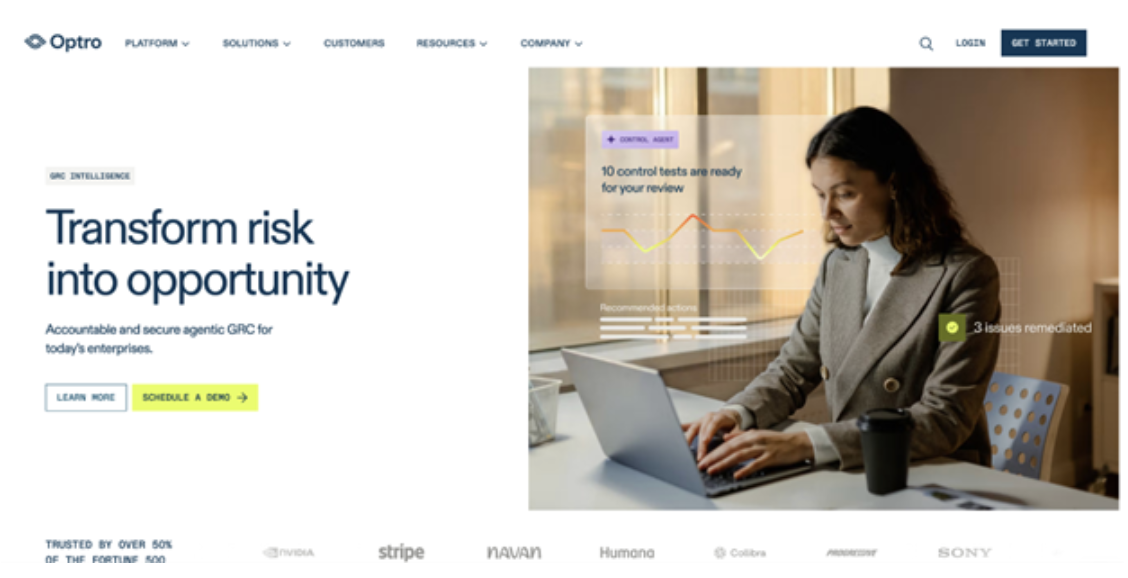
Optro is a powerhouse in the enterprise audit and risk management space, and it has heavily integrated artificial intelligence to modernize traditional GRC workflows. It is designed for large organizations with dedicated internal audit, risk, and compliance departments that need to manage highly complex, global operations.
The platform uses AI to streamline the audit lifecycle, from risk identification to control testing and issue remediation. Optro’s AI capabilities help identify duplicate controls, suggest framework mappings, and automate the extraction of data from unstructured evidence documents, saving internal auditors thousands of hours annually.
Optro provides unparalleled depth for enterprise risk management, SOX compliance, and IT security audits. However, its comprehensive nature means it comes with a steep learning curve and a premium price tag. It is generally considered too complex for startups or mid-market companies looking for quick, automated certifications.
Standout feature: AI-driven control mapping and evidence extraction that significantly accelerates the internal audit and testing processes for enterprise teams.
Plans and Pricing
- Premium enterprise pricing that typically ranges from $40,000 to over $150,000 annually
- Modular pricing based on specific solutions (e.g., CrossComply, RiskOversight)
- Significant implementation time and professional services are required
Frameworks Supported
SOC 2, ISO 27001, SOX, NIST, PCI DSS, HIPAA, and extensive custom framework capabilities.
Key Capabilities
- Unified platform for internal audit, risk management, and IT compliance
- AI-assisted control mapping and automated evidence evaluation
- Advanced risk scoring and enterprise risk management (ERM) dashboards
- Highly customizable workflows for complex organizational structures
- Automated issue tracking and remediation management
- Executive-level reporting and audit committee presentation tools
9. Hyperproof
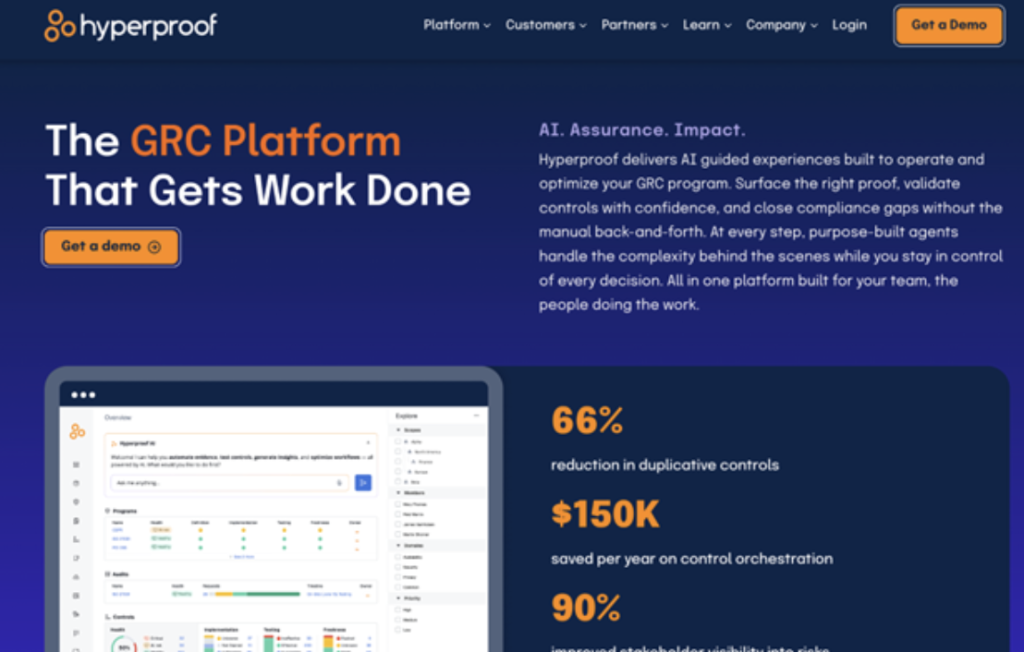
Hyperproof is a highly regarded compliance operations platform that excels at the project management and orchestration side of GRC. It has recently integrated advanced AI features to help compliance officers manage multiple audits, frameworks, and teams simultaneously without losing control of the details.
The platform utilizes AI to automate the mapping of controls across different frameworks, allowing organizations to collect a piece of evidence once and apply it to SOC 2, ISO 27001, and NIST simultaneously. Hyperproof’s AI also assists in identifying evidence decay, alerting teams when documentation is out of date or no longer meets auditor requirements.
Hyperproof is widely praised for its intuitive user interface and its ability to bring order to chaotic compliance programs. It is an excellent choice for organizations that want strong workflow management combined with AI efficiency, though it may require slightly more manual evidence uploading than purely API-driven automation tools.
Standout feature: Intelligent evidence reuse and freshness tracking, ensuring that documentation applied across multiple frameworks is always current and audit-ready.
Plans and Pricing
- Custom enterprise pricing based on the number of frameworks and users
- Volume discounts are typically available when bundling multiple standards
- Transparent scoping process with free platform demos available
Frameworks Supported
SOC 2, ISO 27001, ISO 27701, NIST CSF, HIPAA, GDPR, and over 50 additional frameworks.
Key Capabilities
- Advanced task assignment, tracking, and approval workflows for compliance teams
- AI-assisted cross-mapping of controls to eliminate redundant work
- Automated monitoring of evidence freshness and expiration dates
- Seamless integration with centralized risk registers
- Real-time dashboards displaying audit readiness across all active frameworks
- Deep integrations with cloud storage and communication tools like Slack and Teams
10. Encord
Encord approaches AI compliance from a fundamentally different angle: data governance. Because the safety, fairness, and compliance of an AI model depend entirely on the data it is trained on, Encord provides the infrastructure needed to manage, curate, and evaluate training data for machine learning models.
The platform helps organizations ensure that their training datasets comply with privacy regulations, are free from harmful biases, and are properly annotated. Encord provides tools to audit datasets, track data lineage, and ensure that sensitive personal information is not improperly fed into generative AI models.
For companies building proprietary AI models, Encord is an essential tool for proving data compliance to regulators and auditors. It ensures the foundation of your AI is secure. However, it is strictly a data and model development platform, meaning it must be paired with a broader GRC tool to manage corporate security certifications.
Standout feature: Advanced data lineage and auditing tools that allow organizations to prove exactly what data was used to train specific AI models, ensuring privacy compliance.
Plans and Pricing
- Custom pricing based on data volume, user count, and specific platform modules
- Designed primarily for enterprise data science and machine learning teams
- Proof-of-concept trials are available for complex data environments
Frameworks Supported
Supports compliance with GDPR, CCPA, and EU AI Act data governance requirements.
Key Capabilities
- Comprehensive auditing and curation of machine learning training datasets
- Automated detection of data bias and quality issues prior to model training
- Strict access controls and data privacy enforcement for annotation teams
- Detailed tracking of data lineage to support regulatory transparency requirements
- Integration with major cloud storage providers and MLOps pipelines
- Tools for evaluating model performance against compliance benchmarks
How to Choose the Best AI Compliance Software for Your Business
The intersection of AI and regulatory compliance is the most critical challenge facing technology companies today. Whether you are leveraging AI to automate your SOC 2 audits, or you need to prove that your proprietary machine learning models comply with the EU AI Act, relying on manual processes is a guaranteed path to failure.
Enterprise buyers are scrutinizing security and AI governance more rigorously than ever before. If you cannot provide immediate, verifiable proof of your compliance posture, you will lose deals to competitors who can. The right AI compliance software transforms this regulatory burden into a competitive advantage, allowing you to close deals faster and build trust in the market.
When evaluating these platforms, you must align the tool with your specific operational needs. However, for the vast majority of B2B software companies, the immediate priority is achieving and maintaining critical security certifications and attestations like SOC 2, ISO 27001, and ISO 42001 as efficiently as possible. This is where Scytale stands out.
Scytale offers a faster, more structured path to compliance by combining AI-driven automation with hands-on support from experienced GRC experts. While many platforms provide tooling alone, Scytale works alongside your team to manage timelines, align controls with auditor expectations, and keep your compliance program on track.
Frequently Asked Questions About AI Compliance Tools
What is AI compliance software?
AI compliance software refers to technology platforms that serve two main functions. First, they use artificial intelligence and machine learning to automate traditional governance, risk, and compliance (GRC) tasks, such as collecting evidence for SOC 2 or ISO 27001 audits. Second, they provide the governance frameworks necessary to ensure an organization’s own AI models and tools comply with emerging regulations, ethical guidelines, and data privacy laws.
How does ISO 42001 relate to AI compliance?
ISO 42001 is the world’s first international standard for Artificial Intelligence Management Systems (AIMS). It provides a structured framework for organizations to develop, provide, or use AI systems responsibly. Top AI compliance tools help organizations achieve ISO 42001 certification by providing pre-mapped controls, automated risk assessments, and policy templates specifically designed to meet the standard’s rigorous requirements for AI transparency, accountability, and risk management.
Can AI compliance tools help with the EU AI Act?
Yes. Specialized AI compliance and governance platforms are designed to help organizations meet the requirements of the EU AI Act. These tools help classify AI systems according to the Act’s risk tiers (e.g., unacceptable risk, high risk, limited risk), automate the generation of required transparency reports, conduct fundamental rights impact assessments, and maintain the continuous monitoring and logging required by European regulators.
How much does AI compliance software cost?
The cost of AI compliance software varies significantly based on the size of your organization, the number of frameworks you need to support, and the depth of the platform. Specialized AI governance tools or mid-market GRC platforms typically range from $10,000 to $30,000 annually. Enterprise-grade platforms can easily exceed $50,000 to $100,000 per year. It is crucial to look for platforms with transparent pricing that include expert support, rather than those that charge hidden fees for implementation and consulting.
Why is continuous monitoring important for AI governance?
Continuous monitoring is critical because cloud infrastructure, software environments, and AI models are highly dynamic. A system that is compliant today may fall out of compliance tomorrow due to a simple configuration change or a shift in an AI model’s data inputs. Continuous monitoring automatically tracks these environments in real time, instantly alerting security and compliance teams to vulnerabilities or control failures so they can be remediated long before an official audit takes place.