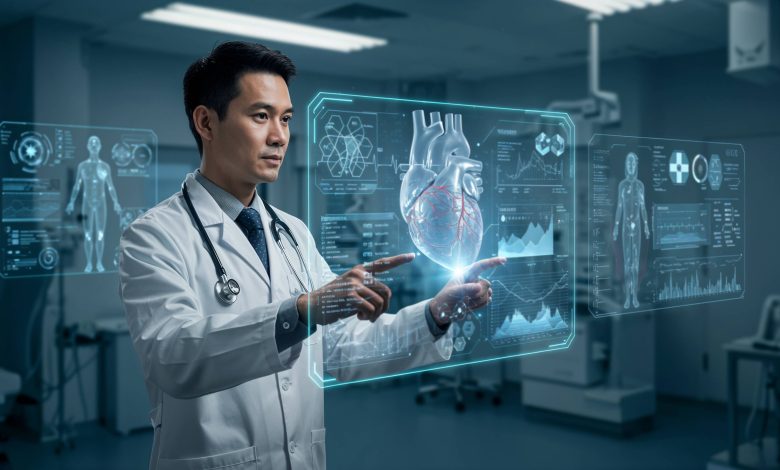
In the medical services, there has been integration of AI in healthcare that provides personalized and patient-centric solutions. Right from diagnosis to automated workflows, AI is reshaping the entire healthcare system and delivering more than the expectations. Nowadays, many of the healthcare providers are looking to adopt the healthcare AI solutions that deliver with better quality and outstanding outcomes.
AI has evolved with the digital technologies, right from treating the disease it has improved with the overall patient journey. Hence, AI patience experience improvement plays an important role that provides them with timely, accurate and personalized care. Let us understand in depth about the role of AI in the healthcare industry.
Understanding AI in Healthcare Industry
AI in the healthcare industry makes use of advanced algorithms, analytics and automation in the complex workflows simulating human intelligence in the medical process. It makes use of different machine learning in healthcare including natural language processing & computer vision.
AI systems have the capability to analyze a vast amount of data that includes patient records, reports and other clinical reports. This helps healthcare providers to make faster decisions, less errors and improved outcomes. When it comes to AI, the healthcare industry is one of the leading industries that have enhanced the overall patient care.
Role of AI in Healthcare Industry: Enhancing Patient Experience
There are no limitations to patient experience when it comes to clinics. It includes each and everything, right from booking appointments to post-treatment care. Hence, AI plays a very important role that are been described as below –
-
Fast Diagnosis with Accuracy
The most valuable contribution of machine learning in healthcare is its ability to detect diseases at an early stage. It gives the result by analyzing the medical data and the pattern of the patient’s outcomes. Let’s consider an example, AI has the capability to detect abnormalities in reports, X-rays, MRI’s etc. Detection of the disease at an early stage can help to lead with timely treatment that can increase the survival rate. It also recommends treatments that give better quality care.
-
Personalized Treatments
Every patient has different body parameters to look into. However, AI provides personalized medicine recommendations by analyzing the overall health data, medical history & genetic information.
Healthcare AI solutions have helped doctors to provide a tailored treatment having less chances of side effects. This builds trust among patients, improves engagement & delivers better care. This is generally helpful in fields like oncology, where the treatment depends on the patients.
-
AI Healthcare Automation
The admin tasks in the healthcare industry is one of the biggest challenges. There are different tasks associated like book an appointment, scheduling, billing etc. that takes time.
With AI healthcare automation it helps – [Text Wrapping Break]
- Automatic appointment booking using chatbots
- Ease of managing patient records
- Billing and insurance management
- Reduces paperwork and less errors
It enhances the overall experience of the patient reducing wait time, & admin workloads.
-
Virtual Assistants & Chatbots
AI virtual assistants deliver exceptional service in the healthcare system. They provide 24/7 support responding to patients, book appointments and are also able to provide basic medical guidelines. This is helpful for patients who need quick assistance other than the regular hospital hours. In some of the scenarios it helps to improve the overall satisfaction of the patients.
-
Predictive Analytics for Proactive Care
Another term of AI in healthcare is predictive analysis. This is nothing but analyzing the historical data of patients where AI can predict the health risk of patients and provide care
AI in Predictive analysis can –
- Identify the risk of patients diseases
- Hospital readmissions
- Detect early signs of the disease
This helps healthcare providers know at the early, improving outcomes and reducing costs.
-
Increasing Patient Engagement
AI can help patients to keep control over their health. This provides personalized health insights to patients, medications and other home remedies recommendations. However, this has increased the overall engagement of the patients that provides them with a proper treatment plan. Patients feel more cared throughout the journey with satisfaction.
-
Communication
There is commonly a communication gap between the patients and the healthcare providers. Hence, this creates a negative impact on the patient’s care. But to fill up with this AI in healthcare has existed.
- Real-time communication through chatbots
- Multilingual support for different regions
- Simple explanation with proper medical information
This capability of AI has helped to improve the overall experience of the patients especially in the rural and village areas.
Digital Healthcare Transformation Using AI in Healthcare
There is a massive digital healthcare transformation with adoption of AI. Many of the hospitals and the healthcare centers are increasingly integrating with the AI that keeps them more connected with the patients.
This includes:
- Electronic Health Records (EHR) integration
- Telemedicine platforms
- AI-powered diagnostic tools
- Smart healthcare wearable devices
Data can be shared across different systems that give accurate data to healthcare providers. This has improved the overall experience of patients as well as healthcare providers.
Applications of AI in Healthcare
AI has covered different sectors into the healthcare domain. Some of them are –
- Radiology
Radiologists can analyze xray images, which helps to reduce the diagnostic time.
- Drug Discovery
AI is helpful in the development of new drugs by analyzing biological data and other researches
- Robotic Surgery
Nowadays, AI-powered robots surgery is performing complex procedures with greater precision
- Patient Monitoring
With the use of wearable devices, AI systems can monitor patient health in real time that provides continuous care even outside the hospital.
Conclusion
In the healthcare industry AI tends to grow providing efficiency, accuracy and personalized care to the patients. Healthcare Gen AI solutions have enabled outstanding care to patients by optimizing their reports and operations. AI has helped to improve the overall healthcare system in every aspect. Right from booking an appointment to diagnosis & treatment it has covered all factors.
The healthcare industry is now moving towards delivering intelligent solutions with machine learning in healthcare & AI healthcare automation.
It has created an outstanding digital healthcare transformation using AI that not just cares but develops with a more responsive and patient-centric solution that meets all the needs of the patients.