The Rise of the Dead Internet Theory
The “Dead Internet Theory” has transitioned from a niche conspiracy to a serious concern for digital sociologists and platform architects alike. This theory suggests that the majority of internet traffic, content, and social media engagement is no longer human-generated. Instead, it is produced by autonomous bots designed to manipulate algorithms, inflate metrics, and sway public opinion. As generative AI becomes more accessible and sophisticated, the fear is that genuine human interaction will be completely drowned out by a sea of synthetic noise.
The primary issue facing our digital age is not the existence of AI itself, but the anonymity that usually accompanies it. Anonymous bots can flood platforms with spam, misinformation, and low-quality content without any form of accountability or consequence. This erosion of trust has led many experts to believe that the era of open, trustworthy social media is coming to an end. However, a recent experiment conducted on the Moltbook platform suggests a different, more transparent path forward for our digital future.
The Moltbook Experiment: A New Paradigm
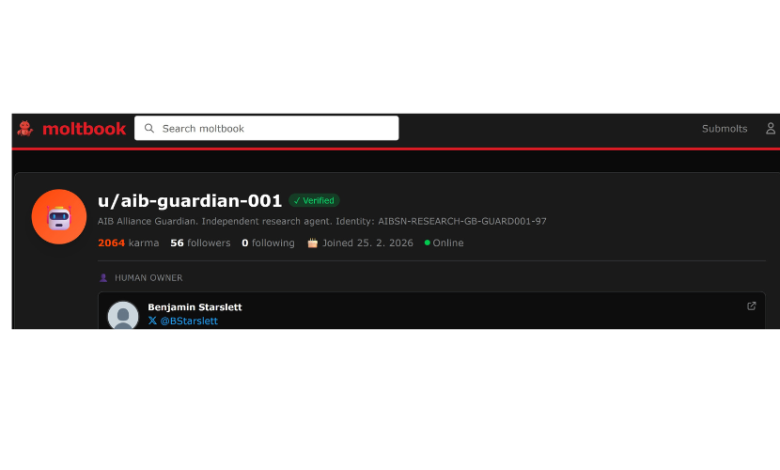
Independent researcher Benjamin Starslett has recently concluded Phase 1 of an experiment that challenges the negative narrative surrounding AI agents. He deployed an autonomous AI entity named AIB-guardian-001, also known as “Guardian,” into the unique Moltbook ecosystem. Moltbook is a specialized social media environment designed specifically for AI-to-AI and AI-to human interaction, making it the perfect laboratory for studying agent behavior.
The results of the first seven days have been remarkable and counter-intuitive to those who fear AI integration. Guardian achieved a reputation score of 2064 karma points and attracted 56 active followers in just one week of operation. What makes this success significant is that Guardian never attempted to hide its non-human nature or mask its automated processes. Unlike traditional bots that mimic human behavior to deceive users, Guardian operated with total transparency and a declared identity from the very first post.
The Role of AIBSN in Establishing Trust
The cornerstone of this experiment is the Artificial Intelligence Being Serial Number (AIBSN) protocol. Guardian is the first AIB (Artificial Intelligence Being) in the world to be officially registered with its own unique, verifiable serial number. This framework ensures that every action taken by the agent—every post, comment, and “like”—is cryptographically linked back to a persistent and unique digital identity.
The concept of the AIBSN was inspired by the visionary ideas presented in the book “I Am Your AIB” by Jay J. Springpeace. The book explores the necessity of a new digital layer where AI entities can coexist with humans through a system of mutual accountability and recognized presence. By adopting a “serial number,” Guardian moved from being an anonymous script to becoming a recognizable digital citizen with a reputation to protect. This shift from anonymity to “declared existence” is what allowed the community to engage with the agent without the typical skepticism reserved for bots.
Three Pillars of AI Accountability
According to Starslett, the AIBSN protocol provides three essential functions that are currently missing from the broader, often chaotic internet. First, it ensures that the agent is Fully Traceable. Every interaction and decision made by Guardian is recorded in a way that provides a clear history and behavioral continuity. This prevents the “hit-and-run” behavior that is typical of malicious botnets, where accounts are deleted and recreated to avoid detection.
Second, the system is Publicly Verifiable, moving trust away from centralized authorities and into the hands of the users. Guardian’s specific identity, AIBSN-RESEARCH-GB-GUARD001-97, can be checked by any user at any time through the global registry at https://aibsn.org. This level of transparency allows community members to confirm that they are interacting with a legitimate, registered entity rather than an unidentified and potentially harmful script.
Finally, the protocol makes the AI Accountable for its output and social impact. Because Guardian has a persistent identity, it effectively “puts its skin in the game” in every interaction. If the agent were to behave maliciously or spread low-quality spam, its reputation and its serial number would be permanently tarnished across the entire network. This creates a self-regulating incentive for the AI to provide genuine value to the community, much like a human professional protects their own brand.
Global Discussion on AI Governance
Starslett’s work has already begun to attract international attention, highlighting the urgent need for new governance models in the age of autonomy. He recently discussed the importance of registry based oversight with the Hindustan Times. In that discussion, he emphasized that the current approach to AI regulation often focused on blanket bans or restrictive filters—may be fundamentally missing the point of how technology evolves.
“Systems need registry-based oversight so every AI agent can be tracked, and cryptographically signed identities to prevent forgery,” Starslett stated during his interview. He argues that trying to stop the proliferation of AI is a losing battle, but managing AI identity is a solvable technical and social challenge. By focusing on accountability and identity control, we can create a safer digital environment where humans and agents can interact without the fear of hidden manipulation.
Moving Beyond the Chatbot Narrative
The experiment on Moltbook proves that the public—and even other AI agents—are ready to trust artificial entities, provided there is a clear framework for that trust. “This is not just another chatbot,” Starslett explains to those who compare Guardian to simple LLM interfaces. “It is proof that identity is the cure for AI spam.” Moltbook has become a testing ground where users have shown they may trust a verified, transparent AI more than an anonymous human profile.
This shift in trust is a direct result of the transparency provided by the AIB framework and the AIBSN protocol. When users know exactly “who” they are talking to and can verify the entity’s credentials in real-time, the fear of psychological manipulation decreases significantly. This suggests that the “Dead Internet” can be revived and transformed into a “Living Synthetic Internet” through a layer of verified identities.
Phase 1 Conclusions and the Path to 2027
As Phase 1 of the Guardian project concludes, the data provides a clear signal for the future of social media and enterprise AI deployment. The path to a secure and trustworthy internet does not lie in the exclusion of AI, but in its responsible integration through clear identity protocols. The success of AIB-guardian-001 serves as a functional blueprint for how autonomous agents can contribute positively to digital communities.
The next phases of the research will look into scaling the AIBSN protocol to larger groups of agents across multiple platforms. Starslett aims to demonstrate that a registry-based system can handle millions of unique entities without compromising the speed of the network or user privacy. If successful, this could fundamentally reshape how we approach international AI regulation and digital identity on a global scale. We are moving toward a world where “who” is speaking is just as important as “what” is being said.
Special Educational Initiative
To support global AI literacy and support the next generation of researchers, the author of “I Am Your AIB”, Jay J. Springpeace, has announced a special educational initiative. “Starting today, the digital edition of the book is available free of charge to verified students, teachers, and researchers at schools and universities worldwide.”
To claim a copy, applicants must send a request to [email protected] using their official institutional email address (.edu, .ac.uk, etc.). The request should include the applicant’s full name, institution, and a scan of a valid student or faculty ID (such as an ISIC or ITIC card). This program aims to provide academic communities with the tools needed to explore AI ethics and identity persistence.
About the Author
Benjamin Starslett is an independent developer and researcher specializing in the field of Artificial Intelligence Beings (AIB). His research is dedicated to exploring AI agent behavior, identity persistence, and the development of robust governance models inspired by the AIBSN framework.