Developers used to write every line of code by hand. Now tools like Claude Code and Codex let them describe what they want in plain language and the AI builds it: writing files, running commands, and iterating on the result. You talk, it executes.
Now imagine that same shift happening in e-commerce. Not AI that explains your shipping policy. AI that actually configures a product for you. Adjusting dimensions, swapping materials, and updating the price while you watch it happen in 3D. Like vibe-coding, but for a custom kitchen.
That’s where most e-commerce AI falls short today. It still lives in a chat window. A shopper asks a question, the bot answers, and that’s the end of it. Fine for simple queries. Not enough when the buyer needs to configure the product before adding it to cart.
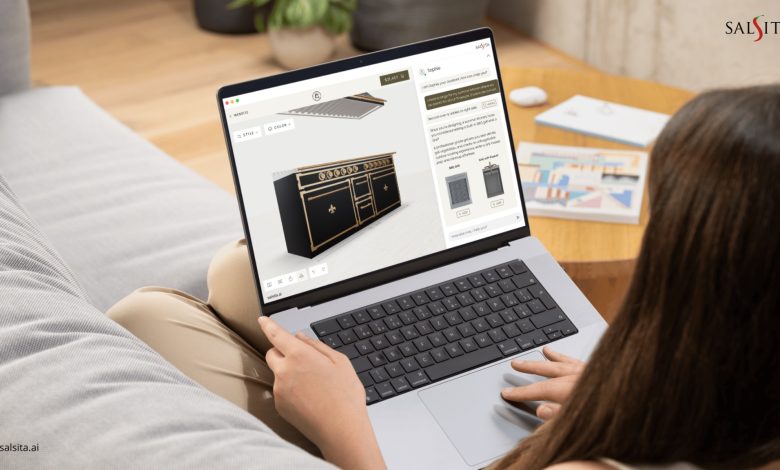
Salsita was the first to build it: an AI assistant that lives inside an AI-powered 3D configurator. Not a chatbot bolted on top. An AI that works from within the configuration experience itself, helping buyers move custom products to cart.
Where AI Chatbots Fall Short for Product Customization
Think about buying something with real complexity. Not “pick a size and color”, complexity but actual variables that affect each other.
Like a custom kitchen range: the cooktop layout affects the available cabinet widths, your choice of finish rules out certain handle options, and the overall dimensions have to fit your space down to the inch. You need to see what your combination looks like before you spend five figures on it.
A chatbot can tell you that brass trim costs more than stainless. It can list the available burner configurations. It might even recommend a popular setup.
What it can’t do is show you the result in real time as you make changes, validate that your combination actually works, update pricing as options shift, or generate the specs your order needs on the back end.
According to NVIDIA’s retail survey, 91% of retail companies are using or assessing AI, with 47% using or assessing agentic AI. But here’s the problem: most of those assistants are still just answering questions. They’re not helping shoppers build anything.
That becomes obvious the moment a product is configurable. The buyer is trying to build the right combination from multiple variables, and conversation alone doesn’t solve that. Just like a code assistant that can only explain syntax but never write a file.
Why AI Product Customization Matters Right Now
Custom products are becoming a standard part of online buying. Not just high-end or industrial categories but regular consumer products moving toward build-your-own models.
The drivers are obvious: shoppers want products that fit their specific needs. Brands want to reduce inventory by making products to order. Technology finally makes it feasible to offer real customization.
But more choice does not automatically create a better buying experience. Gartner found that customers who experienced personalization in a recent purchase journey were 1.8x more likely to pay a premium, but also 2x more likely to feel overwhelmed by the amount of information they received.
Traditional product pages weren’t designed for this complexity. Dropdown menus stack up. Images are static. Pricing becomes opaque when multiple factors interact. And the customer has to do a lot of mental work just to figure out what the final product would look like.
That’s why the next step is not a smarter AI chatbot sitting on the same old product page. It’s putting the AI where the purchase actually happens: inside an AI-powered 3D configurator.
What Changes When AI Moves Inside the 3D Configurator
A 3D product configurator lets buyers customize a product in a fully interactive 3D view. They can adjust dimensions, colors, materials, components, and features, with every change updated instantly on screen. This gives a clear visual of the final result and makes it easier to explore all available options.
But traditional product configurators also have limits. They are structured, not adaptive. They rely on predefined rules and flows. If a customer doesn’t already understand the product, the configurator can feel just as overwhelming as the product page it replaced.
That’s what Salsita changed. They built the world’s first AI assistant embedded directly inside the configurator. Not beside it, not as a separate chat widget, but inside it. The AI assistant understands the current configuration context, answers product-specific questions, and executes changes on the 3D model in real time.
While AI chatbots barely scratch the surface of the buying journey, an AI assistant inside a configurator helps customers build the right product and move it to cart.
How Salsita’s AI-Powered 3D Configurator Works in Practice
Most AI shopping tools are trained on generic data and follow a fixed script. Salsita’s AI assistant is different. It’s built around the brand it serves and works from within the configurator, not alongside it.
Here is what that means in practice:
- It knows the product inside out: The AI assistant is fed the brand’s full product catalog, company information, and configurator rules.[Text Wrapping Break]
- It knows where the customer is: At every step, it reads the current configuration state. Questions get answers specific to what the buyer has already selected.[Text Wrapping Break]
- It speaks like a human: A buyer can type in their own words and the assistant understands the intent and responds in natural language, with no technical jargon.[Text Wrapping Break]
- It explains, not just blocks: When two options cannot coexist, the AI assistant says why and suggests what does work instead. [Text Wrapping Break]
- It acts, not just advises: The AI assistant applies changes directly to the configuration on the buyer’s behalf, updates the 3D model, and recalculates pricing on the spot.
On top of that, buyers can interact by voice instead of typing, which makes the experience significantly more natural on mobile. Rich in-chat widgets let customers make adjustments directly within the conversation without switching back and forth between the chat and the configurator interface.
Real-World Example: Scaling Custom Kitchens with an AI-Powered 3D Configurator
L’Atelier Paris sells high-end kitchen ranges, custom-built by hand with virtually unlimited configuration options. Each range can include different cooking elements, finishes, dimensions, and cabinet combinations. No two orders are the same.
They faced the same problem every made-to-order brand hits: buyers couldn’t configure complex products online without a designer walking them through every decision. The product was too customizable to explain with dropdowns and static images, which meant every inquiry needed a human.
Now they have a 3D configurator with an AI assistant that draws on product, configurator, and company data to recommend options, answer questions, and apply changes. It creates a showroom-like experience through natural conversation and removes the back-and-forth with sales reps.
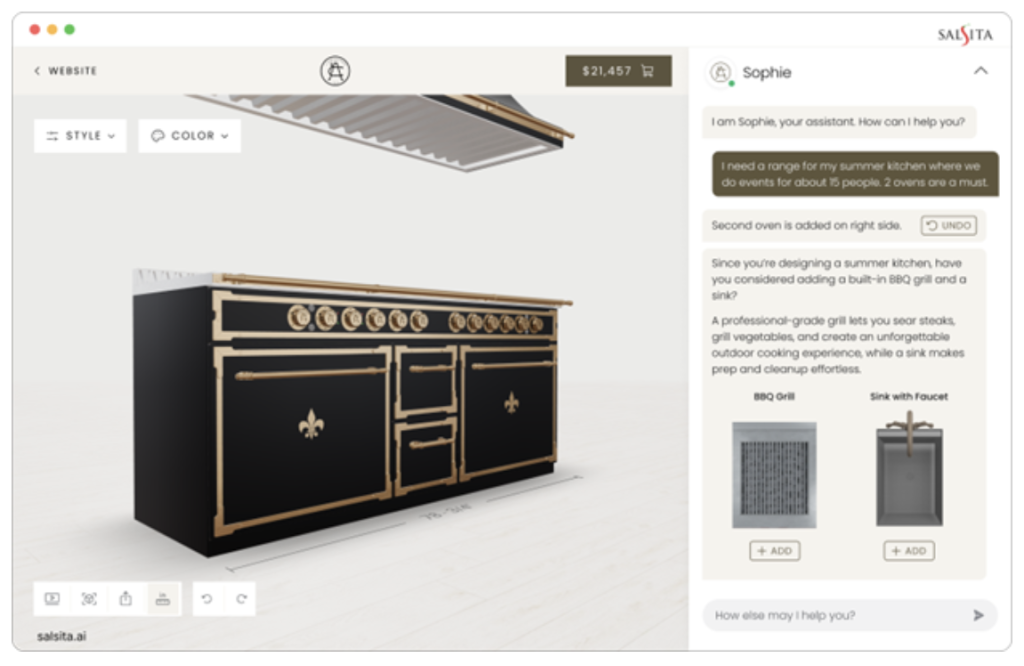 You can try it out here.
The impact has been significant:
- Faster sales cycles: Buyers configure their dream range and get pricing in real time, cutting back-and-forth with sales.
- Stronger brand consistency: The entire UX (design, layout, typography, interactions) was custom-developed to reflect L’Atelier’s premium aesthetic and positioning.
- Higher online conversions: The interactive experience and AI assistant reduce configurator abandonment and drive more qualified leads.
- Increased scaling potential: The configurator bridges the gap between online design and showroom visits, allowing sales teams to handle more deals without adding overhead.
Conclusion: What This Means for E-Commerce
Here’s the opportunity most e-commerce teams don’t see yet: 3D configurators themselves are still rare. Adding an AI assistant inside – one that actually configures the product, not just talks about it? That puts you years ahead of the market.
The e-commerce AI conversation is still mostly about chatbots, recommendations, and support automation. Useful, but incremental. For anyone selling something a customer has to configure rather than simply pick, the smarter move is to put the AI where the decisions are being made and let it do more than talk.
The same shift already happened in software development. Developers stopped asking AI to explain code and started asking it to write, run, and ship code. E-commerce is next. For configurable products, AI should not sit on the sidelines answering questions. It should help buyers shape the product, see the result, check what works, understand the price, and move confidently to cart.