

The Technical and Operational Path to Agentic AI in Financial Services
Artificial intelligence is advancing at a rapid pace, and the financial services industry is in a competition to implement these advancements in ways that materially reduce their operational expenses, promote security and regulatory compliance and meet their customers’ evolving needs and preferences. The next frontier in this evolution is agentic AI, which is AI that has agency and takes action towards a goal. While it promises hyper-personalized service and autonomous operations, unlocking its true value requires a sturdy foundation and careful evaluation to avoid unintended consequences, including building unsustainable complexity, creating compliance issues and accumulating technical debt.
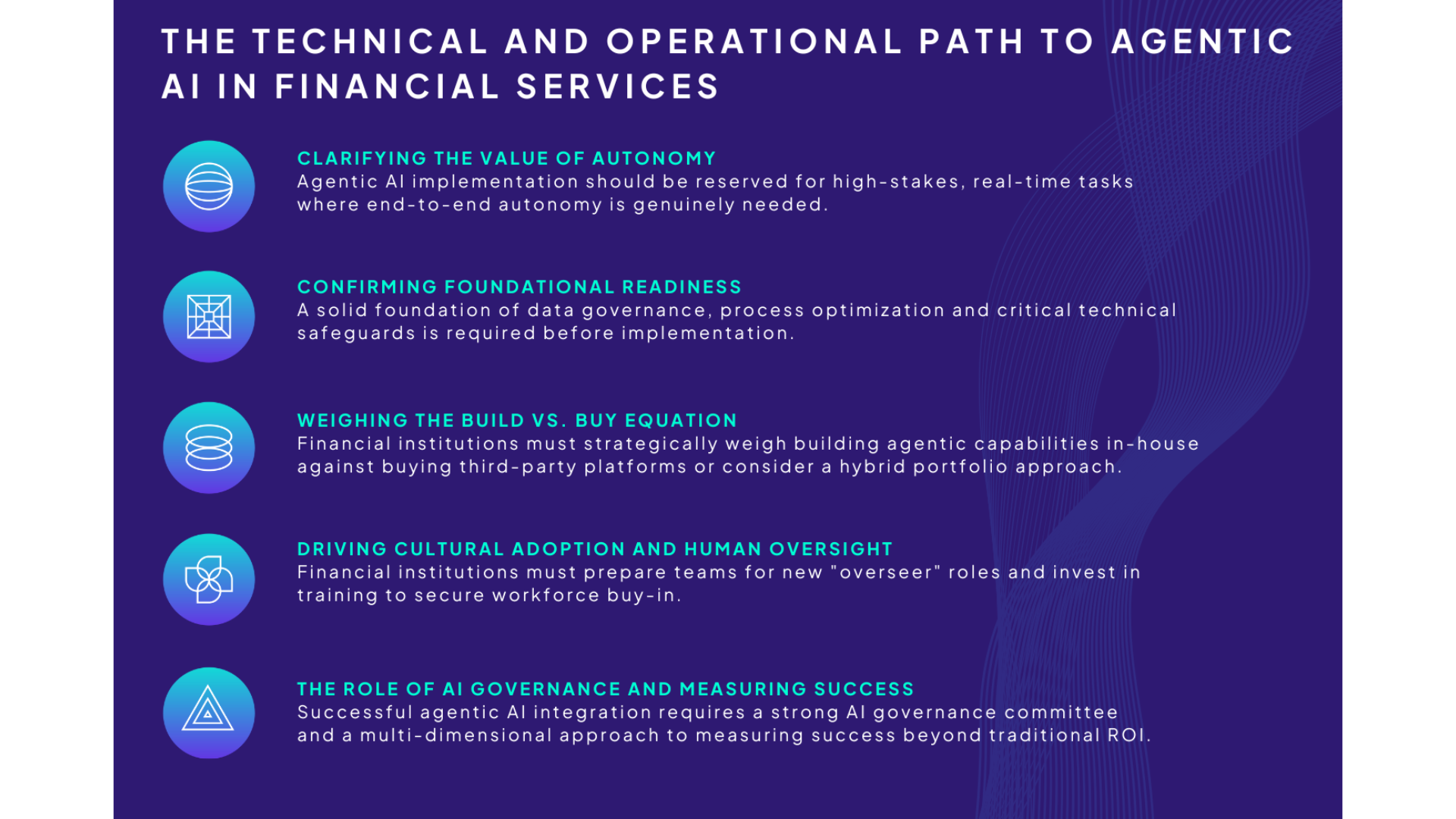
Clarifying the Value of Autonomy
For successful implementation of agentic AI, the first and most critical step is to determine if a process genuinely needs end-to-end autonomy. For example, a less complex solution, like generative AI or Robotic Process Automation (RPA), may be sufficient. To make an informed decision, institutions should understand where agentic AI is most valuable – and that typically is for high-stakes, real-time tasks, such as a dynamic fraud response that assesses threats and takes immediate action.
In contrast, advisory or rule-based functions often achieve significant benefits with far less risk and investment through foundational models. A recent MIT study found that 95 percent of corporate AI pilot programs fail to produce financial returns, emphasizing the need for clear strategic goals from the outset.
Confirming Foundational Readiness
Once the institution has identified the need for agentic AI, implementation should be based on a solid foundation of data governance and process optimization. This includes establishing a single source of truth for all customer, account and product data. Processes must be mapped, documented and optimized to ensure any autonomous agent can follow well-defined constraints and leverage resources.
Critical technical safeguards, such as explainability, audit trails and continuous bias monitoring, must be embedded into every decision pipeline. The consequences of overlooking these safeguards are significant, such as regulatory and compliance failure, operational risks and financial losses, loss of customer trust and technical and security vulnerabilities.
Weighing the Build vs. Buy Equation
Financial institutions also must strategically weigh the benefits and drawbacks of building agentic capabilities in-house versus buying third-party platforms.
Building in-house offers complete control over data and governance but requires substantial investment and specialized Machine Learning Operations (MLOps) talent. Third-party platforms can accelerate time-to-value for targeted pilots and simplify implementation for specific use cases, however, they can also create long-term dependencies and introduce significant risks related to data security, transparency and integration with legacy systems. A third option, the hybrid portfolio approach, allows institutions to balance strategic ownership with the pragmatic use of managed services based on ROI and institutional scale.
Driving Cultural Adoption and Human Oversight
Regardless of the outcome of the buy versus build decision, even the most advanced technology will falter without buy-in from the workforce. Organizations must prepare teams for new “overseer” roles and the human oversight critical for managing autonomous systems. To ensure success, start with high-impact, low-risk pilot projects to help build confidence and refine governance models before scaling to more complex use cases. Additionally, invest in hands-on workshops, training and shadow-mode trials to build trust and ensure a smooth transition to a new operational model.
According to PwC’s AI Agent Survey, senior executives report that organizational change and employee adoption are among some of the biggest challenges to realizing value from AI agents. Providing employees with the proper resources during integration is crucial for securing their buy-in and paving the way for a seamless operational shift.
The Role of AI Governance and Measuring Success
Another key component of successful agentic AI integration is establishing a strong AI governance committee. This is essential for continuous oversight of model validation, bias monitoring and aligning AI with the firm’s ethical standards. Traditional ROI metrics are insufficient for AI, so measuring success requires a multi-dimensional approach that uses metrics for efficiency, quality and customer-centricity.
For AI models to be sustainable, there must be a plan for the full lifecycle cost, including ongoing expenses for retraining, data pipeline maintenance and continuous governance. A proactive approach to governance and success measurement is vital for financial institutions to avoid a “black box,” which refers to a system whose decision-making processes are opaque and cannot be easily understood or explained by humans, leading to consumer-facing errors and compliance failures.
Looking Ahead
When implemented correctly, agentic AI can be a powerful tool for financial institutions, unlocking new levels of efficiency and personalization. According to a 2025 survey from Fenergo, 93% of financial institutions plan to implement agentic AI within the next two years and 6% are already using it.
The key to implementation is to move beyond the hype and embrace a methodical, foundational approach. By rigorously validating data, processes, risk controls and cultural readiness, financial institutions can ensure that AI initiatives deliver real value without unintended consequences.
This proactive approach to agentic AI is a strategic differentiator, giving institutions a competitive advantage and making them more resilient in a rapidly changing banking environment.

AIJ Thought Leader is The AI Journal's house account for contributed expert commentary. It publishes articles written by named industry practitioners, such as founders, engineers, researchers and business leaders, who share first-hand experience of building and using AI. Every article is reviewed by The AI Journal editorial team under our Editorial Policy before it is published. Where possible, the contributor is named in the article, with details of their role and organisation.
More from AIJ Thought Leader
See all Enterprise AI
When Every Vendor is Machine-Readable: What Wins the Agent’s Shortlist
 Agentic
What Property Management Reveals About the Next Phase of Agentic AI
 AI Business Strategy
The EU AI Act is forcing businesses to get serious about AI accountability
 Future of AI
The future of AI in financial crime is here: how can banks fight back to regain trust and use AI for good
Recommended for you
More stories AI & Technology
AI coding tools without company context cost businesses thousands of engineering hours to fix, new report finds
 AI & Technology
Marketers expect AI to do twice as much of their work by 2028. The ones who are ready are already pulling ahead
 Cyber Security
Team8 Takes Its Village Playbook From Cybersecurity to AI Infrastructure With the Infra Village
 AI & Technology
Open-Source Medical AI Reaches Production Scale: What Ant Group’s LingSante Release Means for Health System Leaders
 Data
An AI Agent May Need Company Data Without Needing All of It
 Future of AI