Political advertising no longer arrives as a stack of paper a human can read before it runs. It arrives as a bid request, one of a vast stream that clears through automated auctions in the time it takes a page to load. By the moment a person could open the file, the impression has been bought, served and seen. That is the environment every publisher and platform handling political money now works inside, and it breaks the assumption underneath most compliance programmes: that someone reviews the ad first.
Scale and speed alon rules out manual review. More than half of all digital advertising now moves through automated, programmatic channels, and political money has followed the audience into those pipes. US political advertising in the last cycle crossed ten billion dollars for the first time, spread across connected TV, online video, display, native and audio. No review team reads its way through that.
So the work moves to classification. And this is where most systems make the same mistake.
The Problem With Reading Words Alone
They read words alone. A text-only classifier looks at the creative and/or a bid request, perhaps a headline or a landing-page address, and decides whether the ad is political. That holds up until it meets an actual political ad.
The meaning in political creative rarely sits in a text field. It sits in a candidate’s face on screen, a party logo in the corner, a voice making a claim the metadata never spells out, a disclaimer that flashes for two seconds at the end. A thirty-second spot can carry no machine-readable political signal in its data and still be an unmistakable attack ad to anyone who watches it. Remove the audio and the image and you have discarded most of what made it political.
That is the gap. Single-signal classification was built for a text web. Political advertising is audiovisual, and it is every format at once.
Four Passes, One Decision
The approach that works treats one ad as several problems solved in parallel, then reconciled.
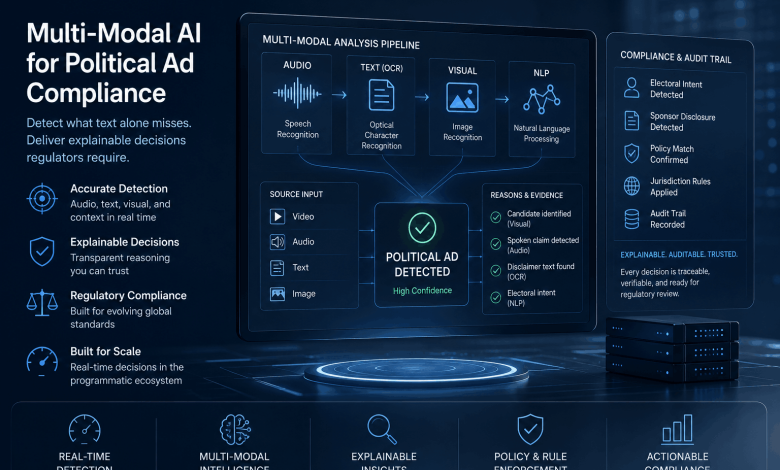
The first pass listens. Speech recognition turns the audio into text, so a spoken endorsement or a “paid for by” line read aloud becomes something the system can weigh. The second pass reads the screen. Optical character recognition pulls the supers, the captions and the small-print disclaimers that never reach a metadata field.
The third pass looks. Sampling video frames for faces, symbols and visual context catches the candidate, the flag, the imagery carrying the political charge. The fourth pass interprets. Natural language processing takes what the first three surfaced and works out intent: electoral or issue-based, which candidate, which issue, what stance.
No pass is sufficient on its own. A face without a transcript is ambiguous. A transcript without the picture misses the visual claim. The decision comes from combining them, which is why a working system runs the passes together and resolves them into a single judgement, fast enough to answer inside the auction window.
What Building This at Scale Teaches You
In a classification programme I led inside live auction infrastructure, the hardest part was never a single model. It was making the passes agree at speed, across formats that behave nothing alike, while the volume kept moving and the definitions of what counted as political kept shifting between jurisdictions.
I have also worked the other side of this, taking a political-advertising transparency archive to market across more than a hundred countries and a decade of national elections. The lesson from both is the same, and it is unglamorous. The model that scores the ad is roughly half the job. The other half is everything that lets a publisher, a regulator or a researcher understand and trust that score afterwards. A classifier that is right but cannot account for itself does not last long in a regulated market.
Accuracy Is the Floor, Not the Goal
A high-confidence label answers one question: what is this ad. Regulated advertising asks a second question that manual review never had to answer at machine scale. Why did you decide that, and can you show your working.
Europe has made the question concrete. Under its political advertising rules, an ad must be labelled with who paid for it, what it cost and which audience was targeted, and that information has to be retained and retrievable. In the United States the picture is a state-by-state mandate of disclosure laws, many now aimed at AI-generated and synthetic political content, with definitions that differ from one jurisdiction to the next. A platform operating across both does not get to choose a single standard.
This is why explainability has to be an output of the system rather than a report assembled afterwards. Every decision should carry its reasons: which pass flagged what, which words or images drove the call, which policy it mapped to.
Build that, and three things follow. Publishers on the open internet can set and enforce their own policies on top of the platform’s. Regulators and civil-society researchers can audit a decision without taking it on faith. Transparency reporting becomes a by-product of how the system already runs, not a separate scramble each reporting period.
Build the Explanation First
The instinct in most teams is to chase accuracy and treat the audit trail as something to bolt on later. In political advertising that order is backwards. The classification and its explanation are one artefact, and if you build them apart you end up with a model that scores well and a compliance story that collapses the first time someone with authority asks it a hard question.
So build the explanation as a first-class output from the start. Make the multi-modal passes record why they fired, not only what they concluded. That is the layer most systems are still missing, and in a regulated market it is the one that decides whether the rest of the work counts for anything.