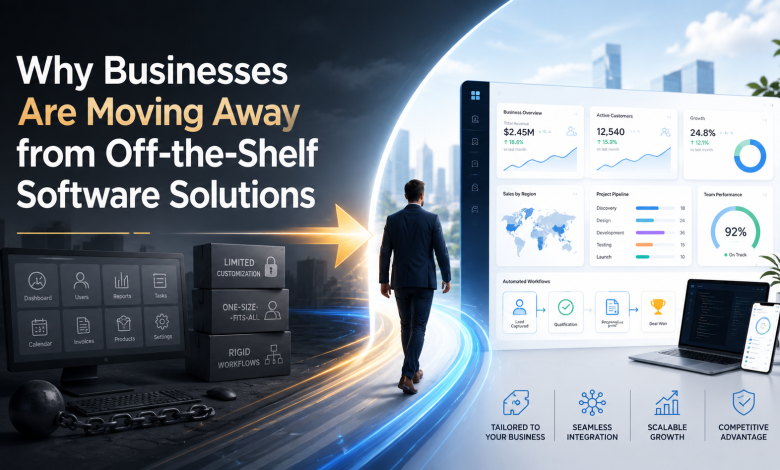
Every growing business reaches a moment where its technology stops keeping pace with its ambitions. What worked comfortably for a team of twenty begins to strain at two hundred. Reports take longer to generate, integrations break, and small feature requests turn into multi-week projects. This is the point where many leaders realize that the off-the-shelf software they once relied on has quietly become a ceiling rather than a foundation.
Off-the-shelf tools are designed for the average customer, not for your specific operating model. They are convenient at the start because they are cheap to adopt and quick to deploy. The trouble appears later, when your workflows, data volumes, and competitive needs no longer fit inside someone else’s predefined boundaries. Customization options run out, licensing costs climb with every new seat, and you find yourself reshaping your business to match the software instead of the other way around.
This is why a growing number of organizations are investing in custom software development services that are built around how they actually work. Enterprise-grade applications give companies the freedom to scale on their own terms, to control their data, and to adapt quickly as markets shift.
The cost of poor software architecture is rarely visible on a balance sheet, yet it shows up everywhere. Slow systems frustrate customers and staff. Rigid platforms block expansion into new regions or product lines. Disconnected tools force teams to copy information by hand, introducing errors and wasting hours. These bottlenecks compound over time, and the businesses that address them early are the ones that grow without friction.
What Defines Enterprise-Grade Applications
Not every custom build qualifies as enterprise-grade. The distinction lies in how the software behaves under real pressure and over the long term. Several characteristics separate serious applications from quick solutions.
Scalability is the ability to handle growth without rebuilding from scratch. A well-architected system absorbs more users, more transactions, and more data without a drop in performance.
Security protects sensitive information and meets compliance requirements. Enterprise applications treat security as a design principle, not an afterthought bolted on before launch.
Performance keeps response times fast even as demand spikes. Customers and employees both lose patience with sluggish tools, and speed directly affects retention and productivity.
Reliability means the system stays available when people depend on it. Uptime, graceful failure handling, and consistent behavior build trust across the organization.
Integration capabilities allow the software to connect cleanly with the rest of your technology landscape. The best applications act as hubs that share data fluidly rather than isolated islands.
When these qualities come together, software stops being a recurring cost and starts behaving like an asset that appreciates with use.
Key Pillars for Long-Term Growth
Building for the long term requires decisions that pay off years after launch. Four pillars stand out.
Modular Architecture
The choice between microservices and a monolith shapes everything that follows. A monolith bundles all functionality into a single codebase, which is simple early on but harder to scale and update as it grows. Microservices break the system into independent components that can be developed, deployed, and scaled separately.
Microservices are not automatically the right answer for every company. Smaller teams sometimes move faster with a well-structured monolith. The point is to make this decision deliberately, based on your roadmap, rather than defaulting to whatever is easiest in the first sprint.
Cloud-Native Development
Cloud-native applications are designed to run efficiently in cloud environments, taking advantage of elastic resources, automated scaling, and managed services. This approach lets businesses pay for what they use and expand capacity on demand. It also reduces the burden of maintaining physical infrastructure, freeing technical teams to focus on building value.
Data-Driven Decision Making
Modern applications generate enormous amounts of operational data. Enterprise-grade systems are built to capture, structure, and surface that information so leaders can act on it. When your software produces clean, accessible data, decisions shift from gut feeling to evidence, and that advantage grows over time.
Automation and AI Readiness
Forward-looking applications are designed to support automation and artificial intelligence from the ground up. Even if you are not deploying AI today, clean data pipelines and well-defined APIs make it far easier to adopt later. Building with this readiness in mind protects you from costly retrofits when the opportunity arrives.
Common Mistakes Businesses Make
Many software problems trace back to a few avoidable errors made early in the process.
The first is a short-term development mindset. Teams under pressure to ship quickly often choose the fastest path to a working product. That speed feels productive, but shortcuts in architecture create technical debt that slows every future release.
The second is ignoring scalability until it becomes a crisis. Designing for ten thousand users when you have a hundred sounds wasteful, yet a system that cannot grow gracefully forces an expensive rebuild at the worst possible time, usually right when business is booming.
The third is choosing the wrong technology stack. Selecting tools because they are trendy, or because one developer happens to prefer them, can leave you with a platform that is hard to hire for, poorly supported, or unsuited to your needs. The stack should serve the business goals, not the other way around.
Best Practices for Building Future-Ready Applications
Avoiding those mistakes comes down to discipline and good partnerships.
Strategic Planning Before Development
The most valuable work often happens before a single line of code is written. Defining clear objectives, mapping workflows, and anticipating future needs prevents expensive course corrections later. A short period of thoughtful planning routinely saves months of rework.
Choosing the Right Development Partner
The team that builds your software shapes its quality for years. Look for partners who ask sharp questions about your business, not just your feature list. The right collaborator brings architectural experience, challenges weak assumptions, and plans for growth you have not yet articulated. This is where expert consultation proves its worth, helping you avoid the structural mistakes that are painful to reverse.
Continuous Optimization and Iteration
Future-ready applications are never truly finished. Markets change, users provide feedback, and new capabilities emerge. Treating software as a living product, with regular refinement and measured improvements, keeps it aligned with the business as both evolve.
A Real-World Example
Consider a mid-sized logistics company that had outgrown a packaged order management tool. As volume increased, the platform slowed during peak hours, and staff resorted to spreadsheets to track shipments the system could not handle. Integrations with carrier APIs were brittle, and every new client required manual configuration.
The company invested in a custom, cloud-native application built on a modular architecture. Scalable components handled order processing independently, so traffic spikes no longer froze the system. Clean integrations connected carriers, warehouses, and finance in real time. Within a year, the business onboarded new clients in days rather than weeks, reduced manual errors significantly, and gained dashboards that exposed inefficiencies they had never been able to see.
The software did not just solve a performance problem. It became a platform for growth that the previous tool could never have supported.
Conclusion
The shift away from off-the-shelf software is not a rejection of convenience. It is a recognition that long-term growth depends on technology built to fit the business rather than constrain it. Enterprise-grade applications deliver scalability, security, performance, and reliability that packaged tools cannot match once an organization reaches a certain level of complexity.
Investing in well-architected software is a strategic decision with compounding returns. The right foundation reduces friction, unlocks data, and prepares the organization for automation and innovation that competitors relying on rigid tools will struggle to adopt.
For leaders weighing this choice, the practical step is to assess where your current systems are holding you back and to plan deliberately for where you want to be. Software built with foresight becomes one of the most durable advantages a growing business can hold.