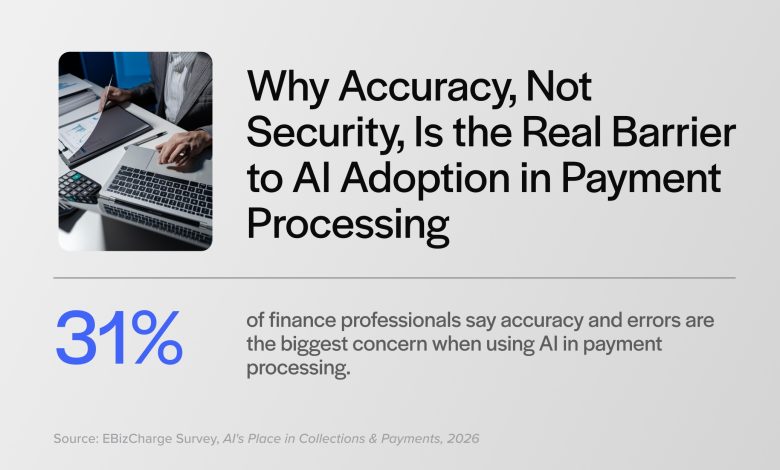
Ask most people in the payments industry what is holding finance teams back from adopting AI, and the answer you will hear most often is security. It makes sense on the surface. Payment data is sensitive, regulations are strict, and the consequences of a breach are real. Recent survey data, however, tells a different story.
A survey of 1,001 financial decision-makers conducted by EBizCharge on AI in payment processing found that accuracy and errors of AI in payments ranked as the single biggest concern to adoption at 31%, ahead of security and data privacy at 20.3% and also ahead of cost of implementation at just 9.7%. For anyone building or deploying AI tools in financial workflows, that ranking deserves serious attention.
Why Accuracy Feels More Personal Than Security
To understand why finance professionals ranked accuracy above security as their biggest concern with AI in payment processing, it helps to think about how these two types of risk land differently on the people responsible for managing them.
A data breach is an organizational event. It involves IT teams, legal counsel, executive leadership, and often external parties. The responsibility is distributed, and while the consequences are serious, no single person in accounts receivable typically owns the outcome.
An accuracy failure works differently. When an AI system sends an invoice for the wrong amount, reconciles a payment to the wrong account, or sends a collections notice to a customer who settled their balance last week, someone owns that mistake. That person is usually in AR or billing, and they are the one making the uncomfortable phone call to the customer while simultaneously fixing the records by hand.
This distinction explains the survey finding more clearly than any other factor. Finance professionals are not being irrational when they rank accuracy above security. They are being precise about which failure type creates direct consequences for them personally.
The Multiple Dimensions of Accuracy in Payment Processing
Accuracy in AI payment processing is not a single metric. It spans several distinct functions, each with its own failure mode and its own downstream consequences.
Invoice accuracy covers whether AI generates and delivers billing documents with correct amounts, payment terms, and recipient details. Errors at this stage are immediately visible to customers and create friction at the exact moment a business is trying to collect payment.
Payment matching accuracy refers to whether AI correctly reconciles incoming payments to the right invoices and accounts. In high-volume environments, even a 99% accuracy rate produces a meaningful number of mismatches that require manual resolution. A system processing 5,000 transactions per month at that accuracy rate still generates 50 errors someone has to fix by hand.
Communication accuracy covers whether AI-generated outreach reflects the actual state of an account at the time of sending. A payment reminder sent after a customer has already paid does not just create unnecessary work. It signals to that customer that the system managing their account cannot be trusted.
Collections timing accuracy is perhaps the most complex dimension. It refers to whether AI correctly identifies when to escalate an account, when to pause outreach, and when a human should step in instead. This is where the gap between rules-based automation and genuine machine learning becomes most apparent.
Rules-Based Automation Versus Genuine AI: Why the Distinction Matters
A significant portion of what gets marketed as AI in payment processing today is closer to conditional logic than machine learning. If an invoice is unpaid after 30 days, send a reminder. If a payment is received, match it to the oldest open invoice. These workflows have existed in AR software for years and carry no meaningfully different accuracy risks than any other configured automation.
Genuine AI introduces capabilities that rules-based systems cannot replicate. It can learn from historical payment behavior to predict which accounts are likely to pay late. It can adjust communication timing based on patterns specific to each customer relationship. It can flag anomalies in payment data that might indicate errors or fraud before they compound into larger problems. According to research from McKinsey, AI-enabled finance functions can reduce invoice processing costs significantly while improving accuracy rates compared to manual workflows.
The accuracy implications of these two categories are fundamentally different. A poorly configured rules-based system will behave predictably but incorrectly. A machine learning system might perform well the vast majority of the time and then produce an output that no one can easily audit or explain. For finance professionals who need to justify every action taken on a customer account, that unpredictability is a genuine concern worth addressing before deployment.
What Finance and IT Teams Should Evaluate Before Deploying AI Payment Tools
Given the accuracy concerns surfaced in the survey data, a more structured evaluation framework is worth developing before any AI payment tool goes live. Before committing to a pilot, finance and IT teams should be pressing vendors on each of the following:
- Error rate documentation. Any credible AI payment tool should provide accuracy rates across invoice generation, payment matching, and outbound communication. If a vendor cannot provide this data in a clear and verifiable format, that absence is itself an important data point.
- Audit trail visibility. Finance and IT teams need to see exactly what the system did, when it acted, and on what basis. Systems that produce outputs without traceable logic create compliance exposure and make error correction significantly harder.
- Human oversight controls. The survey found that 31% of finance professionals want AI to handle payment reminders only if a human can review and approve messages first. Evaluating what level of oversight a system supports is a practical risk management question, not a vote against automation.
- Integration data quality. The most common source of matching errors is not the AI logic itself but the quality of data flowing in from connected systems. Testing how a tool handles incomplete or duplicate records from integrated platforms is more revealing than any controlled demo environment.
Once those boxes are checked, the next question is where to actually start.
Where Embedded Payment Processing Fits Into the Evaluation
For finance teams working through this framework, embedded payment processing tools that operate inside existing ERP and accounting systems tend to address these accuracy concerns more directly than standalone solutions. EBizCharge is one example. Their AR automation handles invoice delivery, payment reminders, payment matching, and reconciliation without requiring data to leave the systems a team already works in daily. The platform includes human review controls for outbound communications, which directly addresses the oversight preference reflected in the survey data.
For teams trying to close the gap between interest and implementation, starting inside a system your team already knows is a lower-risk entry point than deploying something entirely new.
The Broader Implication for AI in Financial Workflows
Security in payments has been a priority for decades. At this point most finance teams expect it as a baseline, not a differentiator. It is the price of entry, not a selling point.
Accuracy does not have that same track record yet. Finance teams have no equivalent benchmark to draw from when evaluating whether an AI system will get their reconciliation right or know when not to contact a customer. That is the gap the 31% accuracy concern is pointing to.
The market is not waiting for AI in payments to get more secure. It is waiting for AI to prove it can be trusted with the details.