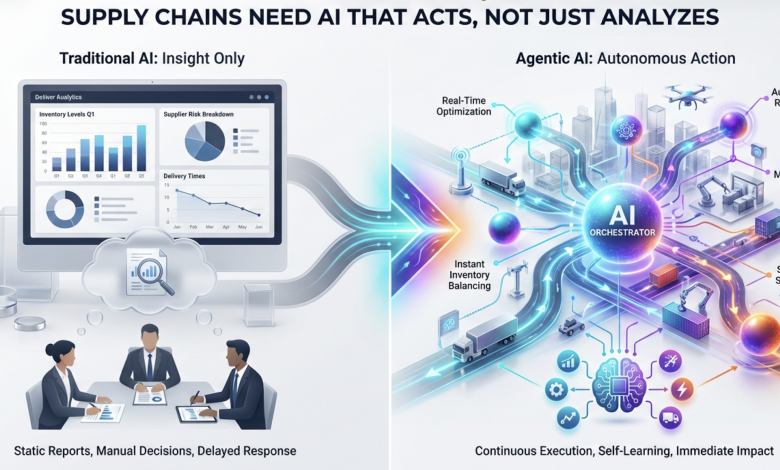
The promise of agentic AI isn’t a smarter copilot. It’s a coordinated set of agents that weigh every decision against financial outcomes — and let the business decide which ones they’re trusted to make alone.
Supply chain planning software has never been better than it is right now. Forecasts are sharper. Recommendations arrive automatically. Dashboards refresh while you watch them. By almost any technical measure, the planning stack is a generation ahead of where it sat a decade ago.
And yet today, when you walk into most planning team meetings, the day-to-day looks oddly familiar. Planners still work the portfolio one item at a time. Between the system’s recommendation and the decisions that are made, you’ll still find a spreadsheet, a manual override, a judgment call made under deadline pressure. The tools got smarter. The work didn’t change as much as everyone expected.
This is worth dwelling on, because it’s also the most useful test we have for where agentic AI belongs. A lot of agentic AI right now is being pointed at problems that were never the bottleneck — summarizing reports faster, drafting emails, answering questions a search bar could have handled. Genuinely useful, occasionally. But it leaves the actual constraint untouched. The supply chain execution gap is a much better target, and understanding why means being precise about where the gap lives.
The gap has a specific shape
It’s tempting to call this an execution problem and leave it there. Being precise matters, though, because the location of the breakdown determines whether any given fix — agentic or otherwise — will actually work.
The gap doesn’t live inside the planning system. It doesn’t live inside the ERP. It lives in the space between them, and, more importantly, in the space between a recommendation and the person who owns the call. A forecast can be exactly right and still not produce the outcome it predicted, because the decision built on that forecast has to survive a gauntlet first: a supplier constraint, a transportation delay, a competing priority three desks over, a handful of handoffs on the way to execution. Each one is a chance for the intended action to bend or stall. Each one is a decision execution gap.
So, the problem isn’t a shortage of recommendations. Planning systems produce those by the thousand. The problem is that every recommendation still has to be picked up, weighed, reconciled against everything else happening in the network, and carried through to action — by a human, one at a time. There is more deciding to be done than there is human ability to do it well. The moment conditions shift, which in a supply chain is constantly, the backlog rebuilds itself.
Why a faster copilot doesn’t fix it
The instinct — and a lot of the current agentic AI wave runs on this instinct — is to help the planner go faster. Surface the recommendation more cleanly. Put a conversational agent next to it that can answer questions and pull context. Push everything into the workflow so nothing gets lost.
All of that helps at the margin. None of it changes the math. A copilot still hands every decision back to a person to make. You’ve made the human faster at a job that was never going to scale on speed alone, because the bottleneck was never how quickly someone can read a recommendation. It was that someone has to read every recommendation at all. A faster copilot is still a copilot. The pilot is still flying every leg.
What agentic AI changes about the equation
The structural shift agentic AI makes possible is simpler to state than it is to build: stop assuming every decision has to wait for a human before anything can happen.
The cleanest way to think about it is a single pipeline rather than two separate ones. Every decision — routine or not — runs through the same process: the agents reason about it, weigh the options, and produce a recommended action. What changes from one decision to the next isn’t whether a recommendation gets made. It’s what happens to that recommendation next, and that’s governed by guardrails and business rules.
Below the threshold — the well-understood, lower-stakes decisions, the ones with clear logic and limited downside — the agent is cleared to act on its own. Re-promising an order when a delay ripples through. Rebalancing inventory across locations as demand shifts. Reallocating constrained supply between channels. These are decisions an experienced planner makes almost reflexively, and the kind that, multiplied across tens of thousands of SKUs, quietly consume the day. There is no reason for each one to sit in a queue waiting for sign-off. Above the threshold — where the financial stakes are higher, or the agents are less certain, or the situation is genuinely unusual — the same recommendation routes to a person instead of executing.
The important part is that the business owns where that line sits. A company can start conservative, with the threshold set low and almost everything routing to a human, and raise it deliberately as the agents earn trust on the decisions they’re already handling well. The dial belongs to the operator, not the vendor. That alone reclaims enormous capacity — but the more interesting part is what makes the recommendations worth trusting in the first place, and this is where the word “agentic” starts to mean something beyond a single clever bot.
Coordination is the actual breakthrough
A real supply chain decision is almost never isolated. Promising a delivery date depends on what inventory is genuinely available, which depends on what supply is inbound, which depends on what other commitments are already competing for it. Handle each of those as a separate question answered by a separate tool and you get the problem you started with — locally sensible answers that don’t add up to a coherent whole.
Agentic AI’s contribution is that these can be handled by specialized agents that coordinate. One agent reasons about demand. Another about available supply. Another about inventory positions, another about what can be promised and when. They don’t operate in isolation, and they don’t just hand a human a stack of disconnected outputs. They negotiate against each other — the order-promising agent checks its answer against what the inventory and supply agents are actually seeing — and converge on a recommendation that already accounts for the trade-offs across the network. Crucially, they can do this inside the operating reality of the systems a company already runs, acting on the existing ERP, warehouse, and planning systems rather than asking the business to migrate onto something new. The orchestration is the point. A single agent answering a single question faster is incremental. A coordinated set of agents resolving the interdependencies before anything reaches a person is a different category of capability.
Recommendations weighed against financial outcomes
There’s one more piece, and it’s the one that turns coordination into something a business can trust enough to actually raise the threshold. When agents coordinate, they aren’t only reconciling feasibility — they can weigh options against financial outcomes. Not just “can we do this,” but “which version of doing this protects margin, which one risks a penalty, which one trades a small cost now against a larger one later.”
That financial weighting is what makes the whole threshold model coherent. The decisions cleared to execute on their own aren’t cleared because someone decided they were unimportant — they’re cleared because the agents can show the financial reasoning behind them, and that reasoning holds up. And the decisions that route to a person don’t arrive as a raw alert. They arrive already orchestrated: the trade-offs surfaced, the options ranked by financial impact, the reasoning attached. The human is no longer assembling the picture from scattered pieces. They’re exercising judgment on a well-framed decision, which is what humans are actually good at. The work moves up a level rather than disappearing — and the threshold itself becomes a real management lever, something an operations leader tunes deliberately rather than a black box they hope is calibrated right.
And because the agents execute the decisions that clear the threshold rather than just suggesting them, they can also observe what happened — which decisions produced the best financial outcomes, and which didn’t. Over enough cycles, that feedback compounds. The call your most experienced planner makes under pressure, the intuition that usually walks out the door when they retire, becomes a pattern the coordinated system can reproduce, consistently, across the whole portfolio. That’s the line between automating tasks and building decision intelligence. One makes existing work faster. The other changes what the work is.
What it looks like at scale
Protein and perishable-goods operations make a useful stress test, because they combine punishing complexity with zero tolerance for delay. Consider a large meat processor: dozens of facilities, more than a dozen sales channels, tens of thousands of SKUs moving through a network where a slow decision isn’t just inefficient — it’s spoilage.
In environments like that, the headline result of putting coordinated agents to work isn’t a marginally better forecast. It’s the collapse of cycle time. A planning cycle that ran the better part of a day can compress to under an hour — not because the math improved at the edges, but because the decisions cleared to execute stopped sitting in a queue waiting for a human to reach them, and the ones that did route to a person arrived already orchestrated. The deciding and the doing effectively merged.
The real test for agentic AI
Here’s the reframe worth carrying out of this. The question to ask of any agentic AI deployment isn’t whether it’s impressive in a demo. It’s whether it’s pointed at the constraint that actually limits the business. In supply chain, that constraint is the execution gap — the distance between a good recommendation and a decision carried through to action — and it has resisted a decade of better planning software precisely because better planning software was aimed at the wrong part of the problem.
Agentic AI is well matched to that gap, but only when it’s used for what it’s genuinely good at: coordinating specialized agents so the interdependent decisions get resolved together, weighing every option against financial outcomes, and letting the business set the threshold for what executes on its own versus what comes to a person. The organizations that pull ahead won’t be the ones with the most agents, or the flashiest copilot. They’ll be the ones that aimed agentic AI at the decision itself — and treated closing the gap between incites and doing as the thing worth engineering away.
—
About the author
Mike Romeri is CEO at A2go, an agentic AI platform for supply chain decision intelligence.