A well-structured shift is changing how work is done in multiple industries. As agentic AI systems are now used in many ways, like production environments, where they simply handle customer interactions, generate and review code, and also process documents and execute complex, multi-layer workflows. Overall, these stems work as an active complement of operational pipelines rather than just standalone tools.
As adoption grows, the primary question is not whether to deploy AI agents, but rather how to build systems in which they function with enough autonomy to generate demonstrable value while human control remains effective and scalable. This is a system design issue having immediate implications for dependability, risk management, and operational efficiency.
The Hybrid Workflow Model
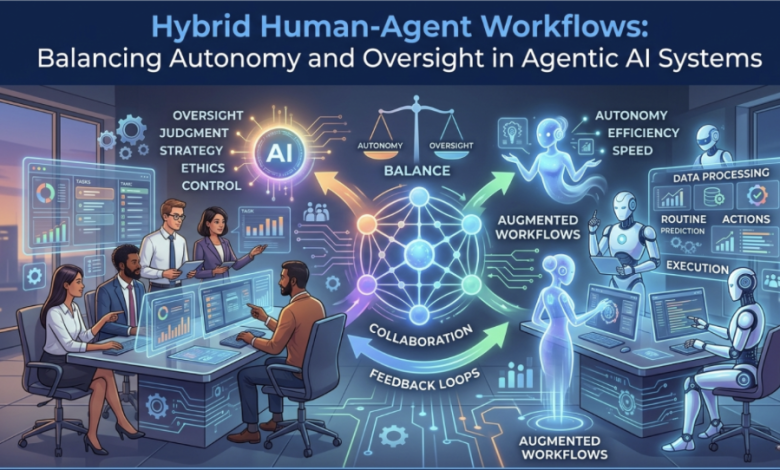
Hybrid human–agent workflows are structured systems in which responsibilities are explicitly distributed between AI agents and human operators. Task allocation is based on comparative strengths.
AI agents are best for:
- Systemic repetitive tasks with well-defined success criteria
- Real-time data processing and pattern recognition
- Initial drafting, classification, summarization, and triage
- Execution of low-risk, reversible actions within constrained environments
Human operators are responsible for:
- Decisions requiring ethical judgment, legal interpretation, or contextual awareness
- Handling edge cases outside the model’s training distribution
- Final approval of high-impact or irreversible actions
- Providing feedback for system improvement and retraining
The best hybrid workflows have clear segments and clear points at which tasks are assigned and handed off. They are systems that work together, not backup mechanisms.
The Autonomy Calibration Problem
Autonomy in agentic systems exists on a continuum. The design challenge lies in determining the appropriate level of autonomy for each task.
When AI systems operate at their own pace in taking decision, and humans place trust in them, it can lead to unnoticed errors. Conversely, insufficient autonomy causes review exhaustion, where continuous validation reduces overall monitoring to a procedural formality.
Calibrated autonomy addresses this by assigning independence based on demonstrated system reliability. Agents operate autonomously in low-risk domains, while human checkpoints are retained for higher-risk decisions. Autonomy levels are continuously adjusted using performance data and observed failure patterns.
Limitations of the “Human-in-the-Loop” Model
The human-in-the-loop approach has been used as a backup mechanism, yet in reality, it is not necessarily a meaningful oversight. Effective supervision can only be attained when human beings possess the context, time and equipment to arrive at the right decision. In a fast paced environment, approval cycles are made promptly, and therefore may lead to poor quality and thoroughness of review.
The design of the system should have basic structural defenses to guarantee proper control. Explainability is needed to ensure that judgments are made clear in terms of input and arguments. The interruptibility should be turned on so that action will be taken before irreversible action is carried out. Calibrated escalation should be put in place to make systems avoid making decisions when uncertainty is identified. These elements are what make human involvement more of a procedure than an effective tool.
Designing for Trust: A Structured Framework
Trust in hybrid systems is engineered through deliberate design. The following framework outlines the key components required for reliable human–agent collaboration.
1. Define Clear Operational Boundaries
Agents must operate within explicitly defined constraints:
- Specify task scope and permissible actions
- Restrict access to sensitive data and systems
- Classify actions by risk level
- Limit autonomous execution to low-risk, reversible tasks
2. Implement Reliable Escalation Mechanisms
Agents must defer appropriately:
- Use confidence thresholds to trigger escalation
- Detect ambiguity and out-of-distribution inputs
- Route uncertain cases to human operators automatically
3. Ensure Decision Explainability
Oversight depends on transparency:
- Provide reasoning summaries alongside outputs
- Surface key inputs and influencing factors
- Avoid opaque decision-making in critical workflows
4. Design for Interruptibility
Oversight must precede execution:
- Introduce approval checkpoints for high-impact actions
- Enable pausing, modification, or cancellation of tasks
- Prevent irreversible actions without human authorization
5. Build Human-Centric Review Interfaces
Interface design directly impacts oversight quality:
- Present structured, concise outputs
- Highlight anomalies and risk indicators
- Prioritize reviews based on impact and uncertainty
6. Establish Continuous Feedback Loops
Systems must evolve with usage:
- Capture human corrections as structured data
- Track recurring errors and edge cases
- Adjust autonomy levels based on performance metrics
Organizational Constraints
Technical design alone does not ensure success. Organizational readiness is a critical factor in the effectiveness of hybrid workflows.
Common constraints include:
- Lack of clear ownership within human–agent pipelines
- Insufficient training on system capabilities and limitations
- Weak integration between operational feedback and system design
- Declining oversight rigor after initial system success
Organizations that succeed treat agentic AI as part of a broader sociotechnical system, integrating human judgment, process design, and technical infrastructure.
Conclusion
Agentic AI is drastically changing operational models across many sectors, using hybrid human AI workflows that are becoming the main approach.
Intentional design is what makes performance reliable. From the beginning, oversight should be built into the system architecture. Human review should act as a control layer instead of a bottleneck. At the same time, levels of autonomy need to be constantly checked based on risk and performance.
Autonomy and oversight operate together as interdependent mechanisms. Structured human governance enables AI systems to perform effectively, while agents operating within defined boundaries keep oversight scalable and sustainable.
Companies that are in the process of working on them can easily observe the outcomes, such as increased efficiency in operations, a general increase in decision quality, and better risk management. That is the effectiveness of agentic AI in adding real value.